Tarro Lucia, Llauradó Elisabet, Albaladejo Rosa, Moriña David, Arija Victoria, Solà Rosa, Giralt Montse
Unit of Farmacobiology, Facultat de Medicina i Ciències de la Salut, Universitat Rovira i Virgili, C/Sant Llorenç 21, Reus 43201, Spain.
Trials. 2014 Feb 14;15:58. doi: 10.1186/1745-6215-15-58.
Obesity is one of the main determinants of avoidable disease burden.To implement a program by university students acting as "health promoting agents" (HPAs) and to evaluate the effects on obesity prevalence of the primary-school-based program that promotes healthy lifestyle, including dietary and physical activity recommendations over 28 months.
Two school clusters were randomly assigned to intervention (24 schools, 1,222 pupils) or control (14 schools, 717 pupils); 78% of pupils were Western European. Mean age (±SD) was 8.4±0.6 years (49.9% females) at baseline. Generalized linear mixed models were used to analyze differences in primary outcome between both groups. Data collected included body mass index (BMI) every year. Dietary habits and lifestyle questionnaires were filled in by the parents at baseline and at the end of the study. The interventions focused on eight lifestyle topics covered in 12 activities (1 hour/activity/session) implemented by HPAs over 3 school academic years.
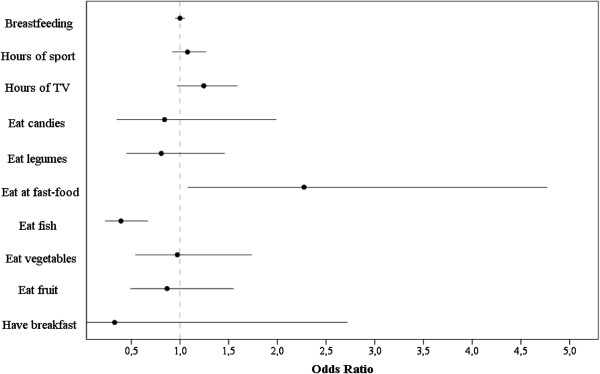
At 28 months, obesity prevalence in boys was decreased -2.36% in the intervention group (from 9.59% to 7.23%) and increased 2.03% (from 7.40% to 9.43%) in the control group; the difference was 4.39% (95% CI 3.48 to 5.30; P=0.01). The boys in the intervention group had an effective reduction of -0.24 units in the change of BMI z-score (from 0.01 to -0.04), compared to control (from -0.10 to 0.09); 5.1% more intervention pupils undertook physical activity>5 hours/week than control pupils (P=0.02).Fish consumption was a protector (odds ratio 0.39; 95% CI 0.23 to 0.67) while "fast-food" consumption was a risk factor for childhood obesity (odds ratio: 2.27; 95% CI 1.08 to 4.77).
Our school-based program, conducted by HPA students, successfully reduced childhood obesity prevalence in boys.
International Standard Randomized Controlled Trial Number: ISRCTN29247645.
肥胖是可避免疾病负担的主要决定因素之一。由大学生担任“健康促进者”(HPAs)实施一项计划,并评估一项以小学为基础的促进健康生活方式计划(包括28个月的饮食和体育活动建议)对肥胖患病率的影响。
将两个学校集群随机分配到干预组(24所学校,1222名学生)或对照组(14所学校,717名学生);78%的学生为西欧人。基线时平均年龄(±标准差)为8.4±0.6岁(49.9%为女性)。使用广义线性混合模型分析两组之间主要结局的差异。每年收集的数据包括体重指数(BMI)。饮食习惯和生活方式问卷由家长在基线时和研究结束时填写。干预措施侧重于HPAs在3个学年实施的12项活动(每项活动/课程1小时)中涵盖的8个生活方式主题。
在28个月时,干预组男孩的肥胖患病率下降了2.36%(从9.59%降至7.23%),而对照组增加了2.03%(从7.40%升至9.43%);差异为4.39%(95%CI 3.48至5.30;P=0.01)。与对照组(从-0.10升至0.09)相比,干预组男孩的BMI z评分变化有效降低了0.24个单位(从0.01降至-0.04);每周进行体育活动超过5小时的干预组学生比对照组学生多5.1%(P=0.02)。食用鱼类是一种保护因素(比值比0.39;95%CI 0.23至0.67),而食用“快餐”是儿童肥胖的一个危险因素(比值比:2.27;95%CI 1.08至4.77)。
我们由HPA学生实施的以学校为基础的计划成功降低了男孩的儿童肥胖患病率。
国际标准随机对照试验编号:ISRCTN29247645。