Moll R, Achtstätter T, Becht E, Balcarova-Ständer J, Ittensohn M, Franke W W
Department of Pathology, University of Mainz Medical School, Federal Republic of Germany.
Am J Pathol. 1988 Jul;132(1):123-44.
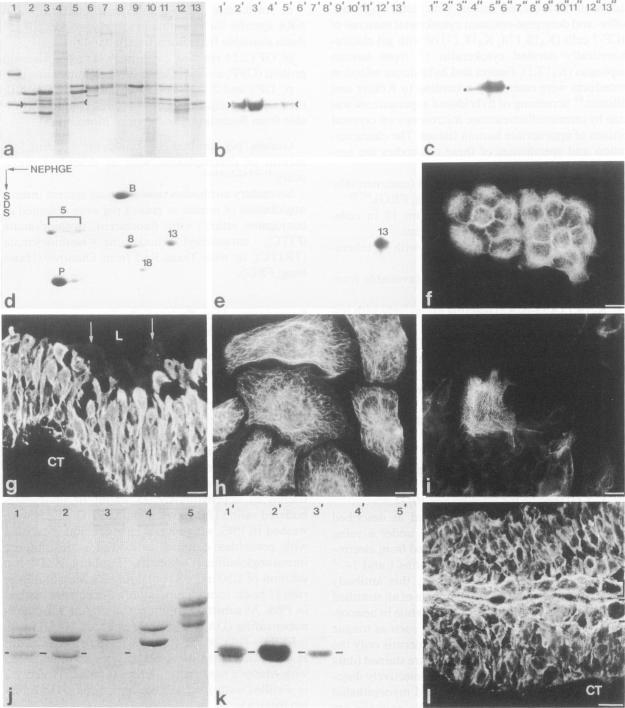
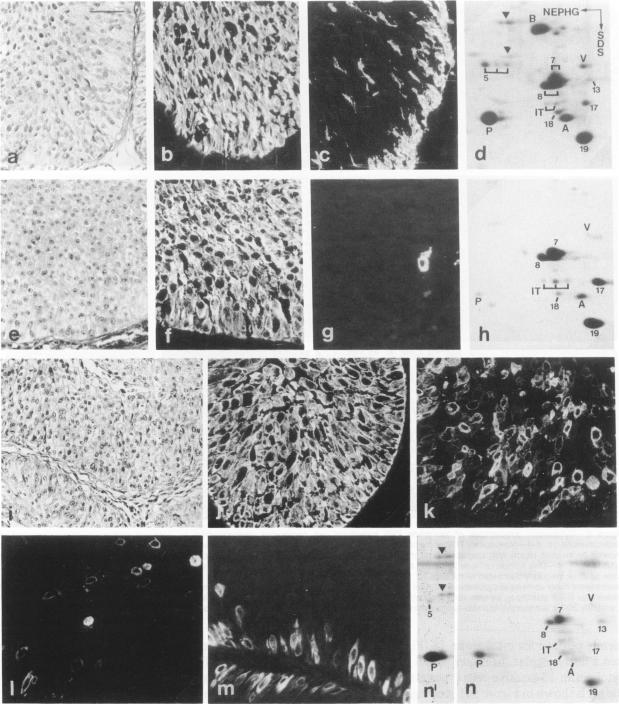
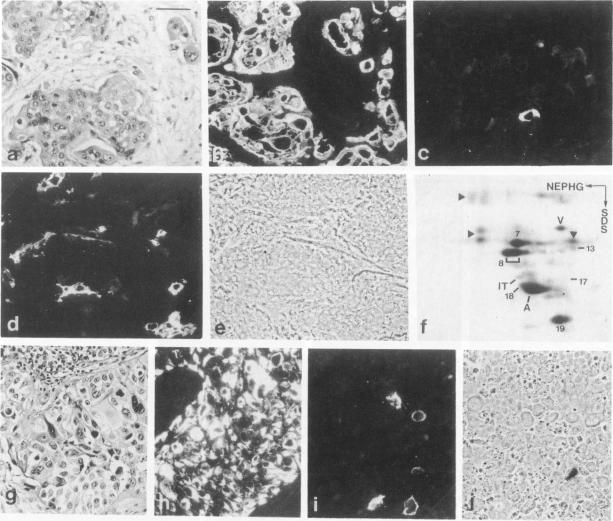
The pattern of cytokeratins expressed in normal urothelium has been compared with that of various forms of transitional cell carcinomas (TCCs; 21 cases) and cultured bladder carcinoma cell lines, using immunolocalization and gel electrophoretic techniques. In normal urothelium, all simple-epithelium-type cytokeratins (polypeptides 7, 8, 18, 19) were detected in all cell layers, whereas antibodies to cytokeratins typical for stratified epithelia reacted with certain basal cells only or, in the case of cytokeratin 13, with cells of the basal and intermediate layers. This pattern was essentially maintained in low-grade (G1, G1/2) TCCs but was remarkably modified in G2 TCCs. In G3 TCCs simple-epithelial cytokeratins were predominant whereas the amounts of component 13 were greatly reduced. Squamous metaplasia was accompanied generally by increased or new expression of some stratified-epithelial cytokeratins. The cytokeratin patterns of cell culture lines RT-112 and RT-4 resembled those of G1 and G2 TCCs, whereas cell line T-24 was comparable to G3 carcinomas. The cell line EJ showed a markedly different pattern. The results indicate that, in the cell layers of the urothelium, the synthesis of stratification-related cytokeratins such as component 13 is inversely oriented compared with that in other stratified epithelia where these proteins are suprabasally expressed, that TCCs retain certain intrinsic cytoskeletal features of urothelium, and that different TCCs can be distinguished by their cytokeratin patterns. The potential value of these observations in histopathologic and cytologic diagnoses is discussed.
运用免疫定位和凝胶电泳技术,将正常尿路上皮中细胞角蛋白的表达模式与多种形式的移行细胞癌(TCCs;21例)及培养的膀胱癌细胞系进行了比较。在正常尿路上皮中,所有简单上皮型细胞角蛋白(多肽7、8、18、19)在所有细胞层均被检测到,而针对复层上皮典型细胞角蛋白的抗体仅与某些基底细胞发生反应,或者就细胞角蛋白13而言,与基底和中间层的细胞发生反应。这种模式在低级别(G1、G1/2)TCCs中基本得以维持,但在G2 TCCs中发生了显著改变。在G3 TCCs中,简单上皮细胞角蛋白占主导,而组分13的量则大幅减少。鳞状化生通常伴随着一些复层上皮细胞角蛋白表达的增加或新表达。细胞系RT - 112和RT - 4的细胞角蛋白模式类似于G1和G2 TCCs,而细胞系T - 24与G3癌相似。细胞系EJ呈现出明显不同的模式。结果表明,在尿路上皮的细胞层中,与分层相关的细胞角蛋白如组分13的合成方向与其他复层上皮相反,在其他复层上皮中这些蛋白质是在基底上层表达的,TCCs保留了尿路上皮某些固有的细胞骨架特征,并且不同的TCCs可以通过其细胞角蛋白模式加以区分。讨论了这些观察结果在组织病理学和细胞学诊断中的潜在价值。