Kottmeier Dorothee M, Rokitta Sebastian D, Tortell Philippe D, Rost Björn
Alfred Wegener Institute Helmholtz Centre for Polar and Marine Research, Am Handelshafen 12, 27570, Bremerhaven, Germany,
Photosynth Res. 2014 Sep;121(2-3):265-75. doi: 10.1007/s11120-014-9984-9. Epub 2014 Feb 23.
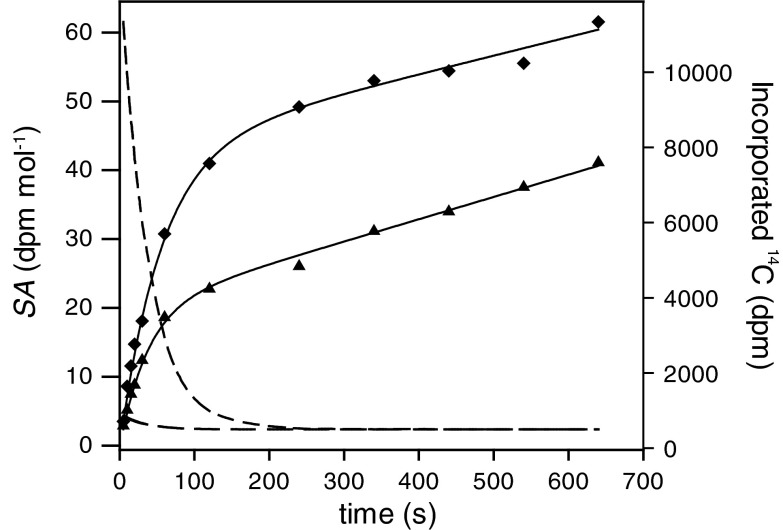
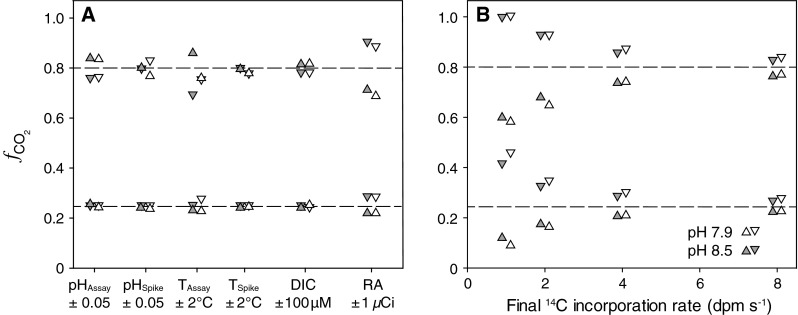
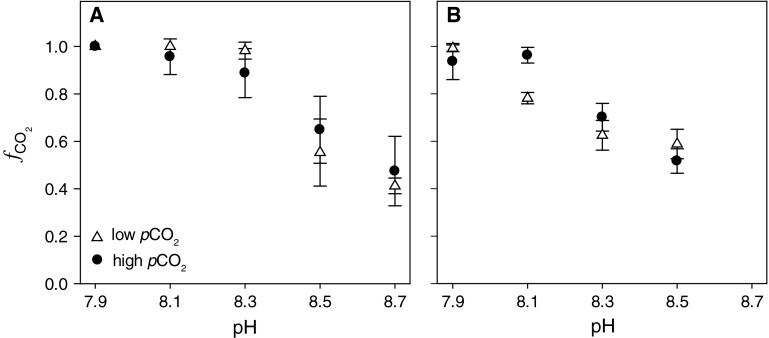
Effects of ocean acidification on Emiliania huxleyi strain RCC 1216 (calcifying, diploid life-cycle stage) and RCC 1217 (non-calcifying, haploid life-cycle stage) were investigated by measuring growth, elemental composition, and production rates under different pCO2 levels (380 and 950 μatm). In these differently acclimated cells, the photosynthetic carbon source was assessed by a (14)C disequilibrium assay, conducted over a range of ecologically relevant pH values (7.9-8.7). In agreement with previous studies, we observed decreased calcification and stimulated biomass production in diploid cells under high pCO2, but no CO2-dependent changes in biomass production for haploid cells. In both life-cycle stages, the relative contributions of CO2 and HCO3 (-) uptake depended strongly on the assay pH. At pH values ≤ 8.1, cells preferentially used CO2 (≥ 90 % CO2), whereas at pH values ≥ 8.3, cells progressively increased the fraction of HCO3 (-) uptake (~45 % CO2 at pH 8.7 in diploid cells; ~55 % CO2 at pH 8.5 in haploid cells). In contrast to the short-term effect of the assay pH, the pCO2 acclimation history had no significant effect on the carbon uptake behavior. A numerical sensitivity study confirmed that the pH-modification in the (14)C disequilibrium method yields reliable results, provided that model parameters (e.g., pH, temperature) are kept within typical measurement uncertainties. Our results demonstrate a high plasticity of E. huxleyi to rapidly adjust carbon acquisition to the external carbon supply and/or pH, and provide an explanation for the paradoxical observation of high CO2 sensitivity despite the apparently high HCO3 (-) usage seen in previous studies.
通过在不同的pCO₂水平(380和950 μatm)下测量生长、元素组成和生产率,研究了海洋酸化对赫氏颗石藻RCC 1216株(钙化的二倍体生命周期阶段)和RCC 1217株(非钙化的单倍体生命周期阶段)的影响。在这些适应不同环境的细胞中,通过在一系列生态相关的pH值(7.9 - 8.7)范围内进行的¹⁴C不平衡测定来评估光合碳源。与先前的研究一致,我们观察到在高pCO₂条件下,二倍体细胞的钙化减少且生物量产量增加,但单倍体细胞的生物量产量没有二氧化碳依赖性变化。在两个生命周期阶段,二氧化碳和碳酸氢根(HCO₃⁻)吸收的相对贡献强烈依赖于测定pH值。在pH值≤8.1时,细胞优先使用二氧化碳(≥90%二氧化碳),而在pH值≥8.3时,细胞逐渐增加碳酸氢根吸收的比例(二倍体细胞在pH 8.7时约为45%二氧化碳;单倍体细胞在pH 8.5时约为55%二氧化碳)。与测定pH的短期影响相反,pCO₂适应历史对碳吸收行为没有显著影响。一项数值敏感性研究证实,只要模型参数(例如pH、温度)保持在典型测量不确定度范围内,¹⁴C不平衡方法中的pH修正就能产生可靠的结果。我们的结果表明,赫氏颗石藻具有很高的可塑性,能够迅速将碳获取调整到外部碳供应和/或pH值,并为先前研究中尽管明显大量使用碳酸氢根(HCO₃⁻)但仍观察到高二氧化碳敏感性这一矛盾现象提供了解释。