Department of Experimental Psychology, Mind, Brain and Behavior Research Center, University of Granada Granada, Spain.
Front Hum Neurosci. 2014 Feb 6;8:31. doi: 10.3389/fnhum.2014.00031. eCollection 2014.
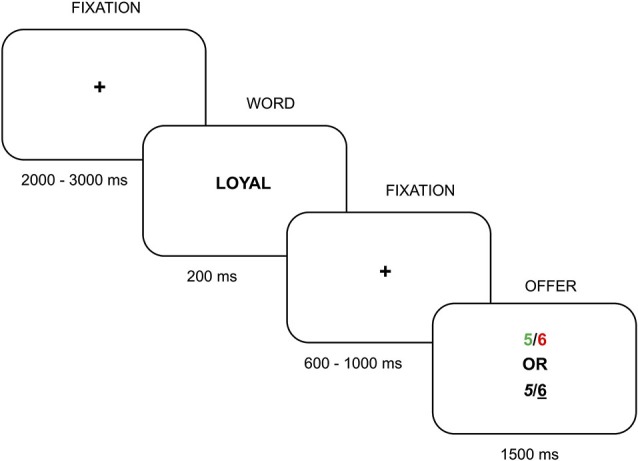
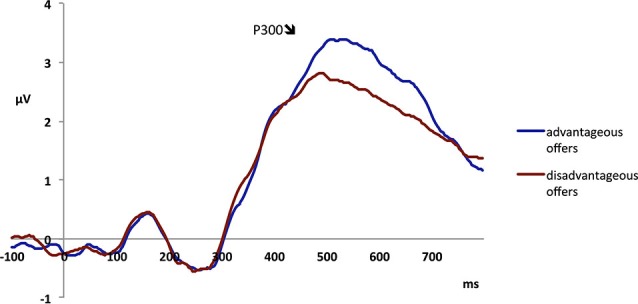
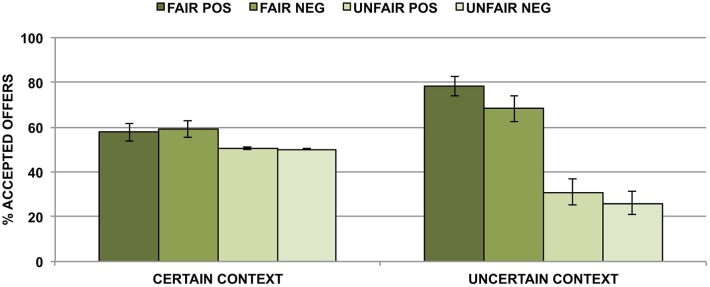
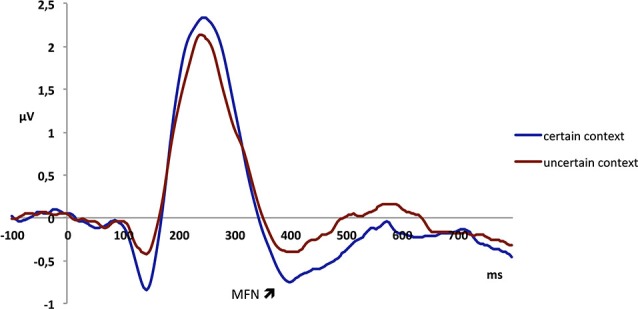
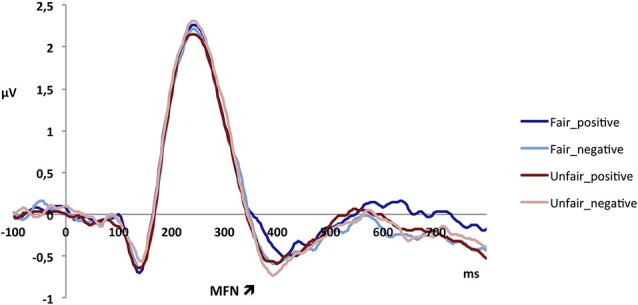
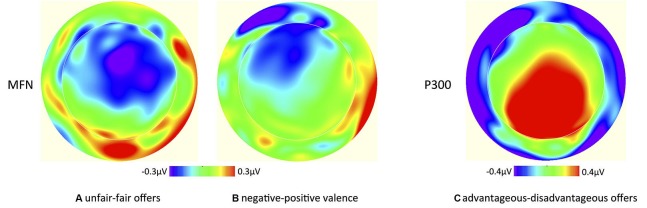
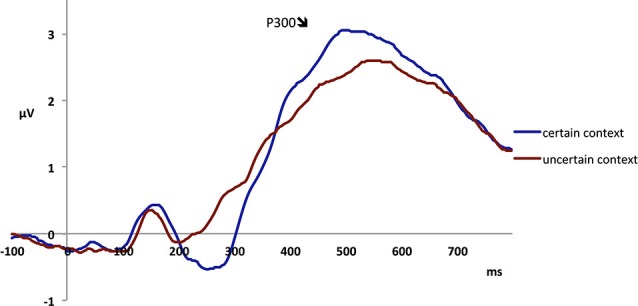
In the present study we employed electrophysiological recordings to investigate the levels of processing at which positive and negative descriptions of other people bias social decision-making in a game in which participants accepted or rejected economic offers. Besides social information, we manipulated the fairness of the assets distribution, whether offers were advantageous or not for the participant and the uncertainty of the game context. Results show that a negative description of the interaction partner enhanced the medial frontal negativity (MFN) in an additive manner with fairness evaluations. The description of the partner interacted with personal benefit considerations, showing that this positive or negative information only biased the evaluation of offers when they did not favor the participant. P300 amplitudes were enhanced by advantageous offers, suggesting their heightened motivational significance at later stages of processing. Throughout all stages, neural activity was enhanced with certainty about the personal assignments of the split. These results provide new evidence on the importance of interpersonal information and considerations of self-interests relative to others in decision-making situations.
在本研究中,我们采用电生理记录来研究在参与者接受或拒绝经济提议的游戏中,他人的积极和消极描述在何种程度上影响社会决策。除了社会信息,我们还操纵了资产分配的公平性、提议对参与者是否有利以及游戏环境的不确定性。结果表明,以附加的方式,与公平性评估一起,交互伙伴的消极描述增强了中额正电势(MFN)。对伙伴的描述与个人利益的考虑相互作用,表明只有当提议对参与者不利时,这种积极或消极的信息才会影响对提议的评估。有利的提议增强了 P300 幅度,表明它们在处理后期具有更高的动机意义。在所有阶段,个人分配的确定性都增强了神经活动。这些结果为人际信息的重要性以及在决策情境中相对于他人的自我利益考虑提供了新的证据。