Malaria Branch, Division of Parasitic Diseases and Malaria, Center for Global Health, Centers for Disease Control and Prevention, Atlanta, GA, USA.
Malar J. 2014 Feb 24;13:67. doi: 10.1186/1475-2875-13-67.
Plasmodium vivax is a predominant species of malaria in parts of South America and there is increasing resistance to drugs to treat infections by P. vivax. The existence of latent hypnozoites further complicates the ability to classify recurrent infections as treatment failures due to relapse, recrudescence of hyponozoites or re-infections. Antigen loci are putatively under natural selection and may not be an optimal molecular marker to define parasite haplotypes in paired samples. Putatively neutral microsatellite loci, however, offer an assessment of neutral haplotypes. The objective here was to assess the utility of neutral microsatellite loci to reconcile cases of recurrent parasitaemia in Amazonian P. vivax populations in Peru.
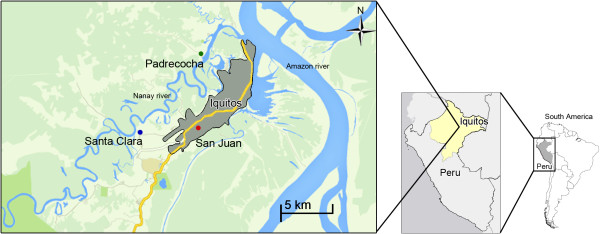
Patient blood samples were collected from three locations in or around Iquitos in the Peruvian Amazon. Five putatively neutral microsatellite loci were characterized from 445 samples to ascertain the within and amongst population variation. A total of 30 day 0 and day of recurrent parasitaemia samples were characterized at microsatellite loci and five polymorphic antigen loci for haplotype classification.
The genetic diversity at microsatellite loci was consistent with neutral levels of variation measured in other South American P. vivax populations. Results between antigen and microsatellite loci for the 30 day 0 and day of recurrent parasitaemia samples were the same for 80% of the pairs. The majority of non-concordant results were the result of differing alleles at microsatellite loci. This analysis estimates that 90% of the paired samples with the same microsatellite haplotype are unlikely to be due to a new infection.
A population-level approach was used to yield a better estimate of the probability of a new infection versus relapse or recrudescence of homologous hypnozoites; hypnozoite activation was common for this cohort. Population studies are critical with the evaluation of genetic markers to assess P. vivax biology and epidemiology. The additional demonstration of microsatellite loci as neutral markers capable of distinguishing the origin of the recurrent parasites (new infection or originating from the patient) lends support to their use in assessment of treatment outcomes.
间日疟原虫是南美的主要疟疾病原虫,而且对治疗间日疟原虫感染的药物的耐药性日益增加。休眠子的存在进一步使复发、休眠子复燃或再感染导致的复发性感染的分类变得复杂。抗原基因座被认为受到自然选择的影响,因此可能不是定义配对样本中寄生虫单倍型的最佳分子标记。然而,假定中性微卫星基因座提供了中性单倍型的评估。本研究的目的是评估中性微卫星基因座在调和秘鲁亚马逊地区间日疟原虫种群中复发性寄生虫血症病例中的效用。
从秘鲁亚马逊地区伊基托斯的三个地点或周围采集了患者的血液样本。从 445 个样本中鉴定了 5 个假定中性微卫星基因座,以确定种群内和种群间的变异。在微卫星基因座和 5 个多态性抗原基因座上对 30 个零时和复发性寄生虫血症日的样本进行了特征分析,以进行单倍型分类。
微卫星基因座的遗传多样性与在其他南美间日疟原虫种群中测量的中性变异水平一致。30 个零时和复发性寄生虫血症日的样本中抗原和微卫星基因座之间的结果有 80%是相同的。大多数不一致的结果是由于微卫星基因座上不同的等位基因。该分析估计,具有相同微卫星单倍型的 90%配对样本不太可能是新感染的结果。
采用群体水平的方法,可以更好地估计新感染与同源休眠子复发或复燃的可能性;该队列中休眠子的激活很常见。种群研究对于评估遗传标记对间日疟原虫生物学和流行病学的影响至关重要。微卫星基因座作为能够区分复发性寄生虫(新感染或源自患者)来源的中性标记的额外证明,支持其用于评估治疗结果。