Cravo-Laureau Cristiana, Duran Robert
Equipe Environnement et Microbiologie UMR IPREM 5254, Université de Pau et des Pays de l'Adour Pau, France.
Front Microbiol. 2014 Feb 12;5:39. doi: 10.3389/fmicb.2014.00039. eCollection 2014.
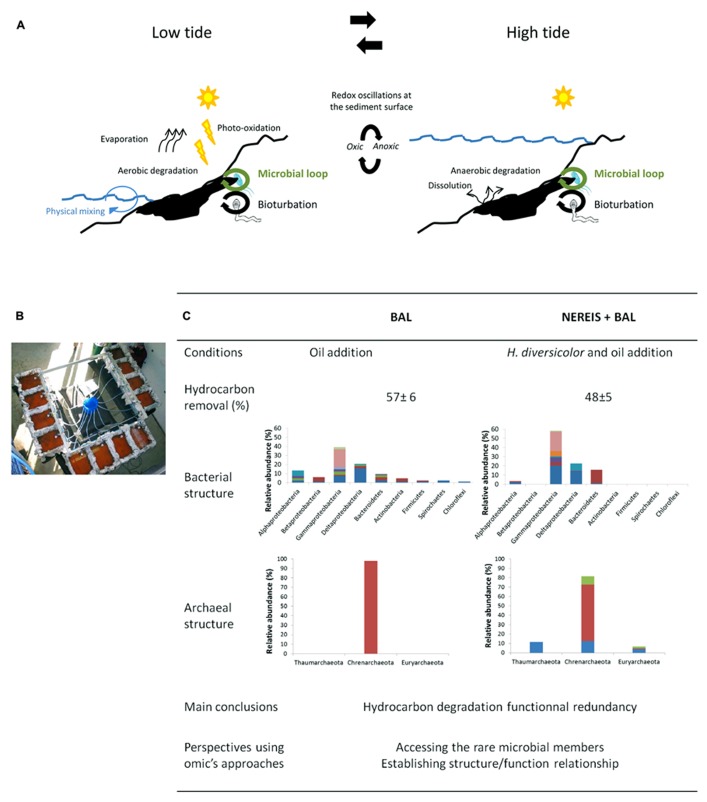
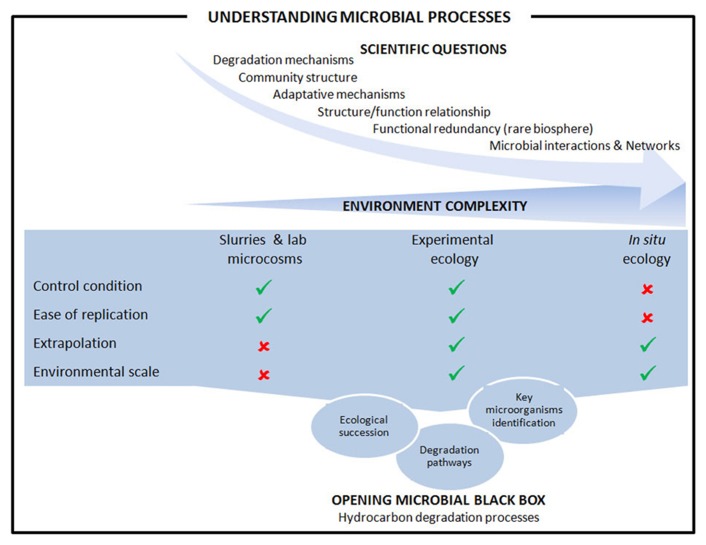
Coastal marine sediments, where important biological processes take place, supply essential ecosystem services. By their location, such ecosystems are particularly exposed to human activities as evidenced by the recent Deepwater Horizon disaster. This catastrophe revealed the importance to better understand the microbial processes involved on hydrocarbon degradation in marine sediments raising strong interests of the scientific community. During the last decade, several studies have shown the key role played by microorganisms in determining the fate of hydrocarbons in oil-polluted sediments but only few have taken into consideration the whole sediment's complexity. Marine coastal sediment ecosystems are characterized by remarkable heterogeneity, owning high biodiversity and are subjected to fluctuations in environmental conditions, especially to important oxygen oscillations due to tides. Thus, for understanding the fate of hydrocarbons in such environments, it is crucial to study microbial activities, taking into account sediment characteristics, physical-chemical factors (electron acceptors, temperature), nutrients, co-metabolites availability as well as sediment's reworking due to bioturbation activities. Key information could be collected from in situ studies, which provide an overview of microbial processes, but it is difficult to integrate all parameters involved. Microcosm experiments allow to dissect in-depth some mechanisms involved in hydrocarbon degradation but exclude environmental complexity. To overcome these lacks, strategies have been developed, by creating experiments as close as possible to environmental conditions, for studying natural microbial communities subjected to oil pollution. We present here a review of these approaches, their results and limitation, as well as the promising future of applying "omics" approaches to characterize in-depth microbial communities and metabolic networks involved in hydrocarbon degradation. In addition, we present the main conclusions of our studies in this field.
沿海海洋沉积物是重要生物过程发生的场所,提供着至关重要的生态系统服务。因其所处位置,这类生态系统特别容易受到人类活动的影响,近期的“深水地平线”灾难便是明证。这场灾难揭示了更好地了解海洋沉积物中烃类降解所涉及的微生物过程的重要性,引发了科学界的浓厚兴趣。在过去十年中,多项研究表明微生物在决定石油污染沉积物中烃类的归宿方面发挥着关键作用,但只有少数研究考虑到了整个沉积物的复杂性。沿海海洋沉积物生态系统具有显著的异质性,拥有高度的生物多样性,并且受到环境条件波动的影响,尤其是由于潮汐导致的重要氧气波动。因此,为了了解烃类在这类环境中的归宿,研究微生物活动至关重要,要考虑沉积物特征、物理化学因素(电子受体、温度)、营养物质、共代谢物的可利用性以及生物扰动活动导致的沉积物再加工。关键信息可以从原位研究中收集,原位研究提供了微生物过程的概况,但难以整合所有涉及的参数。微观实验能够深入剖析烃类降解所涉及的一些机制,但排除了环境复杂性。为了克服这些不足,已经开发了一些策略,通过创建尽可能接近环境条件的实验,来研究受石油污染的天然微生物群落。我们在此对这些方法、它们的结果和局限性,以及应用“组学”方法深入表征参与烃类降解的微生物群落和代谢网络的光明前景进行综述。此外,我们还介绍了我们在该领域研究的主要结论。