
实验性 ARDS 动物模型中时变呼吸系统弹性的可视化。
Visualisation of time-varying respiratory system elastance in experimental ARDS animal models.
机构信息
University of Liège, Liège, Belgium.
出版信息
BMC Pulm Med. 2014 Mar 2;14:33. doi: 10.1186/1471-2466-14-33.
BACKGROUND
Patients with acute respiratory distress syndrome (ARDS) risk lung collapse, severely altering the breath-to-breath respiratory mechanics. Model-based estimation of respiratory mechanics characterising patient-specific condition and response to treatment may be used to guide mechanical ventilation (MV). This study presents a model-based approach to monitor time-varying patient-ventilator interaction to guide positive end expiratory pressure (PEEP) selection.
METHODS
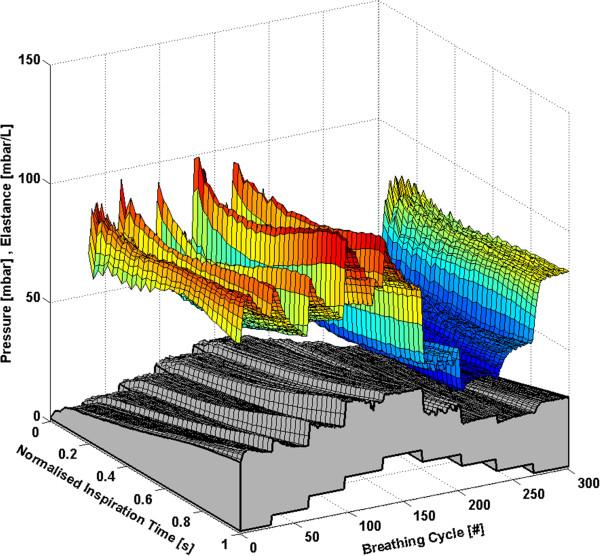
The single compartment lung model was extended to monitor dynamic time-varying respiratory system elastance, Edrs, within each breathing cycle. Two separate animal models were considered, each consisting of three fully sedated pure pietrain piglets (oleic acid ARDS and lavage ARDS). A staircase recruitment manoeuvre was performed on all six subjects after ARDS was induced. The Edrs was mapped across each breathing cycle for each subject.
RESULTS
Six time-varying, breath-specific Edrs maps were generated, one for each subject. Each Edrs map shows the subject-specific response to mechanical ventilation (MV), indicating the need for a model-based approach to guide MV. This method of visualisation provides high resolution insight into the time-varying respiratory mechanics to aid clinical decision making. Using the Edrs maps, minimal time-varying elastance was identified, which can be used to select optimal PEEP.
CONCLUSIONS
Real-time continuous monitoring of in-breath mechanics provides further insight into lung physiology. Therefore, there is potential for this new monitoring method to aid clinicians in guiding MV treatment. These are the first such maps generated and they thus show unique results in high resolution. The model is limited to a constant respiratory resistance throughout inspiration which may not be valid in some cases. However, trends match clinical expectation and the results highlight both the subject-specificity of the model, as well as significant inter-subject variability.
背景
急性呼吸窘迫综合征(ARDS)患者存在肺萎陷风险,这会严重改变呼吸的逐次变化力学。基于模型的呼吸力学估计可用于描述患者的特定情况,并对治疗反应进行预测,从而为机械通气(MV)提供指导。本研究提出了一种基于模型的方法来监测随时间变化的患者-呼吸机相互作用,以指导选择呼气末正压(PEEP)。
方法
将单室肺模型扩展到监测每个呼吸周期内动态的、随时间变化的呼吸系统弹性(Edrs)。考虑了两种单独的动物模型,每个模型均由三只完全镇静的纯皮特兰仔猪(油酸 ARDS 和灌洗 ARDS)组成。在所有六只动物的 ARDS 诱导后,均进行了阶梯式复张手法。为每个对象绘制了每个呼吸周期内的 Edrs 图。
结果
为每个对象生成了六个随时间变化的、呼吸特异性的 Edrs 图。每个 Edrs 图都显示了患者对机械通气(MV)的特定反应,表明需要基于模型的方法来指导 MV。这种可视化方法提供了对随时间变化的呼吸力学的高分辨率见解,有助于临床决策。使用 Edrs 图,可以确定最小的随时间变化的弹性,这可用于选择最佳的 PEEP。
结论
实时连续监测吸气力学可进一步深入了解肺生理学。因此,这种新的监测方法有可能帮助临床医生指导 MV 治疗。这些是首次生成的此类地图,因此以高分辨率显示了独特的结果。该模型在整个吸气过程中限制为恒定的呼吸阻力,在某些情况下可能不成立。但是,趋势符合临床预期,结果突出了模型的个体特异性以及显著的个体间变异性。


 Zotero 插件