Department of Mechanical Engineering, Centre for Bio-Engineering, University of Canterbury, Private Bag 4800, Christchurch, New Zealand.
Department of Intensive Care, Erasme University of Hospital, 1070, Brussels, Belgium.
Biomed Eng Online. 2018 Feb 20;17(1):24. doi: 10.1186/s12938-018-0455-y.
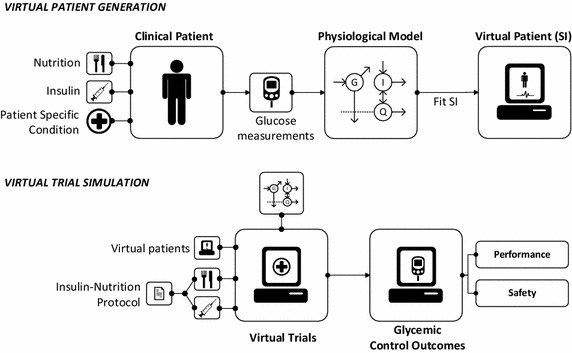
Critical care, like many healthcare areas, is under a dual assault from significantly increasing demographic and economic pressures. Intensive care unit (ICU) patients are highly variable in response to treatment, and increasingly aging populations mean ICUs are under increasing demand and their cohorts are increasingly ill. Equally, patient expectations are growing, while the economic ability to deliver care to all is declining. Better, more productive care is thus the big challenge. One means to that end is personalised care designed to manage the significant inter- and intra-patient variability that makes the ICU patient difficult. Thus, moving from current "one size fits all" protocolised care to adaptive, model-based "one method fits all" personalised care could deliver the required step change in the quality, and simultaneously the productivity and cost, of care. Computer models of human physiology are a unique tool to personalise care, as they can couple clinical data with mathematical methods to create subject-specific models and virtual patients to design new, personalised and more optimal protocols, as well as to guide care in real-time. They rely on identifying time varying patient-specific parameters in the model that capture inter- and intra-patient variability, the difference between patients and the evolution of patient condition. Properly validated, virtual patients represent the real patients, and can be used in silico to test different protocols or interventions, or in real-time to guide care. Hence, the underlying models and methods create the foundation for next generation care, as well as a tool for safely and rapidly developing personalised treatment protocols over large virtual cohorts using virtual trials. This review examines the models and methods used to create virtual patients. Specifically, it presents the models types and structures used and the data required. It then covers how to validate the resulting virtual patients and trials, and how these virtual trials can help design and optimise clinical trial. Links between these models and higher order, more complex physiome models are also discussed. In each section, it explores the progress reported up to date, especially on core ICU therapies in glycemic, circulatory and mechanical ventilation management, where high cost and frequency of occurrence provide a significant opportunity for model-based methods to have measurable clinical and economic impact. The outcomes are readily generalised to other areas of medical care.
重症监护室(ICU)面临着双重压力,一方面是人口统计学和经济方面的压力显著增加,另一方面是 ICU 患者的治疗反应存在很大差异,而且人口老龄化意味着 ICU 的需求不断增加,患者群体的病情也越来越严重。同样,患者的期望也在不断提高,而提供医疗服务的经济能力却在下降。因此,更好、更高效的医疗护理是一个巨大的挑战。达到这一目标的一种手段是个性化护理,旨在管理 ICU 患者的显著个体间和个体内差异,这些差异使得 ICU 患者的护理变得困难。因此,从当前的“一刀切”的方案化护理转向适应性、基于模型的“一种方法适合所有”的个性化护理,可以在护理质量方面带来所需的变革,同时也可以提高护理的效率和成本。人体生理学的计算机模型是个性化护理的独特工具,因为它们可以将临床数据与数学方法相结合,为每个患者创建特定的模型和虚拟患者,从而设计新的、个性化的、更优化的方案,并实时指导护理。这些模型依赖于在模型中识别随时间变化的患者特定参数,这些参数捕捉患者间和患者内的变异性,以及患者之间的差异和患者病情的演变。经过适当验证,虚拟患者代表真实患者,可以在计算机中用于测试不同的方案或干预措施,或者实时指导护理。因此,这些基础模型和方法为下一代护理提供了基础,也是在大型虚拟患者群体中安全快速地开发个性化治疗方案的工具,同时也可以通过虚拟试验进行研究。本文回顾了用于创建虚拟患者的模型和方法。具体来说,本文介绍了使用的模型类型和结构以及所需的数据。然后介绍了如何验证由此产生的虚拟患者和试验,以及这些虚拟试验如何帮助设计和优化临床试验。还讨论了这些模型与更高阶、更复杂的类器官模型之间的联系。在每一部分中,都探讨了截至目前的报告进展情况,特别是在血糖、循环和机械通气管理等核心 ICU 治疗方面,这些治疗的高成本和高频率为基于模型的方法提供了一个具有显著临床和经济影响的机会。这些结果很容易推广到其他医疗保健领域。