Shigemura Jun, Tanigawa Takeshi, Nishi Daisuke, Matsuoka Yutaka, Nomura Soichiro, Yoshino Aihide
Department of Psychiatry, National Defense Medical College, Tokorozawa, Saitama, Japan.
Department of Public Health, Ehime University Graduate School of Medicine, Toon, Ehime, Japan.
PLoS One. 2014 Feb 19;9(2):e87516. doi: 10.1371/journal.pone.0087516. eCollection 2014.
The 2011 Fukushima Daiichi Nuclear Power Plant accident was the worst nuclear disaster since Chernobyl. The nearby Daini plant also experienced substantial damage but remained intact. Workers for the both plants experienced multiple stressors as disaster victims and workers, as well as the criticism from the public due to their company's post-disaster management. Little is known about the psychological pathway mechanism from nuclear disaster exposures, distress during and immediately after the event (peritraumatic distress; PD), to posttraumatic stress responses (PTSR).
A self-report questionnaire was administered to 1,411 plant employees (Daiichi, n = 831; Daini, n = 580) 2-3 months post-disaster (total response rate: 80.2%). The socio-demographic characteristics and disaster-related experiences were assessed as independent variables. PD and PTSR were measured by the Japanese versions of Peritraumatic Distress Inventory and the Impact of Event Scale-Revised, respectively. The analysis was conducted separately for the two groups. Bivariate regression analyses were performed to assess the relationships between independent variables, PD, and PTSR. Significant variables were subsequently entered in the multiple regression analyses to explore the pathway mechanism for development of PTSR.
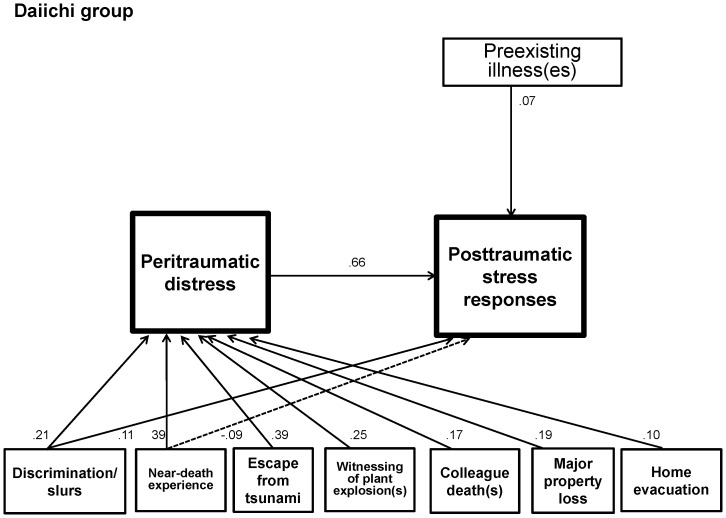
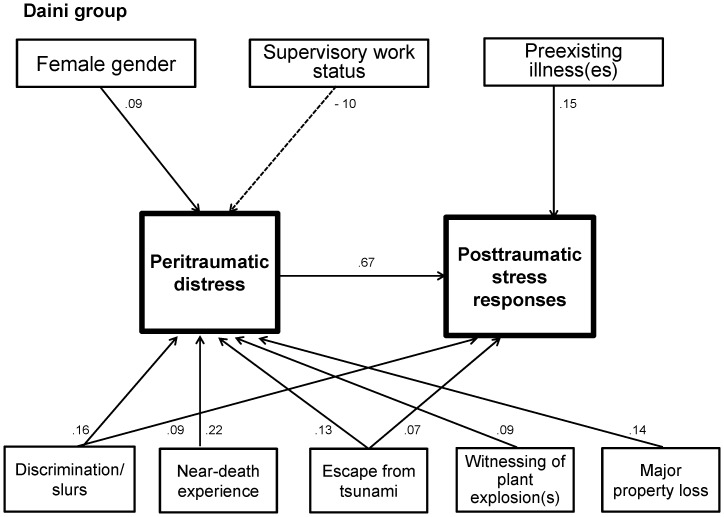
For both groups, PTSR highly associated with PD (Daiichi: adjusted β, 0.66; p<0.001; vs. Daini: adjusted β, 0.67; p<0.001). PTSR also associated with discrimination/slurs experience (Daiichi: 0.11; p<0.001; vs. Daini, 0.09; p = 0.005) and presence of preexisting illness(es) (Daiichi: 0.07; p = 0.005; vs. Daini: 0.15; p<.0001). Other disaster-related variables were likely to be associated with PD than PTSR.
Among the Fukushima nuclear plant workers, disaster exposures associated with PD. PTSR was highly affected by PD along with discrimination/slurs experience.
2011年福岛第一核电站事故是自切尔诺贝利事故以来最严重的核灾难。附近的第二核电站也遭受了重大破坏,但仍保持完好。两座核电站的工作人员作为灾难受害者和工作人员经历了多重压力源,同时也因公司的灾后管理受到公众批评。关于从核灾难暴露、事件期间及刚结束时的痛苦(创伤周围痛苦;PD)到创伤后应激反应(PTSR)的心理路径机制,人们了解甚少。
在灾后2至3个月,对1411名核电站员工(第一核电站,n = 831;第二核电站,n = 580)进行了一份自填式问卷调查(总回复率:80.2%)。社会人口学特征和与灾难相关的经历被评估为自变量。PD和PTSR分别通过创伤周围痛苦量表和事件影响量表修订版的日语版本进行测量。对两组分别进行分析。进行双变量回归分析以评估自变量、PD和PTSR之间的关系。随后将显著变量纳入多元回归分析,以探索PTSR发展的路径机制。
对于两组而言,PTSR与PD高度相关(第一核电站:调整后的β,0.66;p < 0.001;第二核电站:调整后的β,0.67;p < 0.001)。PTSR还与歧视/诋毁经历相关(第一核电站:0.11;p < 0.001;第二核电站,0.09;p = 0.005)以及既往疾病的存在相关(第一核电站:0.07;p = 0.005;第二核电站:0.15;p <.0001)。其他与灾难相关的变量与PD的关联可能比与PTSR更强。
在福岛核电站工作人员中,灾难暴露与PD相关。PTSR受到PD以及歧视/诋毁经历的高度影响。