Department of Conservation Biology, Estación Biológica de Doñana (EBD-CSIC) Calle Américo Vespucio s/n, Sevilla, Spain.
PLoS One. 2014 Feb 26;9(2):e90292. doi: 10.1371/journal.pone.0090292. eCollection 2014.
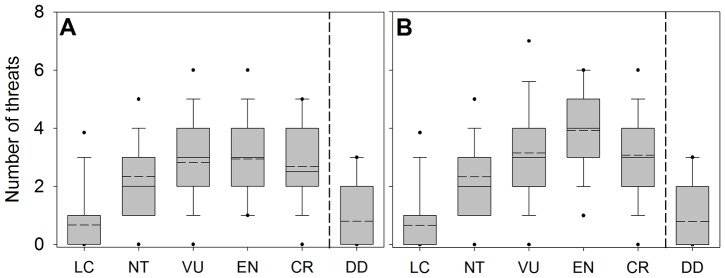
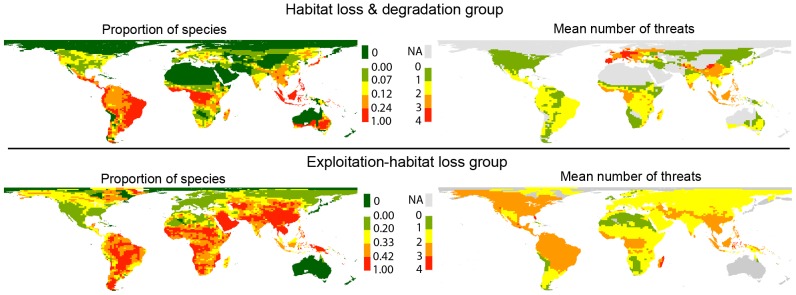
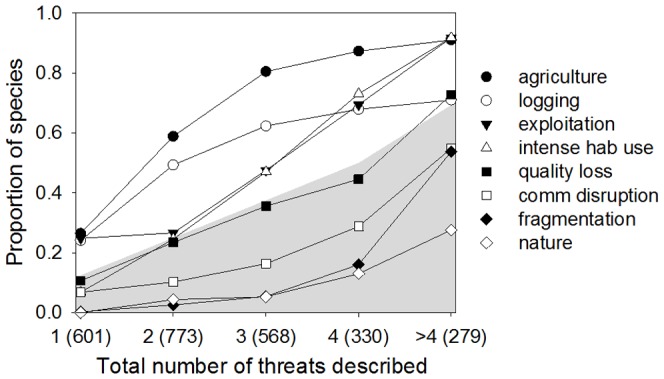
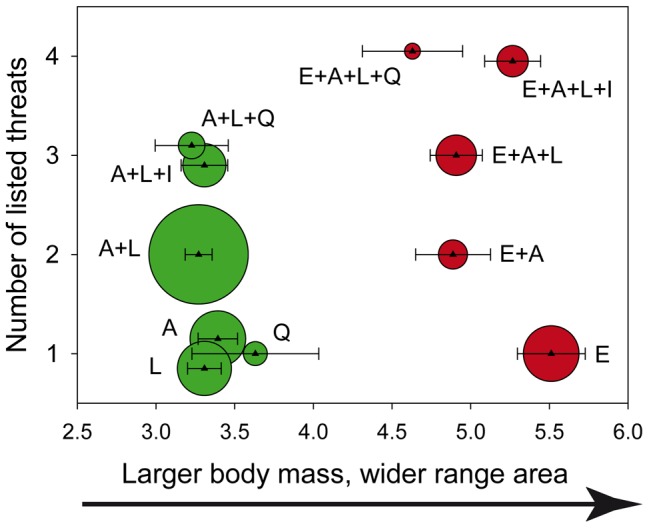
An important challenge for conservation today is to understand the endangerment process and identify any generalized patterns in how threats occur and aggregate across taxa. Here we use a global database describing main current external threats in mammals to evaluate the prevalence of distinct threatening processes, primarily of anthropogenic origin, and to identify generalized drivers of extinction and their association with vulnerability status and intrinsic species' traits. We detect several primary threat combinations that are generally associated with distinct species. In particular, large and widely distributed mammals are affected by combinations of direct exploitation and threats associated with increasing landscape modification that go from logging to intense human land-use. Meanwhile, small, narrowly distributed species are affected by intensifying levels of landscape modification but are not directly exploited. In general more vulnerable species are affected by a greater number of threats, suggesting increased extinction risk is associated with the accumulation of external threats. Overall, our findings show that endangerment in mammals is strongly associated with increasing habitat loss and degradation caused by human land-use intensification. For large and widely distributed mammals there is the additional risk of being hunted.
当今保护面临的一个重要挑战是理解濒危过程,并确定威胁发生的一般模式以及在分类群中聚集的方式。在这里,我们使用一个全球数据库来描述哺乳动物的主要当前外部威胁,以评估不同威胁过程的普遍性,这些威胁主要源于人为因素,并确定灭绝的一般驱动因素及其与脆弱性状况和内在物种特征的关系。我们检测到几种通常与不同物种相关的主要威胁组合。特别是,大型和广泛分布的哺乳动物受到直接开发和与景观不断变化相关的威胁的组合的影响,这些变化从伐木到密集的人类土地利用。与此同时,小型、分布狭窄的物种受到不断加剧的景观变化的影响,但没有受到直接开发。一般来说,更脆弱的物种受到更多威胁的影响,这表明随着外部威胁的积累,灭绝风险会增加。总体而言,我们的研究结果表明,哺乳动物的濒危状态与人类土地利用强度导致的栖息地丧失和退化密切相关。对于大型和广泛分布的哺乳动物来说,还有被狩猎的额外风险。