Anastasopoulou Panagiota, Tubic Mirnes, Schmidt Steffen, Neumann Rainer, Woll Alexander, Härtel Sascha
House of Competence - hiper.campus, Karlsruhe Institute of Technology, Karlsruhe, Germany.
Department of Sport and Sports Science, Karlsruhe Institute of Technology, Karlsruhe, Germany.
PLoS One. 2014 Feb 28;9(2):e90606. doi: 10.1371/journal.pone.0090606. eCollection 2014.
The measurement of activity energy expenditure (AEE) via accelerometry is the most commonly used objective method for assessing human daily physical activity and has gained increasing importance in the medical, sports and psychological science research in recent years.
The purpose of this study was to determine which of the following procedures is more accurate to determine the energy cost during the most common everyday life activities; a single regression or an activity based approach. For this we used a device that utilizes single regression models (GT3X, ActiGraph Manufacturing Technology Inc., FL., USA) and a device using activity-dependent calculation models (move II, movisens GmbH, Karlsruhe, Germany).
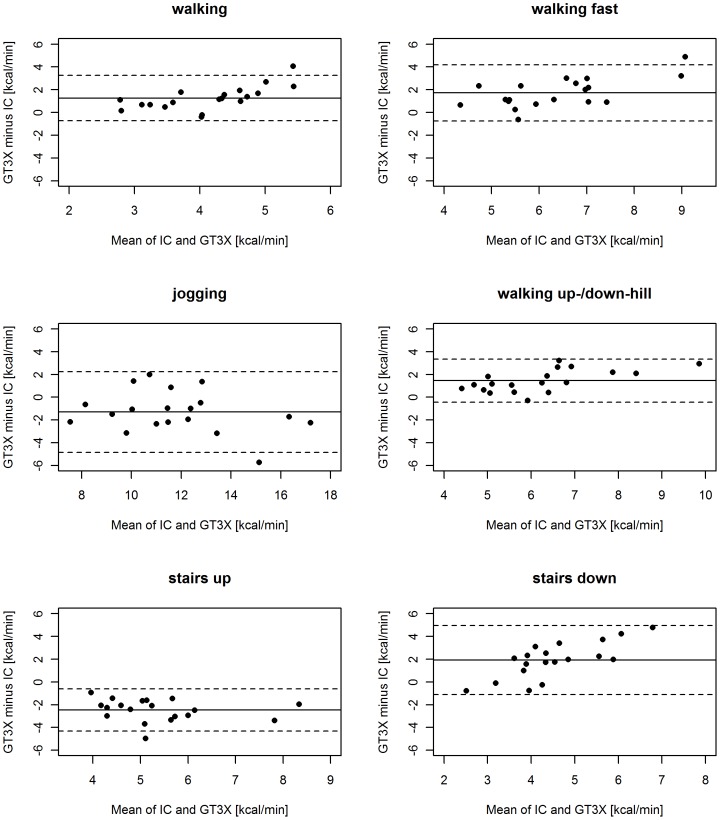
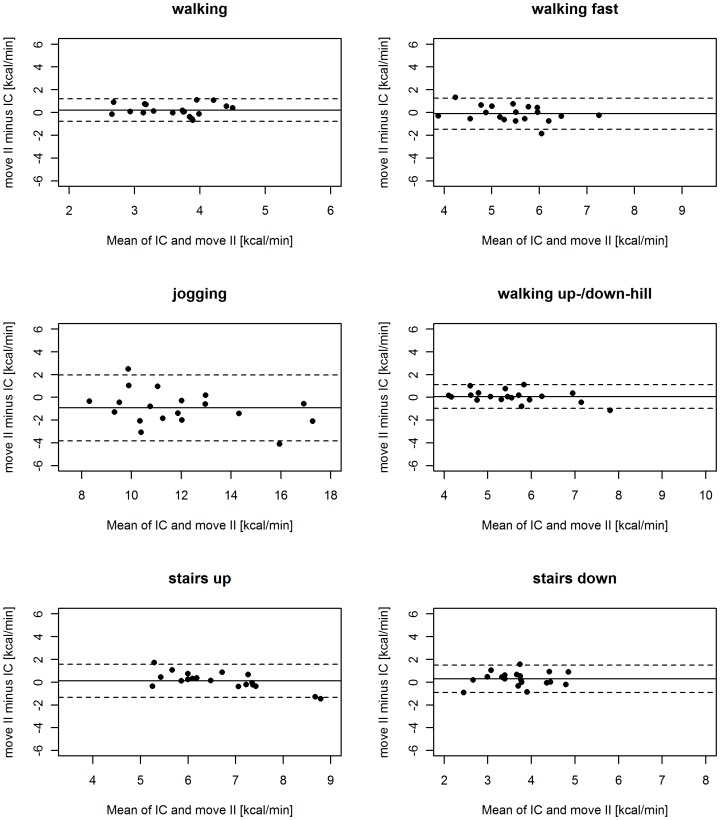
Nineteen adults (11 male, 8 female; 30.4±9.0 years) wore the activity monitors attached to the waist and a portable indirect calorimeter (IC) as reference measure for AEE while performing several typical daily activities. The accuracy of the two devices for estimating AEE was assessed as the mean differences between their output and the reference and evaluated using Bland-Altman analysis.
The GT3X overestimated the AEE of walking (GT3X minus reference, 1.26 kcal/min), walking fast (1.72 kcal/min), walking up-/downhill (1.45 kcal/min) and walking upstairs (1.92 kcal/min) and underestimated the AEE of jogging (-1.30 kcal/min) and walking upstairs (-2.46 kcal/min). The errors for move II were smaller than those for GT3X for all activities. The move II overestimated AEE of walking (move II minus reference, 0.21 kcal/min), walking up-/downhill (0.06 kcal/min) and stair walking (upstairs: 0.13 kcal/min; downstairs: 0.29 kcal/min) and underestimated AEE of walking fast (-0.11 kcal/min) and jogging (-0.93 kcal/min).
Our data suggest that the activity monitor using activity-dependent calculation models is more appropriate for predicting AEE in daily life than the activity monitor using a single regression model.
通过加速度计测量活动能量消耗(AEE)是评估人类日常身体活动最常用的客观方法,近年来在医学、体育和心理学研究中变得越来越重要。
本研究的目的是确定以下哪种程序在确定最常见的日常生活活动中的能量消耗时更准确;单一回归法还是基于活动的方法。为此,我们使用了一种利用单一回归模型的设备(GT3X,美国佛罗里达州ActiGraph制造技术公司)和一种使用与活动相关的计算模型的设备(move II,德国卡尔斯鲁厄市movisens有限公司)。
19名成年人(11名男性,8名女性;30.4±9.0岁)在进行几项典型的日常活动时,佩戴系于腰部的活动监测器和便携式间接热量计(IC)作为AEE的参考测量工具。将两种设备估计AEE的准确性评估为其输出与参考值之间的平均差异,并使用Bland-Altman分析进行评估。
GT3X高估了步行(GT3X减去参考值,1.26千卡/分钟)、快走(1.72千卡/分钟)、上坡/下坡行走(1.45千卡/分钟)和上楼梯(1.92千卡/分钟)的AEE,低估了慢跑(-1.30千卡/分钟)和下楼梯(-2.46千卡/分钟)的AEE。对于所有活动,move II的误差均小于GT3X。move II高估了步行(move II减去参考值,0.21千卡/分钟)、上坡/下坡行走(0.06千卡/分钟)和楼梯行走(上楼梯:0.13千卡/分钟;下楼梯:0.29千卡/分钟)的AEE,低估了快走(-0.11千卡/分钟)和慢跑(-0.93千卡/分钟)的AEE。
我们的数据表明,使用与活动相关的计算模型的活动监测器比使用单一回归模型的活动监测器更适合预测日常生活中的AEE。