Laboratory of Chromosome Dynamics, Institute of Molecular and Cellular Biosciences.
Genes Dev. 2014 Mar 15;28(6):594-607. doi: 10.1101/gad.237313.113. Epub 2014 Mar 3.
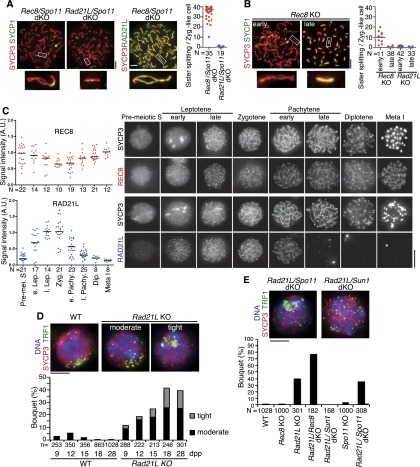
During meiosis, homologous chromosome (homolog) pairing is promoted by several layers of regulation that include dynamic chromosome movement and meiotic recombination. However, the way in which homologs recognize each other remains a fundamental issue in chromosome biology. Here, we show that homolog recognition or association initiates upon entry into meiotic prophase before axis assembly and double-strand break (DSB) formation. This homolog association develops into tight pairing only during or after axis formation. Intriguingly, the ability to recognize homologs is retained in Sun1 knockout spermatocytes, in which telomere-directed chromosome movement is abolished, and this is the case even in Spo11 knockout spermatocytes, in which DSB-dependent DNA homology search is absent. Disruption of meiosis-specific cohesin RAD21L precludes the initial association of homologs as well as the subsequent pairing in spermatocytes. These findings suggest the intriguing possibility that homolog recognition is achieved primarily by searching for homology in the chromosome architecture as defined by meiosis-specific cohesin rather than in the DNA sequence itself.
在减数分裂过程中,同源染色体(homolog)的配对受到包括染色体动态运动和减数重组在内的几个层次的调节。然而,同源染色体相互识别的方式仍然是染色体生物学中的一个基本问题。在这里,我们表明,同源染色体的识别或关联在轴形成和双链断裂(DSB)形成之前的减数分裂前期进入时就开始了。这种同源关联只有在轴形成期间或之后才会发展成紧密配对。有趣的是,Sun1 敲除精母细胞中保留了识别同源染色体的能力,在这些细胞中,端粒定向的染色体运动被废除,即使在 Spo11 敲除精母细胞中也是如此,在这些细胞中,DSB 依赖性 DNA 同源搜索是不存在的。减数分裂特异性黏连蛋白 RAD21L 的破坏阻止了同源染色体的初始关联以及随后在精母细胞中的配对。这些发现表明了一种有趣的可能性,即同源染色体的识别主要是通过在由减数分裂特异性黏连蛋白定义的染色体结构中而不是在 DNA 序列本身中搜索同源性来实现的。