Instituto de Ciências Biomédicas, Universidade Federal do Rio de Janeiro Rio de Janeiro, Brasil ; Instituto Nacional de Neurociência Translacional, CNPq/MCT São Paulo, Brasil.
D'Or Institute for Research and Education (IDOR) Rio de Janeiro, Brasil ; Bioimaging National Center, Federal University of Rio de Janeiro Rio de Janeiro, Brazil.
Front Neuroanat. 2014 Feb 17;8:5. doi: 10.3389/fnana.2014.00005. eCollection 2014.
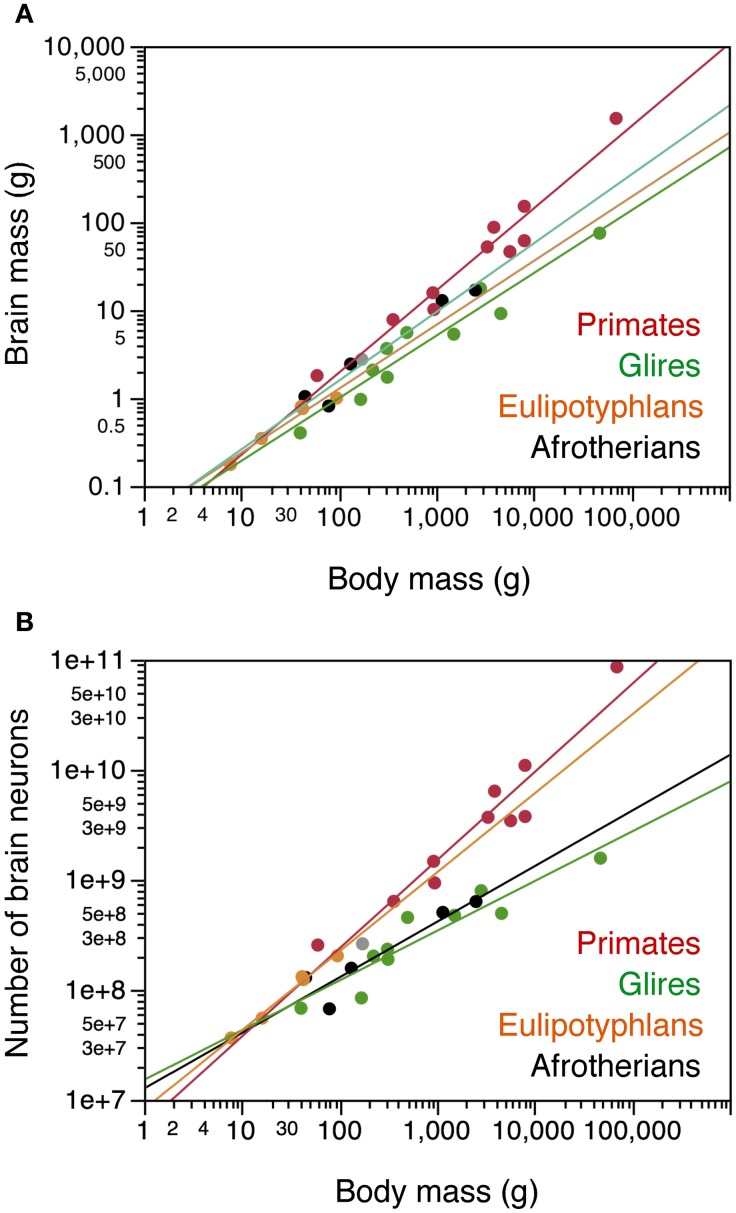
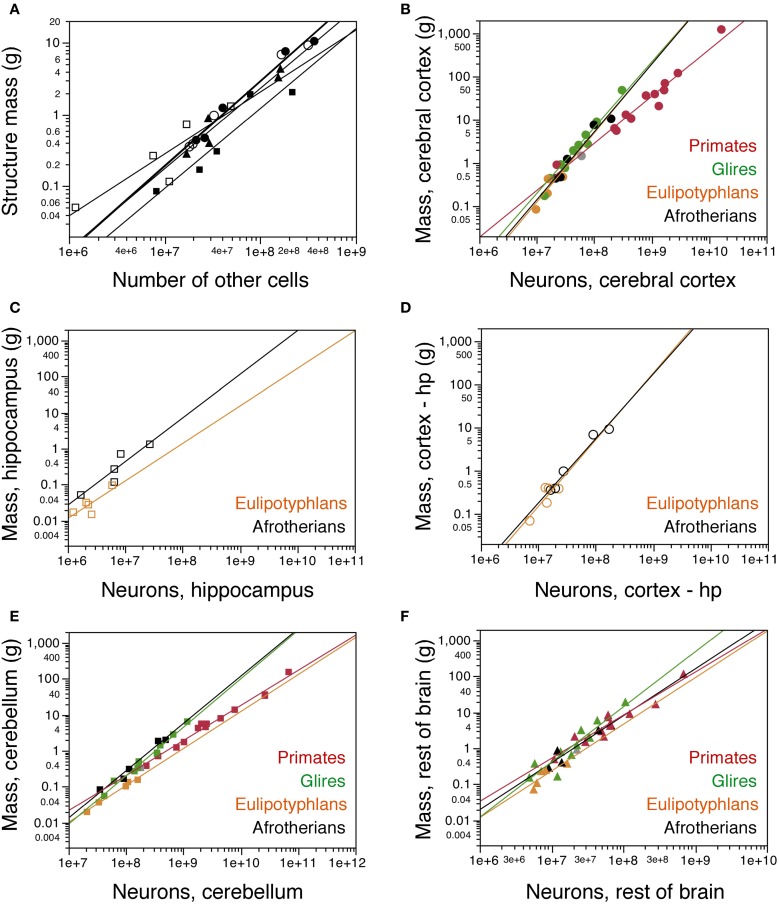
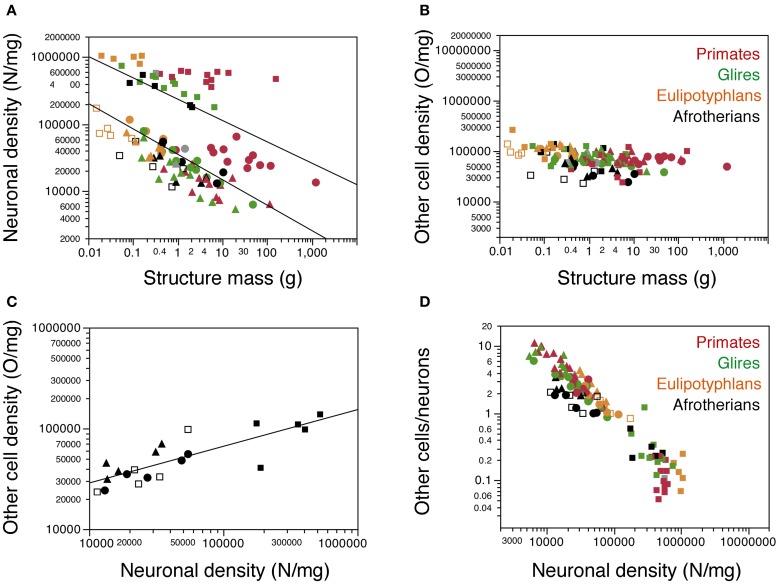
Quantitative analysis of the cellular composition of rodent, primate and eulipotyphlan brains has shown that non-neuronal scaling rules are similar across these mammalian orders that diverged about 95 million years ago, and therefore appear to be conserved in evolution, while neuronal scaling rules appear to be free to vary in evolution in a clade-specific manner. Here we analyze the cellular scaling rules that apply to the brain of afrotherians, believed to be the first clade to radiate from the common eutherian ancestor. We find that afrotherians share non-neuronal scaling rules with rodents, primates and eulipotyphlans, as well as the coordinated scaling of numbers of neurons in the cerebral cortex and cerebellum. Afrotherians share with rodents and eulipotyphlans, but not with primates, the scaling of number of neurons in the cortex and in the cerebellum as a function of the number of neurons in the rest of the brain. Afrotheria also share with rodents and eulipotyphlans the neuronal scaling rules that apply to the cerebral cortex. Afrotherians share with rodents, but not with eulipotyphlans nor primates, the neuronal scaling rules that apply to the cerebellum. Importantly, the scaling of the folding index of the cerebral cortex with the number of neurons in the cerebral cortex is not shared by either afrotherians, rodents, or primates. The sharing of some neuronal scaling rules between afrotherians and rodents, and of some additional features with eulipotyphlans and primates, raise the interesting possibility that these shared characteristics applied to the common eutherian ancestor. In turn, the clade-specific characteristics that relate to the distribution of neurons along the surface of the cerebral cortex and to its degree of gyrification suggest that these characteristics compose an evolutionarily plastic suite of features that may have defined and distinguished mammalian groups in evolution.
对啮齿动物、灵长类动物和真兽亚纲动物大脑的细胞组成进行定量分析表明,在这些大约 9500 万年前分化的哺乳动物目中,非神经元的缩放规律是相似的,因此在进化中似乎是保守的,而神经元的缩放规律似乎可以以特定于分支的方式自由变化。在这里,我们分析了适用于真兽亚纲动物大脑的细胞缩放规律,真兽亚纲动物被认为是第一个从共同的真兽类祖先辐射出来的分支。我们发现,真兽亚纲动物与啮齿动物、灵长类动物和真兽亚纲动物具有相同的非神经元缩放规律,以及大脑皮层和小脑神经元数量的协调缩放。真兽亚纲动物与啮齿动物和真兽亚纲动物一样,但与灵长类动物不同,其大脑皮层和小脑神经元的数量与大脑其余部分的神经元数量呈函数关系。真兽亚纲动物也与啮齿动物和真兽亚纲动物具有相同的适用于大脑皮层的神经元缩放规律。真兽亚纲动物与啮齿动物共享,但与真兽亚纲动物和灵长类动物不同,适用于小脑的神经元缩放规律。重要的是,大脑皮层的折叠指数与大脑皮层神经元数量的缩放关系既不适用于真兽亚纲动物,也不适用于啮齿动物或灵长类动物。真兽亚纲动物与啮齿动物之间共享一些神经元缩放规律,与真兽亚纲动物和灵长类动物之间共享一些其他特征,这提出了一个有趣的可能性,即这些共享特征适用于共同的真兽类祖先。反过来,与神经元在大脑皮层表面的分布以及其脑回程度相关的分支特异性特征表明,这些特征构成了一套进化上具有可塑性的特征,这些特征可能在进化中定义和区分了哺乳动物群体。