Instituto de Ciências Biomédicas, Universidade Federal do Rio de Janeiro Rio de Janeiro, Brazil.
Front Neuroanat. 2012 Feb 2;6:3. doi: 10.3389/fnana.2012.00003. eCollection 2012.
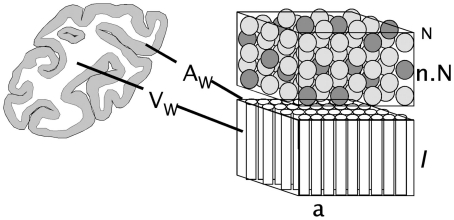
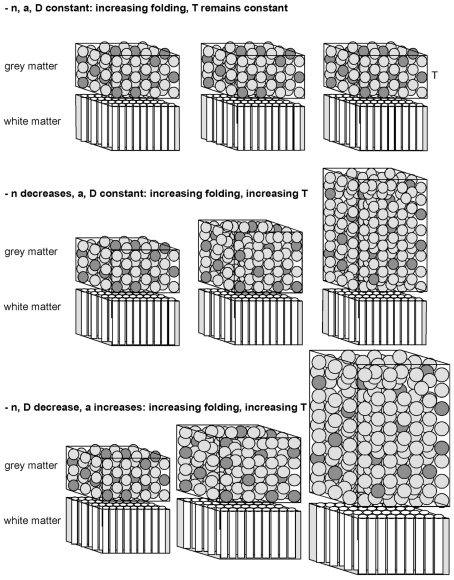
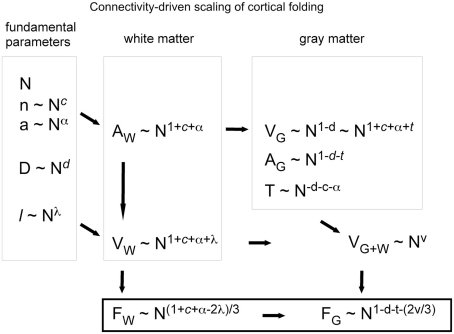
Larger mammalian cerebral cortices tend to have increasingly folded surfaces, often considered to result from the lateral expansion of the gray matter (GM), which, in a volume constrained by the cranium, causes mechanical compression that is relieved by inward folding of the white matter (WM), or to result from differential expansion of cortical layers. Across species, thinner cortices, presumably more pliable, would offer less resistance and hence become more folded than thicker cortices of a same size. However, such models do not acknowledge evidence in favor of a tension-based pull onto the GM from the inside, holding it in place even when the constraint imposed by the cranium is removed. Here we propose a testable, quantitative model of cortical folding driven by tension along the length of axons in the WM that assumes that connections through the WM are formed early in development, at the same time as the GM becomes folded, and considers that axonal connections through the WM generate tension that leads to inward folding of the WM surface, which pulls the GM surface inward. As an important necessary simplifying hypothesis, we assume that axons leaving or entering the WM do so approximately perpendicularly to the WM-GM interface. Cortical folding is thus driven by WM connectivity, and is a function of the fraction of cortical neurons connected through the WM, the average length, and the average cross-sectional area of the axons in the WM. Our model predicts that the different scaling of cortical folding across mammalian orders corresponds to different combinations of scaling of connectivity, axonal cross-sectional area, and tension along WM axons, instead of being a simple function of the number of GM neurons. Our model also explains variations in average cortical thickness as a result of the factors that lead to cortical folding, rather than as a determinant of folding; predicts that for a same tension, folding increases with connectivity through the WM and increased axonal cross-section; and that, for a same number of neurons, higher connectivity through the WM leads to a higher degree of folding as well as an on average thinner GM across species.
较大的哺乳动物大脑皮层往往具有越来越褶皱的表面,这通常被认为是由于灰质(GM)的侧向扩张所致,在颅骨限制的体积内,这种扩张导致了白质(WM)的向内折叠,从而缓解了机械压缩,或者是由于皮质层的差异扩张所致。在不同物种中,较薄的皮质层,推测更具柔韧性,阻力更小,因此比相同大小的较厚皮质层更容易折叠。然而,这些模型并没有承认有一种基于张力的拉力从内部作用于 GM 的证据,即使颅骨施加的限制被移除,这种拉力也能将 GM 固定在适当的位置。在这里,我们提出了一个可测试的、基于 WM 中的轴突长度产生张力的皮质褶皱定量模型,该模型假设 WM 中的连接是在 GM 折叠的早期形成的,同时考虑到 WM 中的轴突连接会产生张力,导致 WM 表面向内折叠,从而将 GM 表面向内拉动。作为一个重要的简化假设,我们假设离开或进入 WM 的轴突几乎垂直于 WM-GM 界面。因此,皮质褶皱是由 WM 连接性驱动的,是通过 WM 连接的皮质神经元的分数、轴突在 WM 中的平均长度和平均横截面积的函数。我们的模型预测,不同哺乳动物阶序的皮质褶皱的不同比例对应于连接性、轴突横截面积和 WM 轴突张力的不同组合的比例,而不是 GM 神经元数量的简单函数。我们的模型还解释了平均皮质厚度的变化是由于导致皮质褶皱的因素,而不是褶皱的决定因素;预测对于相同的张力,褶皱随 WM 中的连接性增加和轴突横截面积增加而增加;并且对于相同数量的神经元,WM 中的更高连接性导致更高程度的褶皱以及跨物种平均更薄的 GM。