Pandey Ramesh Prasad, Parajuli Prakash, Koirala Niranjan, Lee Joo Ho, Park Yong Il, Sohng Jae Kyung
Department of Pharmaceutical Engineering, Institute of Biomolecule Reconstruction, Sun Moon University, Asan 336-708, Korea.
Mol Cells. 2014 Feb;37(2):172-7. doi: 10.14348/molcells.2014.2348. Epub 2014 Feb 19.
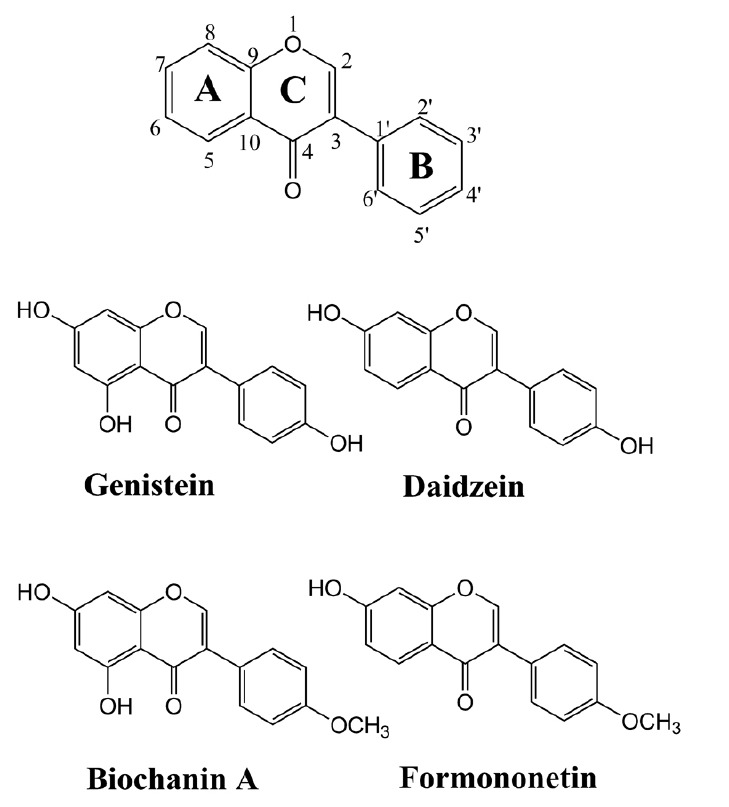
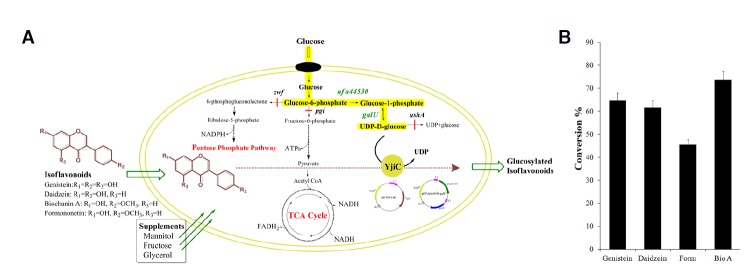
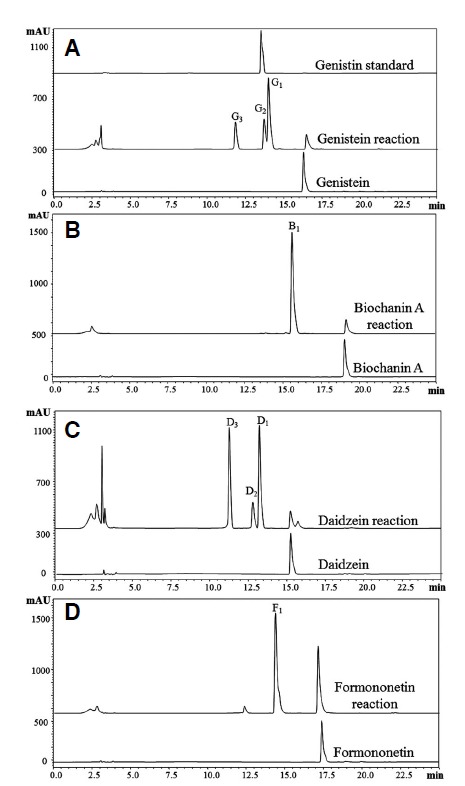
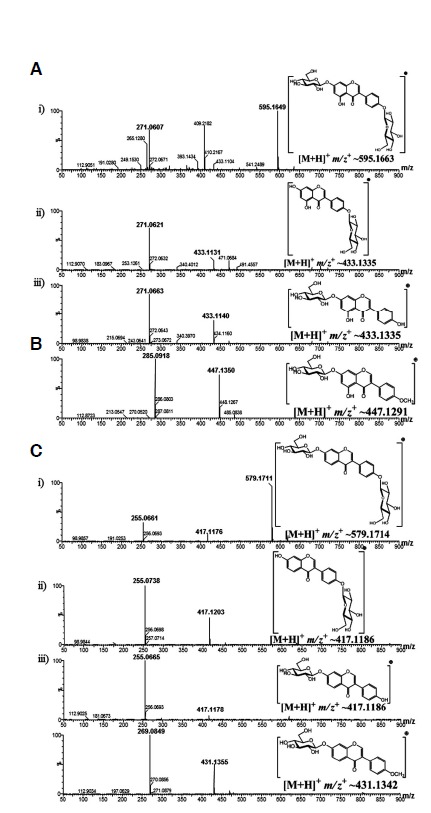
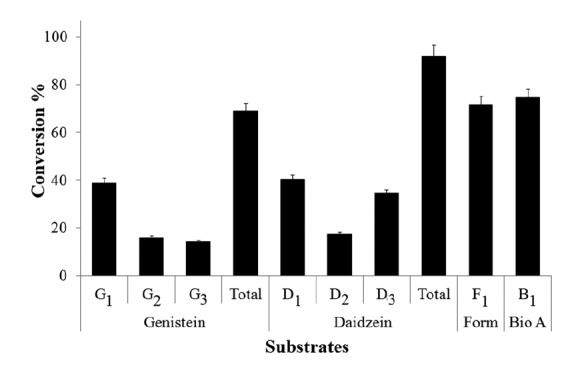
A glycosyltransferase, YjiC, from Bacillus licheniformis has been used for the modification of the commercially available isoflavonoids genistein, daidzein, biochanin A and formononetin. The in vitro glycosylation reaction, using UDP-α-D-glucose as a donor for the glucose moiety and aforementioned four acceptor molecules, showed the prominent glycosylation at 4' and 7 hydroxyl groups, but not at the 5(th) hydroxyl group of the A-ring, resulting in the production of genistein 4'-O-β-D-glucoside, genistein 7-O-β-D-glucoside (genistin), genistein 4',7-O-β-D-diglucoside, biochanin A-7-O-β-D-glucoside (sissotrin), daidzein 4'-O-β-D-glucoside, daidzein 7-O-β-D-glucoside (daidzin), daidzein 4', 7-O-β-D-diglucoside, and formononetin 7-O-β-D-glucoside (ononin). The structures of all the products were elucidated using high performance liquid chromatography-photo diode array and high resolution quadrupole time-of-flight electrospray ionization mass spectrometry (HR QTOFESI/MS) analysis, and were compared with commercially available standard compounds. Significantly higher bioconversion rates of all four isoflavonoids was observed in both in vitro as well as in vivo bioconversion reactions. The in vivo fermentation of the isoflavonoids by applying engineered E. coli BL21(DE3)/ΔpgiΔzwfΔushA overexpressing phosphoglucomutase (pgm) and glucose 1-phosphate uridyltransferase (galU), along with YjiC, found more than 60% average conversion of 200 μM of supplemented isoflavonoids, without any additional UDP-α-D-glucose added in fermentation medium, which could be very beneficial to large scale industrial production of isoflavonoid glucosides.
来自地衣芽孢杆菌的一种糖基转移酶YjiC已被用于修饰市售的异黄酮染料木黄酮、大豆苷元、鹰嘴豆芽素A和芒柄花素。体外糖基化反应以UDP-α-D-葡萄糖作为葡萄糖部分的供体,上述四种受体分子参与反应,结果显示在4'和7位羟基上有显著的糖基化,但A环的5位羟基未发生糖基化,从而产生了染料木黄酮4'-O-β-D-葡萄糖苷、染料木黄酮7-O-β-D-葡萄糖苷(染料木苷)、染料木黄酮4',7-O-β-D-二葡萄糖苷、鹰嘴豆芽素A-7-O-β-D-葡萄糖苷(刺芒柄花苷)、大豆苷元4'-O-β-D-葡萄糖苷、大豆苷元7-O-β-D-葡萄糖苷(大豆苷)、大豆苷元4',7-O-β-D-二葡萄糖苷以及芒柄花素7-O-β-D-葡萄糖苷(芒柄花苷)。所有产物的结构均通过高效液相色谱-光电二极管阵列以及高分辨率四极杆飞行时间电喷雾电离质谱(HR QTOFESI/MS)分析得以阐明,并与市售标准化合物进行了比较。在体外和体内生物转化反应中均观察到所有四种异黄酮的生物转化率显著更高。通过应用过表达磷酸葡萄糖变位酶(pgm)和葡萄糖1-磷酸尿苷转移酶(galU)的工程化大肠杆菌BL21(DE3)/ΔpgiΔzwfΔushA以及YjiC对异黄酮进行体内发酵,发现200 μM补充的异黄酮平均转化率超过60%,且发酵培养基中未添加任何额外的UDP-α-D-葡萄糖,这对于异黄酮葡萄糖苷的大规模工业生产可能非常有益。