Department of Cardiology, St. Antonius Hospital, Koekoekslaan 1, 3435 CM, Nieuwegein, the Netherlands,
Neth Heart J. 2014 Aug;22(7-8):328-33. doi: 10.1007/s12471-014-0539-7.
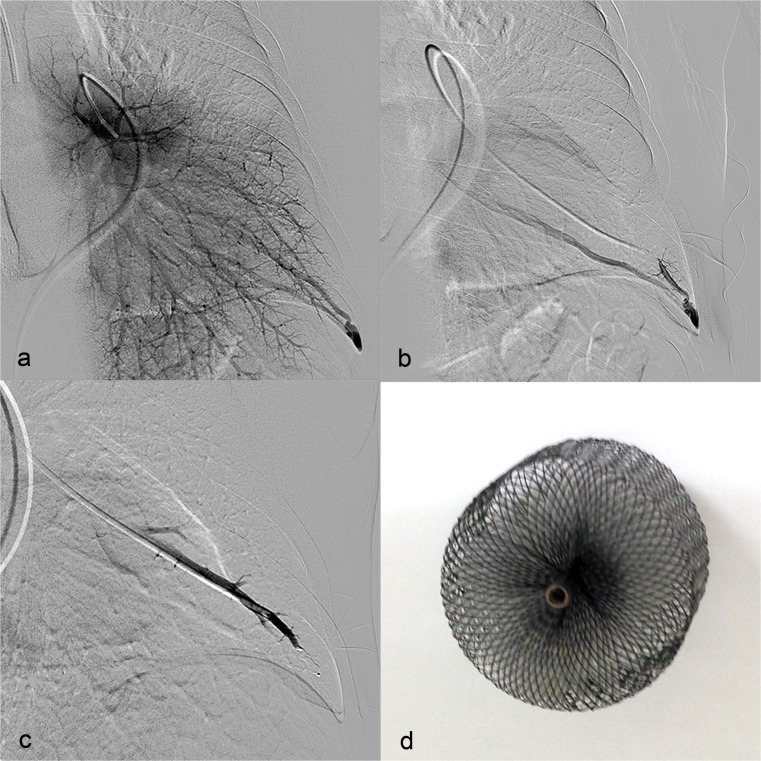
Transcatheter embolisation is widely used to close pulmonary arteriovenous malformations (PAVMs) in patients with hereditary haemorrhagic telangiectasia (HHT). Data on the direct cardiovascular haemodynamic changes induced by this treatment are scarce.
We investigated the direct haemodynamic effects of transcatheter embolisation of PAVMs, using non-invasive finger pressure measurements.
During the procedure, blood pressure, heart rate (HR), stroke volume (SV), cardiac output (CO), total peripheral resistance (TPR) and delta pressure/delta time (dP/dt) were continuously monitored using a Finometer®. Potential changes in these haemodynamic parameters were calculated from the pressure registrations using Modelflow® methodology. Absolute and relative changes were calculated and compared using the paired sample t-test.
The present study includes 29 HHT patients (mean age 39 ± 15 years, 11 men) who underwent transcatheter embolotherapy of PAVMs. The total number of embolisations was 72 (mean per patient 2.5). Directly after PAVM closure, SV and CO decreased significantly by -11.9 % (p = 0.01) and -9.5 % (p = 0.01) respectively, without a significant change in HR (1.8 %). Mean arterial blood pressure increased by 4.1 % (p = 0.02), while the TPR and dP/dt did not increase significantly (5.8 % and 0.2 %, respectively).
Significant haemodynamic changes occur directly after transcatheter embolisation of PAVMs, amongst which a decrease in stroke volume and cardiac output are most important.
经导管栓塞术被广泛用于治疗遗传性出血性毛细血管扩张症(HHT)患者的肺动静脉畸形(PAVM)。关于这种治疗方法直接引起的心血管血液动力学变化的数据很少。
我们使用非侵入性手指压力测量来研究经导管 PAVM 栓塞治疗引起的直接血液动力学效应。
在手术过程中,使用 Finometer®连续监测血压、心率(HR)、每搏量(SV)、心输出量(CO)、总外周阻力(TPR)和压力/时间变化率(dP/dt)。使用 Modelflow®方法从压力记录中计算这些血液动力学参数的潜在变化。使用配对样本 t 检验计算绝对和相对变化,并进行比较。
本研究包括 29 例 HHT 患者(平均年龄 39±15 岁,男性 11 例),这些患者接受了 PAVM 的经导管栓塞治疗。总共进行了 72 次栓塞(平均每位患者 2.5 次)。PAVM 关闭后,SV 和 CO 直接分别显著下降 11.9%(p=0.01)和 9.5%(p=0.01),而 HR 无明显变化(1.8%)。平均动脉血压升高 4.1%(p=0.02),而 TPR 和 dP/dt 没有明显增加(分别为 5.8%和 0.2%)。
经导管 PAVM 栓塞后会立即发生显著的血液动力学变化,其中 SV 和 CO 的下降最为重要。