Carlsson Ingela K, Dahlin Lars B
Department of Hand Surgery, Skane University Hospital, Lund University, Malmö, SE-205 02, Sweden.
BMC Musculoskelet Disord. 2014 Mar 14;15:83. doi: 10.1186/1471-2474-15-83.
Cold sensitivity is a common complaint following hand injuries. Our aim was to investigate long-term self-reported cold sensitivity, and its predictors and the importance of sense of coherence (SOC), 8 years after a hand injury as well as in patients treated for Hand Arm Vibration Syndrome (HAVS) during the same time period.
Responses to the Cold Intolerance Symptom Severity (CISS) questionnaire and the Sense of Coherence (SOC) questionnaire were investigated in hand injured patients (n = 64) and in patients with HAVS (n = 26). The Mann-Whitney U-Test was used to identify significant differences between subgroups. When analysing predictors for cold sensitivity severity, the Spearman rank correlation (rS coefficient) were used for quantitative predictive variables, Mann-Whitney U-Test for dichotomous variables and Kruskal-Wallis Test for multiple categorical data. The Wilcoxon's signed rank test was used to investigate longitudinal changes in outcome.
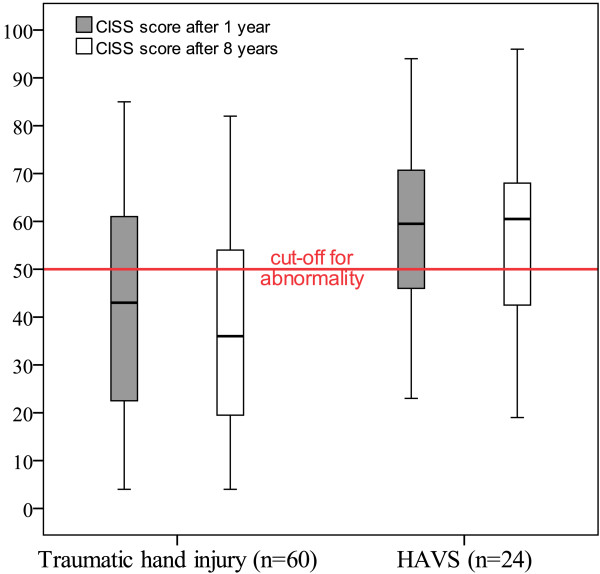
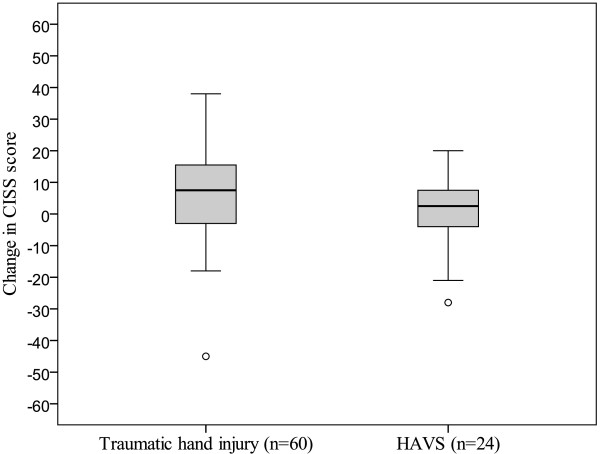
There was a significant change in total CISS score for patients with traumatic hand injury, indicating fewer problems with cold sensitivity over time. Symptoms, such as stiffness, weakness and skin colour change on cold exposure, caused fewer problems, but perceived pain/aching and numbness remained unchanged as well as time needed for relief of symptoms on return to a warm environment. The negative impact of cold sensitivity on daily activities and at work was reduced, but problems when engaged in hobbies or when being exposed to cold wintry weather remained unchanged. None of the investigated predictors related to the hand injury were significantly associated with a change in cold sensitivity at the 8-year follow up. In contrast, no significant change in cold sensitivity was noted in the patients with HAVS for any of the situations included in the CISS questionnaire. A lower sense of coherence score correlated significantly with worse cold sensitivity (CISS score) in both patient groups.
The negative impact of cold sensitivity on daily life was reduced for patients with traumatic hand injury, but did not change over time in patients with HAVS. A low SOC is associated with worse cold sensitivity in such groups of patients. Information about relieving strategies should be provided for patients with cold sensitivity.
手部受伤后,对寒冷敏感是常见的主诉。我们的目的是调查手部受伤8年后以及同期接受手臂振动综合征(HAVS)治疗的患者长期自我报告的寒冷敏感性、其预测因素以及连贯感(SOC)的重要性。
对手部受伤患者(n = 64)和HAVS患者(n = 26)进行了不耐寒症状严重程度(CISS)问卷和连贯感(SOC)问卷的调查。使用曼-惠特尼U检验来确定亚组之间的显著差异。在分析寒冷敏感性严重程度的预测因素时,对定量预测变量使用斯皮尔曼等级相关性(rS系数),对二分变量使用曼-惠特尼U检验,对多个分类数据使用克鲁斯卡尔-沃利斯检验。使用威尔科克森符号秩检验来研究结果的纵向变化。
手部创伤患者的CISS总分有显著变化,表明随着时间推移,寒冷敏感性问题减少。诸如僵硬、无力和寒冷暴露时皮肤颜色变化等症状引起的问题减少,但感觉到的疼痛/酸痛和麻木以及回到温暖环境后症状缓解所需的时间保持不变。寒冷敏感性对日常活动和工作的负面影响有所降低,但从事爱好活动或暴露在寒冷的冬季天气时的问题保持不变。在8年随访中,与手部损伤相关的所有调查预测因素均与寒冷敏感性变化无显著关联。相比之下,HAVS患者在CISS问卷所包括的任何情况下,寒冷敏感性均无显著变化。在两个患者组中,较低的连贯感得分均与较差的寒冷敏感性(CISS得分)显著相关。
手部创伤患者中,寒冷敏感性对日常生活的负面影响有所降低,但HAVS患者的寒冷敏感性并未随时间变化。在这类患者群体中,低SOC与较差的寒冷敏感性相关。应为寒冷敏感患者提供缓解策略的信息。