Laboratorio de Inmunodeficiencias y Retrovirus Humanos, Centro de Investigación Biomédica de Occidente, CMNO, IMSS, Guadalajara 44340, México.
BMC Bioinformatics. 2014 Mar 15;15:72. doi: 10.1186/1471-2105-15-72.
The correlations of genotypic and phenotypic tests with treatment, clinical history and the significance of mutations in viruses of HIV-infected patients are used to establish resistance mutations to protease inhibitors (PIs). Emerging mutations in human immunodeficiency virus type 1 (HIV-1) protease confer resistance to PIs by inducing structural changes at the ligand interaction site. The aim of this study was to establish an in silico structural relationship between natural HIV-1 polymorphisms and unusual HIV-1 mutations that confer resistance to PIs.
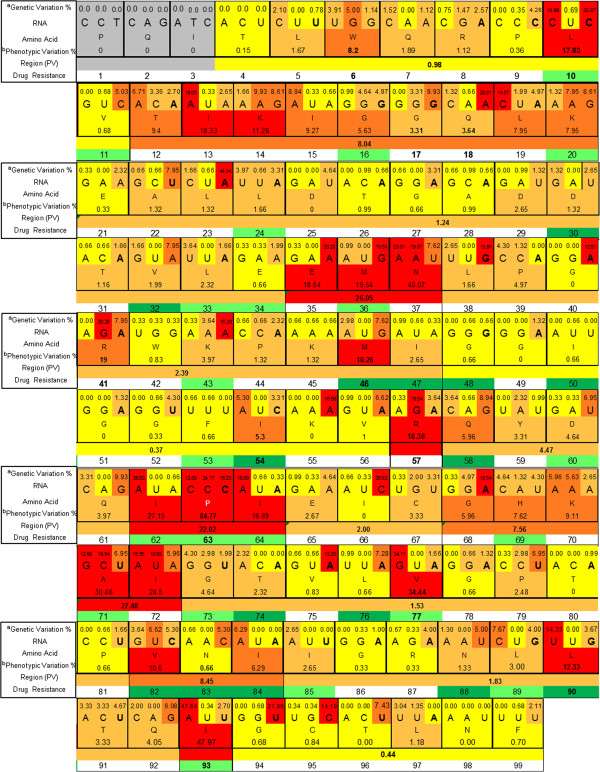
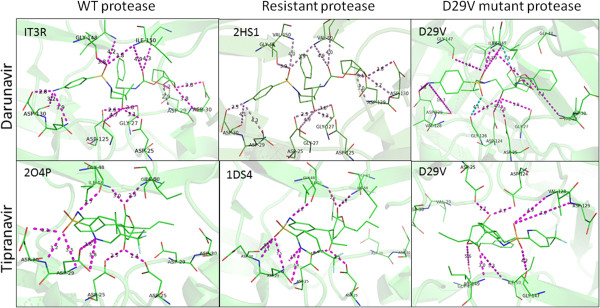
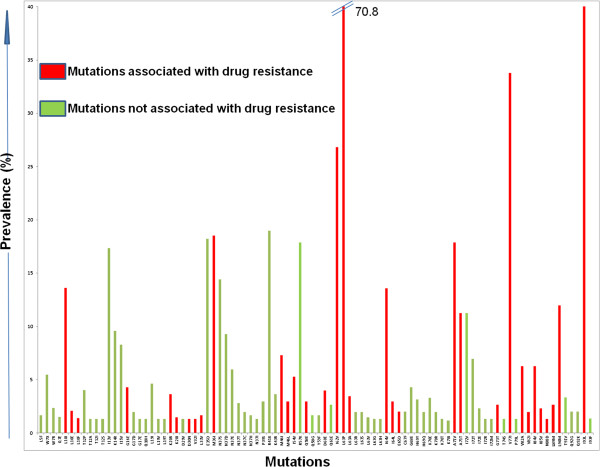
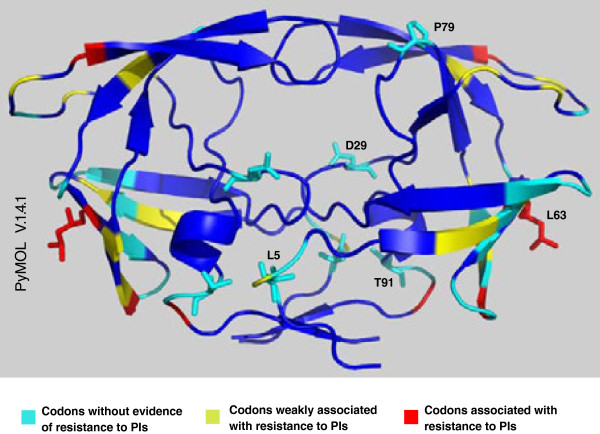
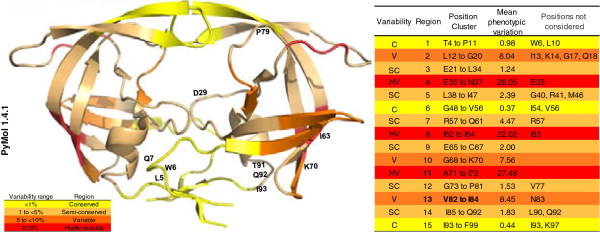
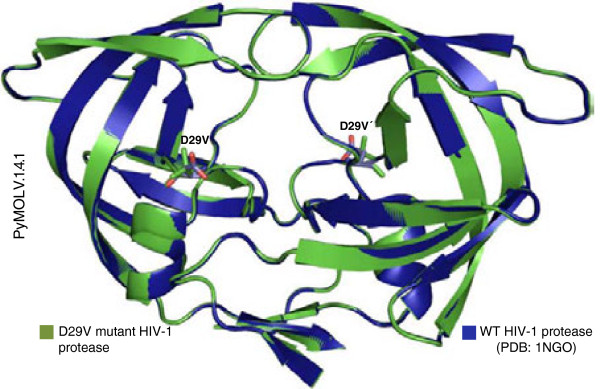
Protease sequences isolated from 151 Mexican HIV-1 patients that were naïve to, or subjected to antiretroviral therapy, were examined. We identified 41 unrelated resistance mutations with a prevalence greater than 1%. Among these mutations, nine exhibited positive selection, three were natural polymorphisms (L63S/V/H) in a codon associated with drug resistance, and six were unusual mutations (L5F, D29V, L63R/G, P79L and T91V). The D29V mutation, with a prevalence of 1.32% in the studied population, was only found in patients treated with antiretroviral drugs. Using in silico modelling, we observed that D29V formed unstable protease complexes when were docked with lopinavir, saquinavir, darunavir, tipranavir, indinavir and atazanavir.
The structural correlation of natural polymorphisms and unusual mutations with drug resistance is useful for the identification of HIV-1 variants with potential resistance to PIs. The D29V mutation likely confers a selection advantage in viruses; however, in silico, presence of this mutation results in unstable enzyme/PI complexes, that possibly induce resistance to PIs.
对 HIV 感染者病毒的基因型和表型检测与治疗、临床病史以及突变的意义相关,从而确定对蛋白酶抑制剂(PI)的耐药突变。人类免疫缺陷病毒 1 型(HIV-1)蛋白酶的新出现突变通过诱导配体相互作用位点的结构变化而赋予对 PI 的耐药性。本研究旨在建立 HIV-1 天然多态性与赋予 PI 耐药性的不寻常 HIV-1 突变之间的计算结构关系。
对 151 名未接受或接受过抗逆转录病毒治疗的墨西哥 HIV-1 患者的分离蛋白酶序列进行了检查。我们鉴定了 41 个与耐药相关的非同义突变,其发生率大于 1%。在这些突变中,有 9 个发生了正选择,3 个是与耐药相关的密码子中的天然多态性(L63S/V/H),6 个是不寻常的突变(L5F、D29V、L63R/G、P79L 和 T91V)。在所研究的人群中,D29V 突变的发生率为 1.32%,仅在接受抗逆转录病毒药物治疗的患者中发现。通过计算模型,我们观察到当与洛匹那韦、沙奎那韦、达芦那韦、替拉那韦、茚地那韦和阿扎那韦对接时,D29V 突变形成不稳定的蛋白酶复合物。
对天然多态性和不寻常突变与耐药性的结构相关性的研究有助于识别对 PI 具有潜在耐药性的 HIV-1 变体。D29V 突变可能赋予病毒选择优势;然而,在计算模型中,这种突变的存在导致酶/PI 复合物不稳定,可能诱导对 PI 的耐药性。