Neuparth Maria João, Proença Jorge Brandão, Santos-Silva Alice, Coimbra Susana
Centro de Investigação em Actividade Física, Saúde e Lazer, Universidade do Porto, Rua Dr. Plácido Costa 91, 4200-450 Porto, Portugal ; Centro de Investigação das Tecnologias da Saúde (CITS), Instituto Politécnico da Saúde do Norte (IPSN), Cooperativa de Ensino Superior, Politécnico e Universitário (CESPU), Rua José António Vidal 81, 4760-409 Vila Nova de Famalicão, Portugal.
Instituto Superior de Ciências da Saúde Norte (ISCS-N), CESPU, Rua Central de Gandra 1317, 4585-116 Gandra, Portugal.
ISRN Obes. 2013 Jan 17;2013:142097. doi: 10.1155/2013/142097. eCollection 2013.
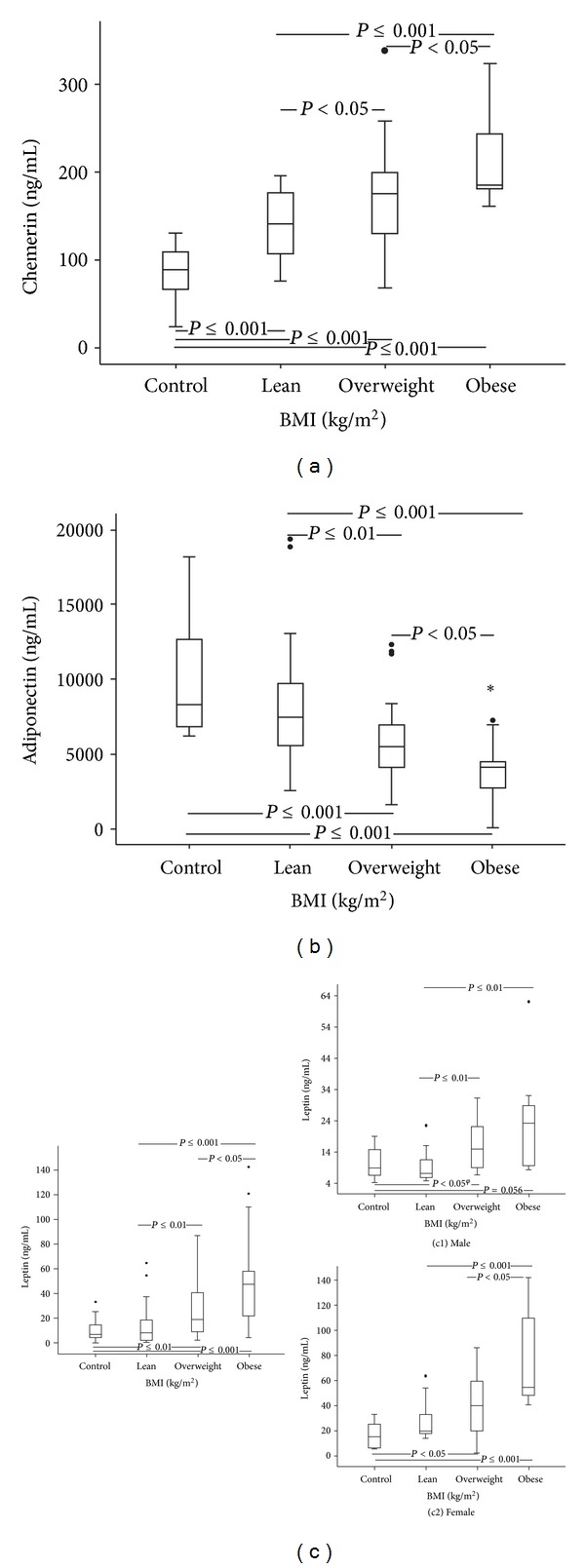
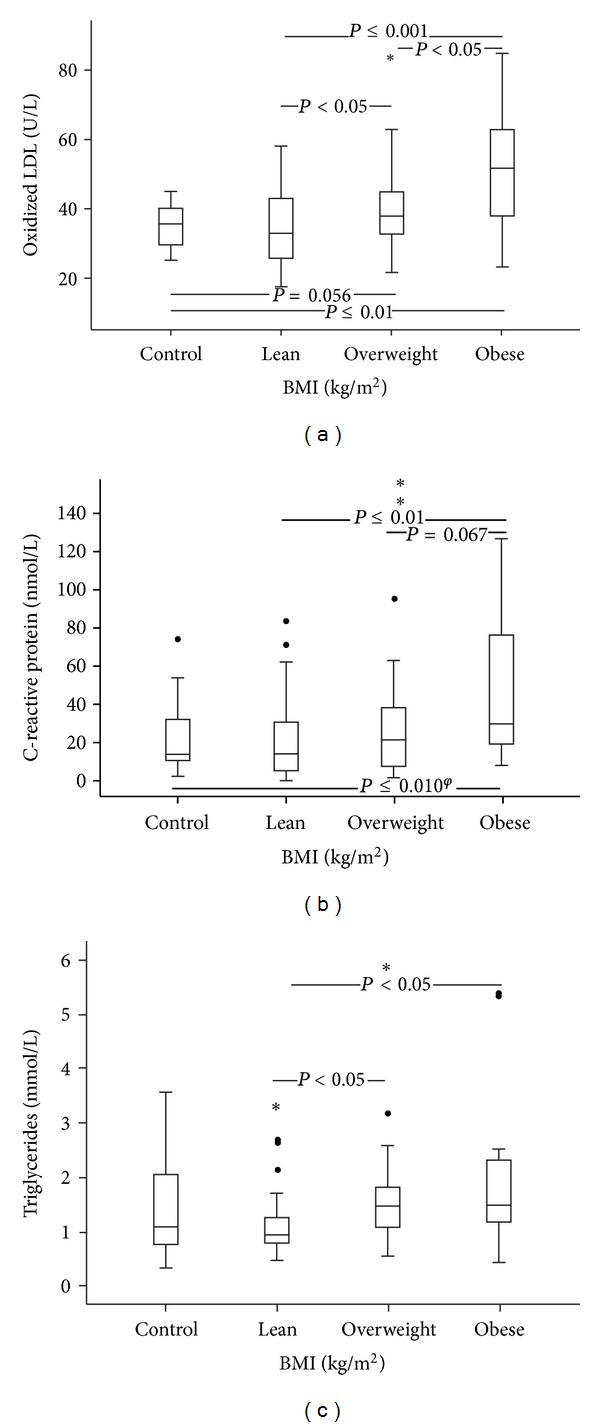
Aim. Our aim was to study how different BMI scores may influence the levels of inflammation, oxidative stress, adipogenesis, glucose, and lipid metabolism, in lean, overweight, and obese Portuguese patients with type 2 diabetes mellitus (T2DM). Methods. We studied 28 lean, 38 overweight, and 17 obese patients with T2DM and 20 controls (gender and age matched). The circulating levels of oxLDL, CRP, and some adipokines-adiponectin, leptin, and chemerin-and the lipid profile were evaluated. Results. Obese patients presented significantly lower levels of adiponectin and higher leptin, oxLDL, and chemerin levels, as compared to the overweight, lean, and control groups. Overweight, compared to lean and control, subjects showed significantly lower adiponectin and higher leptin and chemerin levels; oxLDL values were significantly higher in overweight than in lean patients. Lean patients presented significantly higher chemerin values than the control. Obese patients presented significantly higher CRP values, as compared to lean patients and the control group. Obese and overweight patients presented significantly higher triglycerides values than lean patients. Except for CRP, all the observed significant changes between control and patients remained significant after statistical adjustment for the body mass index (BMI). Conclusion. The levels of leptin, adiponectin, oxLDL, CRP, and triglycerides in patients with T2DM seem to be more associated with obesity and less with diabetes. Chemerin levels were raised in lean, overweight, and obese patients, suggesting that, independently of BMI, an adipocyte dysfunction occurs. Moreover, chemerin may provide an important early biomarker of adipocyte dysfunction and a link between obesity and type 2 diabetes mellitus.
目的。我们的目的是研究不同的体重指数(BMI)评分如何影响葡萄牙的2型糖尿病(T2DM)瘦型、超重和肥胖患者的炎症、氧化应激、脂肪生成、葡萄糖及脂质代谢水平。方法。我们研究了28例T2DM瘦型患者、38例超重患者、17例肥胖患者以及20名对照者(性别和年龄匹配)。评估了氧化型低密度脂蛋白(oxLDL)、C反应蛋白(CRP)以及一些脂肪因子(脂联素、瘦素和趋化素)的循环水平和血脂谱。结果。与超重、瘦型和对照组相比,肥胖患者的脂联素水平显著降低,瘦素、oxLDL和趋化素水平升高。与瘦型和对照组相比,超重受试者的脂联素水平显著降低,瘦素和趋化素水平升高;超重患者的oxLDL值显著高于瘦型患者。瘦型患者的趋化素值显著高于对照组。与瘦型患者和对照组相比,肥胖患者的CRP值显著升高。肥胖和超重患者的甘油三酯值显著高于瘦型患者。除CRP外,在对体重指数(BMI)进行统计调整后,对照组与患者之间观察到的所有显著变化仍然显著。结论。T2DM患者的瘦素、脂联素、oxLDL、CRP和甘油三酯水平似乎与肥胖的关联更大,与糖尿病的关联较小。瘦型、超重和肥胖患者的趋化素水平均升高,这表明无论BMI如何,均存在脂肪细胞功能障碍。此外,趋化素可能是脂肪细胞功能障碍的重要早期生物标志物,也是肥胖与2型糖尿病之间的一个联系。