School of Physics and Astronomy, Nottingam, UK.
SISTEMIC, Engineering Faculty, Universidad de Antioquia, Medellín, Colombia.
Neuroimage. 2014 Jul 1;94:89-95. doi: 10.1016/j.neuroimage.2014.02.033. Epub 2014 Mar 14.
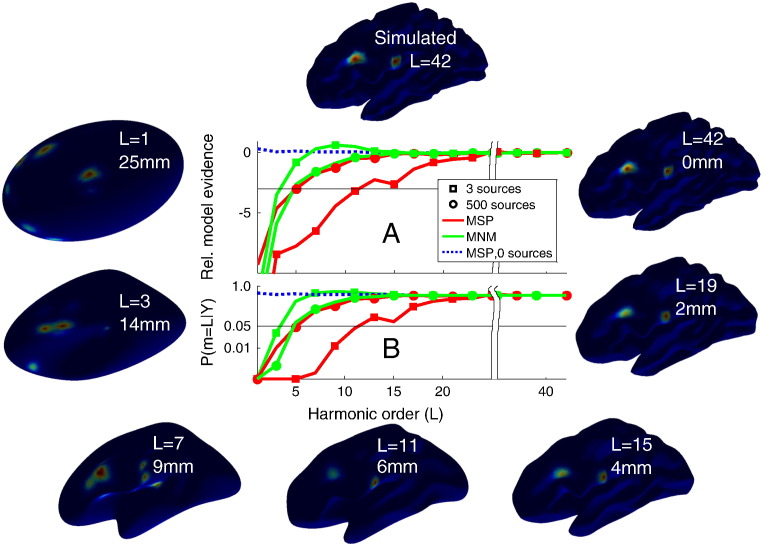
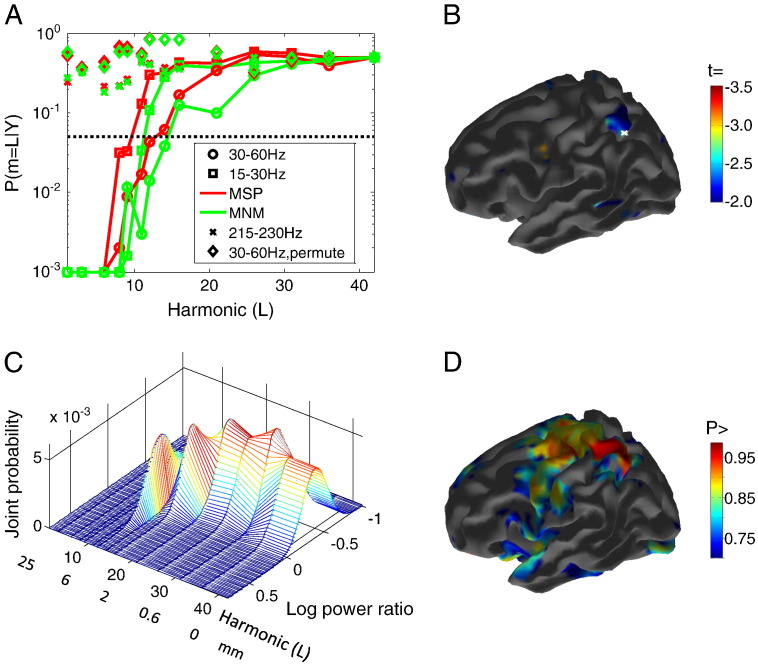
There are now a number of non-invasive methods to image human brain function in-vivo. However, the accuracy of these images remains unknown and can currently only be estimated through the use of invasive recordings to generate a functional ground truth. Neuronal activity follows grey matter structure and accurate estimates of neuronal activity will have stronger support from accurate generative models of anatomy. Here we introduce a general framework that, for the first time, enables the spatial distortion of a functional brain image to be estimated empirically. We use a spherical harmonic decomposition to modulate each cortical hemisphere from its original form towards progressively simpler structures, ending in an ellipsoid. Functional estimates that are not supported by the simpler cortical structures have less inherent spatial distortion. This method allows us to compare directly between magnetoencephalography (MEG) source reconstructions based upon different assumption sets without recourse to functional ground truth.
现在有许多非侵入性的方法可以在体内对人类大脑功能进行成像。然而,这些图像的准确性仍然未知,目前只能通过使用侵入性记录来生成功能的真实情况来估计。神经元活动遵循灰质结构,并且对神经元活动的准确估计将从解剖结构的准确生成模型中得到更有力的支持。在这里,我们介绍了一个通用框架,该框架首次能够经验性地估计功能脑图像的空间变形。我们使用球谐分解将每个大脑半球从其原始形式调制到逐渐更简单的结构,最终形成一个椭球体。不受更简单的皮质结构支持的功能估计具有较小的固有空间变形。该方法使我们能够直接比较基于不同假设集的脑磁图(MEG)源重建,而无需诉诸功能真实情况。