Aibar Alberto, Chanal Julien
University of Geneva, Geneva, Switzerland.
University of Geneva, Geneva, Switzerland; Distance Learning University, Brig, Switzerland.
PLoS One. 2015 Apr 13;10(4):e0121238. doi: 10.1371/journal.pone.0121238. eCollection 2015.
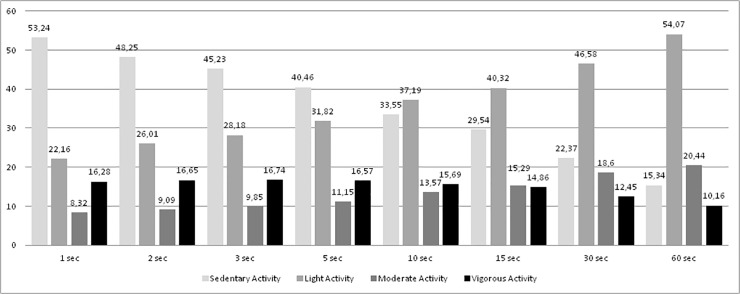
Despite a consensus emerging that affirms that shorter epochs should be used in youth to correctly register physical activity levels in free-living conditions, little is known about its effect on children's physical activity conducted in structured periods of time. This study analyzed the effect that epoch length (1, 2, 3, 5, 10, 15, 30 and 60s) may have on different physical activity intensities in physical education lessons.
A sample of 1912 individual measures of physical education lessons were measured with a GT3X accelerometer. Data were collected from 1227 Swiss Elementary school students recruited in 17 elementary schools. PE lessons lasted from 45 minutes to one and a half hours. Data, originally collected in 1-s epoch, were then reintegrated into 2s, - 3s - 5s - 10s - 15s - 30s -60s epochs.
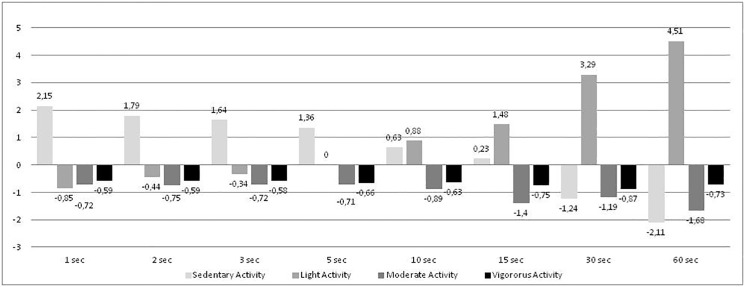
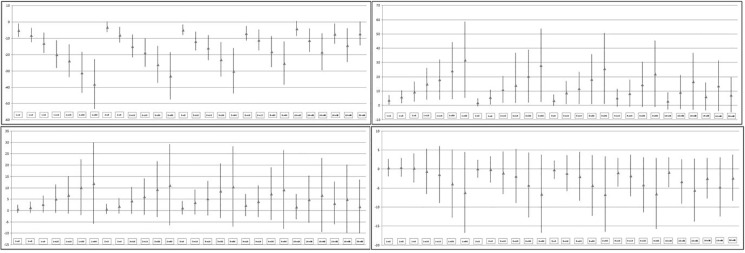
Longer epochs were associated with higher levels of light (F = 8197.6, p < .001), moderate (F = 2708.17, p < .001), and moderate-to-vigorous physical activity (F = 888.08, p < .001). However, longer epochs showed lower levels of sedentary activity (F = 31714.33, p < .001) and vigorous physical activity (F = 1910.97, p < .001). Bias increased in all PA intensities when shorter epochs were compared with longer epochs. There were statistically significant differences in compliance with physical education guidelines (χ(2) = 989.27, p<.001), showing higher levels with longer epochs.
PA context may have some influence on the effects that epoch length have on PA estimates, more specifically on MVPA. Nevertheless, the use of a high-frequency sampling interval should be used to more accurately assess children's PA.
尽管已达成共识,即应采用较短的时间间隔来准确记录青少年在自由生活条件下的身体活动水平,但对于其在结构化时间段内对儿童身体活动的影响知之甚少。本研究分析了时间间隔长度(1、2、3、5、10、15、30和60秒)对体育课中不同身体活动强度的影响。
使用GT3X加速度计对1912节体育课的个体测量数据进行了采样。数据收集自17所小学招募的1227名瑞士小学生。体育课持续45分钟至一个半小时。最初以1秒时间间隔收集的数据随后被重新整合为2秒、3秒、5秒、10秒、15秒、30秒和60秒的时间间隔。
较长的时间间隔与较高水平的轻度(F = 8197.6,p <.001)、中度(F = 2708.17,p <.001)和中等到剧烈身体活动(F = 888.08,p <.001)相关。然而,较长的时间间隔显示出较低水平的久坐活动(F = 31714.33,p <.001)和剧烈身体活动(F = 1910.97,p <.001)。与较长时间间隔相比,较短时间间隔时所有身体活动强度的偏差均增加。在体育教育指南的依从性方面存在统计学显著差异(χ(2) = 989.27,p<.001),较长时间间隔时显示出更高的水平。
身体活动背景可能对时间间隔长度对身体活动估计的影响有一定作用,更具体地说是对中等到剧烈身体活动的影响。尽管如此,应使用高频采样间隔来更准确地评估儿童的身体活动。