Koh Hyung-Woo, Cho Sung-Hyoun, Kim Cheol-Yong
Department of Physical Therapy, Graduate School of Physical Therapy, Daegu University, Republic of Korea.
Department of Physical Therapy, Ulsan College, Republic of Korea.
J Phys Ther Sci. 2014 Feb;26(2):295-9. doi: 10.1589/jpts.26.295. Epub 2014 Feb 28.
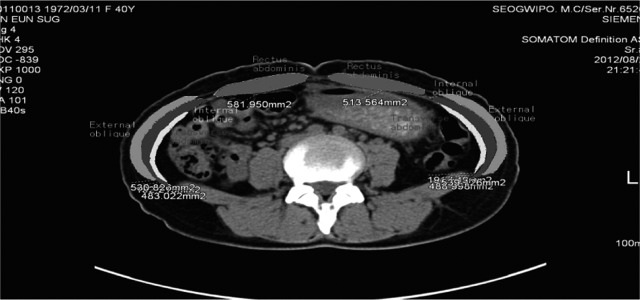
[Purpose] The purpose of this study was to examine the effects of hollowing and bracing exercises on cross-sectional areas of abdominal muscles. [Subjects] Thirty healthy female adults participated in this study. The exclusion criteria were orthopedic or neurologic diseases. [Methods] The subjects of this study were assigned randomly to one of two groups, each with 15 people. Each group performed a 60-minute exercise program, one performed a bracing exercise, and the other performed a hollowing exercise, with both groups performing the exercise three times a week for six weeks. [Results] The changes in cross-sectional areas after the bracing exercise showed statistically significant differences in the left rectus abdominis and both internal and external obliques. The changes in cross-sectional areas after the hollowing exercise showed statistically significant differences in the left and right transversus abdominis and left rectus abdominis. [Conclusion] Performing bracing exercises rather than hollowing exercises is more effective for activating the abdominal muscles.
[目的]本研究旨在探讨收腹和支撑练习对腹部肌肉横截面积的影响。[对象]30名健康成年女性参与了本研究。排除标准为骨科或神经疾病。[方法]本研究的受试者被随机分为两组,每组15人。每组进行60分钟的锻炼计划,一组进行支撑练习,另一组进行收腹练习,两组均每周进行3次练习,共持续6周。[结果]支撑练习后横截面积的变化在左侧腹直肌以及腹内斜肌和腹外斜肌上均显示出统计学上的显著差异。收腹练习后横截面积的变化在左右腹横肌和左侧腹直肌上显示出统计学上的显著差异。[结论]进行支撑练习而非收腹练习对激活腹部肌肉更有效。