Department of Pathology and Laboratory Medicine, University of Rochester Medical Center, Rochester, New York, United States of America; Department of Biomedical Engineering, University of Rochester, Rochester, New York, United States of America.
Department of Pathology and Laboratory Medicine, University of Rochester Medical Center, Rochester, New York, United States of America.
PLoS One. 2014 Mar 21;9(3):e91234. doi: 10.1371/journal.pone.0091234. eCollection 2014.
The obesity epidemic has resulted in a large increase in type 2 diabetes (T2D). While some secondary complications of T2D are well recognized and their cellular and molecular mechanisms are defined, the impact of T2D on the musculoskeletal system is less understood. Clinical evidence suggests that tendon strength and repair are compromised. Here, a mouse model of obesity and T2D recapitulates the deleterious effects of this condition on tendon repair.
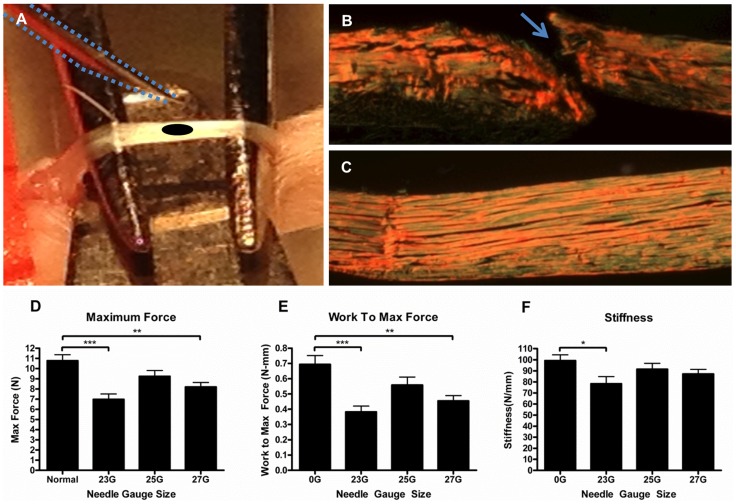
Male C57BL/6J mice at 5 weeks of age were placed on a high fat (HF)(60% kcal) or low fat (10% kcal) diet for 12 weeks. The flexor digitorum longus (FDL) tendon was then injured by puncturing it with a beveled needle. Progression of FDL tendon healing was assessed through biomechanical and histological analysis at 0, 7, 14 and 28 days post-injury.
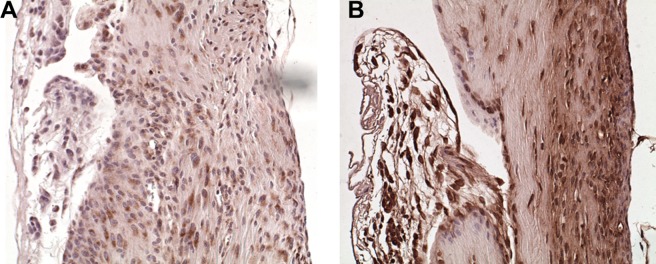
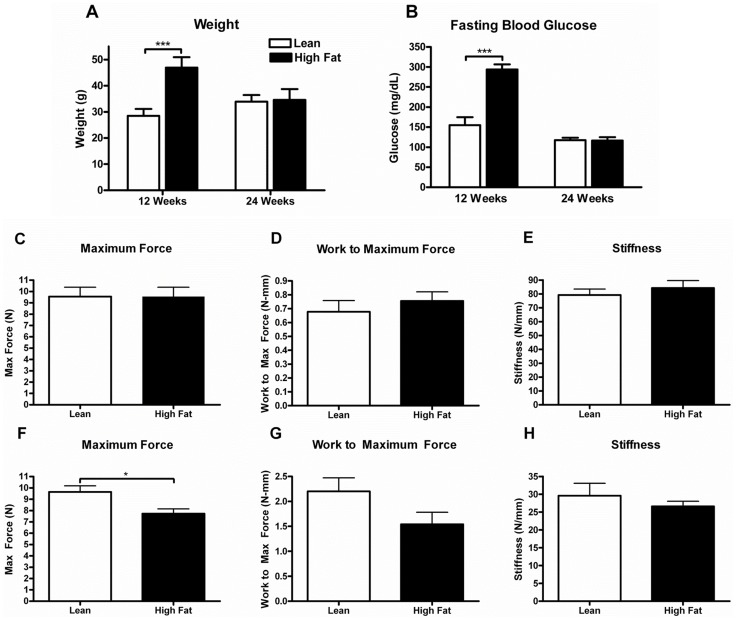
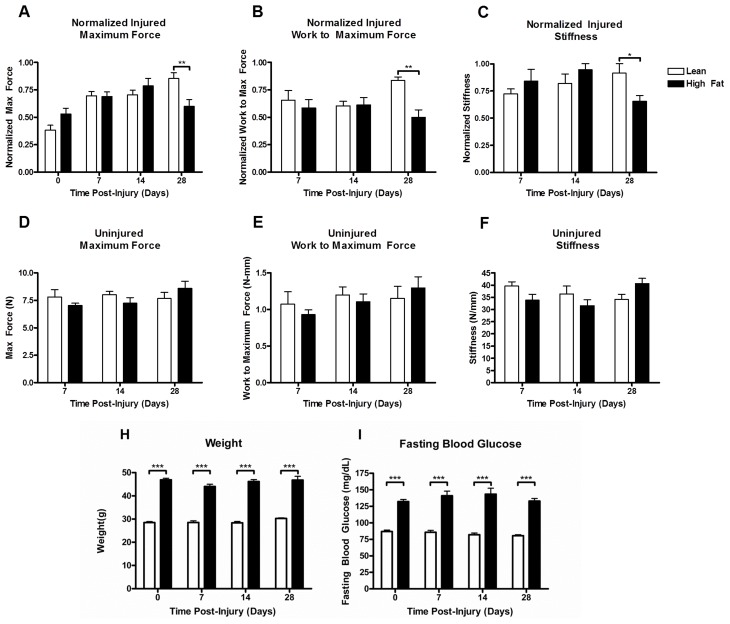
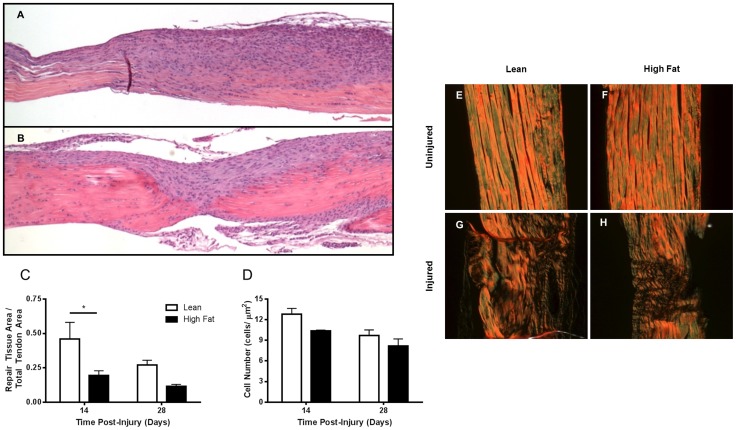
HF-fed mice displayed increased body weight and elevated fasting glucose levels, both consistent with T2D. No differences in biomechanical properties of the uninjured FDL tendon were observed after 12 weeks on HF versus lean diets, but decreased maximum force in uninjured tendons from HF-fed mice was observed at 24 weeks. Following puncture injury, tendons from HF-fed mice displayed impaired biomechanical properties at day 28 post injury. In support of defective repair in the HF-fed mice, histological examination of the injury site showed a smaller area of repair and lower cell content in the repair area of HF-fed mice. Insulin receptors were expressed in most cells at the injury site regardless of diet.
The HF-diet mouse model of obesity and T2D reproduces the impaired tendon healing that is observed in this patient population. The exact mechanism is unknown, but we hypothesize that a cellular defect, perhaps involving insulin resistance, leads to decreased proliferation or recruitment to the injury site, and ultimately contributes to defective tendon healing.
肥胖症的流行导致 2 型糖尿病(T2D)的大量增加。虽然 T2D 的一些继发性并发症已得到广泛认识,其细胞和分子机制也已确定,但 T2D 对肌肉骨骼系统的影响还不太清楚。临床证据表明,肌腱强度和修复能力受损。在这里,肥胖症和 T2D 的小鼠模型再现了这种疾病对肌腱修复的有害影响。
5 周龄雄性 C57BL/6J 小鼠被置于高脂肪(HF)(60%卡路里)或低脂肪(10%卡路里)饮食中 12 周。然后用斜角针刺穿屈肌肌腱(FDL)肌腱造成损伤。通过生物力学和组织学分析在损伤后 0、7、14 和 28 天评估 FDL 肌腱愈合的进展。
HF 喂养的小鼠表现出体重增加和空腹血糖升高,这两种情况都与 T2D 一致。在 HF 与瘦饮食 12 周后,未受伤的 FDL 肌腱的生物力学特性没有差异,但 HF 喂养的小鼠未受伤的肌腱在 24 周时最大力下降。在穿刺损伤后,HF 喂养的小鼠的肌腱在损伤后 28 天显示出受损的生物力学特性。支持 HF 喂养的小鼠修复有缺陷,损伤部位的组织学检查显示 HF 喂养的小鼠修复区域的修复面积较小,细胞含量较低。无论饮食如何,胰岛素受体在损伤部位的大多数细胞中都有表达。
HF 饮食肥胖症和 T2D 的小鼠模型再现了在这种患者人群中观察到的受损的肌腱愈合。确切的机制尚不清楚,但我们假设细胞缺陷,可能涉及胰岛素抵抗,导致增殖或募集到损伤部位减少,并最终导致肌腱愈合不良。