Department of Medicine, Pulmonary and Critical Care Medicine, University Medical Center Giessen and Marburg, Philipps-University Marburg, Member of the German Center for Lung Research (DZL), Marburg, Germany.
Respir Res. 2014 Mar 25;15(1):36. doi: 10.1186/1465-9921-15-36.
Pulmonary rehabilitation has been demonstrated to improve exercise capacity, dyspnoea, quality of life and to reduce the adverse effects of acute exacerbations. Current guidelines recommend exercise training in patients with mild to very severe disease. However, there is insufficient data comparing the efficacy of different training approaches and intensities.
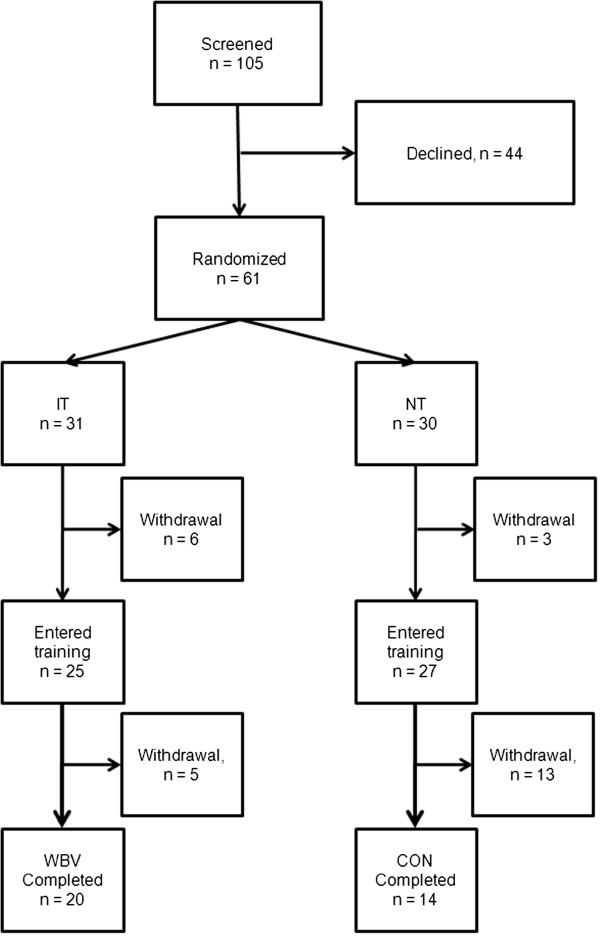
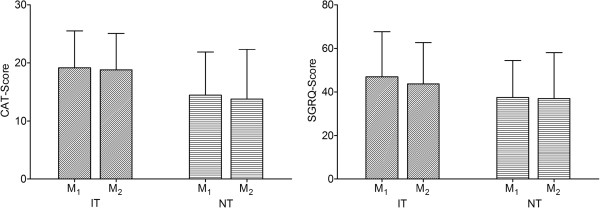
Between January 2009 and December 2012, 105 COPD patients were screened to participate in the study. 61 patients were randomly assigned into an individualized training group or into a non-individualized training group. Both groups exercised once a week for 60 minutes over a time period of three months. At the beginning and after three months, the following measurements were performed: 6-minute walking test (6-MWT), health-related quality of life (St. Georges Respiratory Questionnaire; SGRQ and COPD-Assessment-Test; CAT), M. rectus femoris cross-sectional area, and inflammatory markers in peripheral blood.
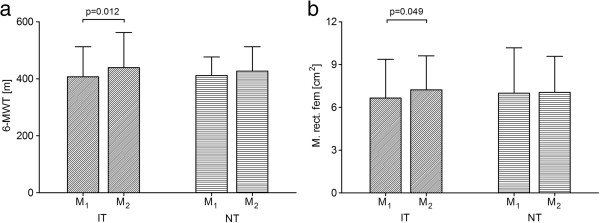
Only in the individualized training group we observed a significant change of the 6-MWT (increase of 32.47 m; p = 0.012) and the cross-sectional area of the M. rectus fermoris (increase of 0.57 cm2; p = 0.049), while no significant changes occurred in the non-individualized training group. Peroxisome-proliferator-activated receptor-γ coactivator 1α increased in the individualized training only after the three months training period (increase of 0.43 relative copies; p = 0.017), all other myokines and inflammatory markers were not influenced by either of the programs. The total drop-out-rate was 44.3%.
A low frequency outpatient training program may induce modest improvements in exercise capacity and muscle mass only if it is performed on an individualized basis.
肺康复已被证明可改善运动能力、呼吸困难、生活质量,并减少急性加重的不利影响。目前的指南建议在轻度至非常严重疾病的患者中进行运动训练。然而,对于不同训练方法和强度的疗效比较,数据还不够充分。
在 2009 年 1 月至 2012 年 12 月期间,筛选了 105 例 COPD 患者参与该研究。61 例患者被随机分配到个体化训练组或非个体化训练组。两组患者每周进行一次训练,每次 60 分钟,持续 3 个月。在开始和 3 个月后,进行以下测量:6 分钟步行测试(6-MWT)、健康相关生活质量(圣乔治呼吸问卷;SGRQ 和 COPD 评估测试;CAT)、股直肌横截面面积和外周血中的炎症标志物。
仅在个体化训练组中,我们观察到 6-MWT(增加 32.47m;p=0.012)和股直肌横截面面积(增加 0.57cm2;p=0.049)有显著变化,而非个体化训练组则无显著变化。过氧化物酶体增殖物激活受体-γ共激活因子 1α仅在个体化训练 3 个月后增加(相对拷贝增加 0.43;p=0.017),所有其他肌因子和炎症标志物均不受任何方案的影响。总的脱落率为 44.3%。
如果是基于个体化的方式进行低频率的门诊训练计划,可能会适度改善运动能力和肌肉质量。