Sierra Carlos, Bernal María-José, Blasco Javier, Martínez Rosario, Dalmau Jaime, Ortuño Inmaculada, Espín Beatriz, Vasallo María-Isabel, Gil David, Vidal María-Luisa, Infante Dámaso, Leis Rosaura, Maldonado José, Moreno José-Manuel, Román Enriqueta
Hospital Materno-Infantil, Avda. Arroyo de los Ángeles s/n, 29011, Málaga, Spain.
Eur J Nutr. 2015 Feb;54(1):89-99. doi: 10.1007/s00394-014-0689-9. Epub 2014 Mar 27.
Currently, there is no consensus concerning the possible beneficial colonic and systemic effects of prebiotic-containing infant formula. This study assesses whether the feeding of a galactooligosaccharides (GOS)-containing infant formula (0.44 g/dl of GOS) and the subsequent feeding of a GOS-containing follow-on formula (0.50 g/dl of GOS) have a prebiotic effect on intestinal microbiota that helps to decrease infections and allergy manifestations in healthy infants during the first year of life.
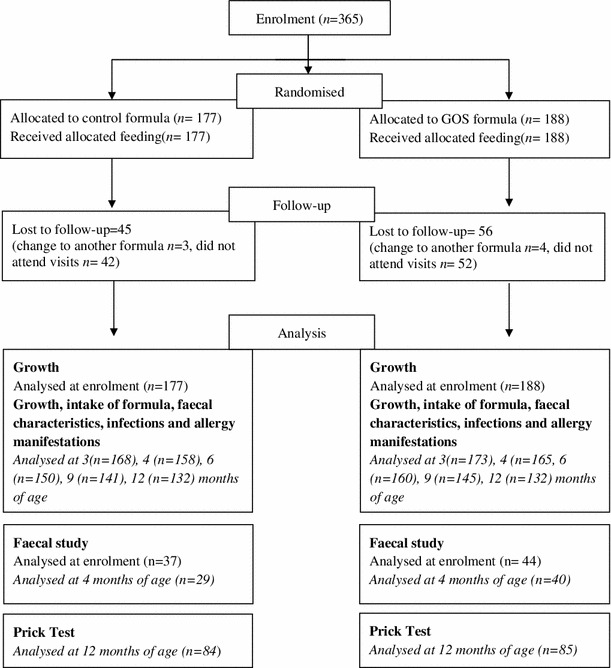
A multicentre, randomised, double-blind and placebo-controlled trial was carried out on 365 healthy term infants enrolled before 8 weeks of age and randomly assigned to a formula with or without GOS, until 12 months of age. The incidence of infections and allergy manifestations, the antibiotics prescribed and faecal characteristics were recorded up to 12 months of age, while faecal samples were collected up to 4 months for the measurement of secretory immunoglobulin A, short-chain fatty acids and microbiota.
A prebiotic effect on the faecal analysis was observed at 4 months of life. The GOS group showed a lower faecal pH (P = 0.019), a lower decreasing trend in secretory immunoglobulin A (P = 0.078), lower butyric acid concentration (P = 0.040) and an increase in Bifidobacterium counts (P = 0.010). Changes in faecal characteristics involved greater frequency (P < 0.001) and softer consistency (P < 0.05). The incidence of infections or allergic manifestations during the first year of life was similar in both groups, with no statistical differences (P > 0.05).
The feeding of GOS-containing infant formula produced a definite prebiotic effect consisting of changes in faecal composition and microbiota, and in faecal consistency and the frequency of defaecation. No changes in the incidence of infection or allergic manifestation during the first year of life were observed.
目前,关于含益生元的婴儿配方奶粉可能对结肠及全身产生的有益影响尚无定论。本研究评估含低聚半乳糖(GOS)的婴儿配方奶粉(0.44克/分升GOS)喂养以及随后含GOS的后续配方奶粉(0.50克/分升GOS)喂养是否对肠道微生物群具有益生元效应,有助于降低健康婴儿在生命第一年的感染和过敏表现。
对365名8周龄前入组的健康足月儿进行了一项多中心、随机、双盲和安慰剂对照试验,将其随机分配至含或不含GOS的配方奶粉组,直至12月龄。记录至12月龄时的感染和过敏表现发生率、开具的抗生素以及粪便特征,同时在4月龄前收集粪便样本以测量分泌型免疫球蛋白A、短链脂肪酸和微生物群。
在4月龄时观察到对粪便分析有益生元效应。GOS组粪便pH值较低(P = 0.019),分泌型免疫球蛋白A的下降趋势较低(P = 0.078),丁酸浓度较低(P = 0.040),双歧杆菌计数增加(P = 0.010)。粪便特征的变化包括排便频率更高(P < 0.001)和质地更软(P < 0.05)。两组在生命第一年的感染或过敏表现发生率相似,无统计学差异(P > 0.05)。
含GOS的婴儿配方奶粉喂养产生了明确的益生元效应,包括粪便成分和微生物群的变化,以及粪便质地和排便频率的变化。在生命第一年未观察到感染或过敏表现发生率的变化。