Sharma Sudhaa, Tandon Vishal R, Mahajan Shagun, Mahajan Vivek, Mahajan Annil
Department of Obstetrics and Gynecology, Superspeciality Hospital, GMC, Jammu, Jammu and Kashmir, India.
Department of Pharmacology, Superspeciality Hospital, GMC, Jammu, Jammu and Kashmir, India.
J Midlife Health. 2014 Jan;5(1):6-9. doi: 10.4103/0976-7800.127782.
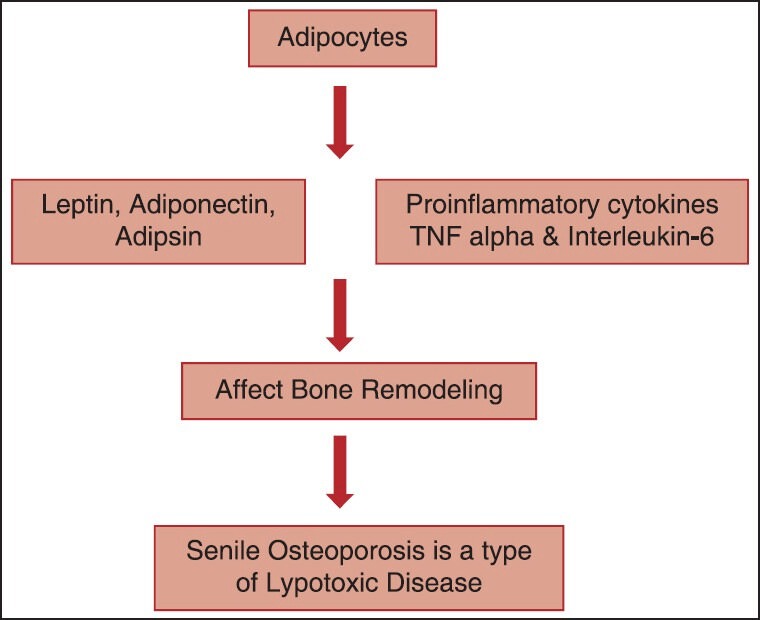
Osteoporosis and obesity are worldwide health problems. Interestingly, both are associated with significant morbidity and mortality. Both the diseases have common linkage as bone marrow mesenchymal stromal cells are the common precursors for both osteoblasts and adipocytes. Aging may shift composition of bone marrow by increasing adipocytes, osteoclast activity, and decreasing osteoblast activity, resulting into osteoporosis. Adipocytes secret leptin, adiponectin, adipsin, as well as proinflammatory cytokines, that contributes in pathogenesis of osteoporosis. This new concept supports the hypothesis, that the positive correlation of weight and body mass index (BMI) with bone mineral density (BMD) is not confirmed by large population-based studies. Thus, the previous concept, that obesity is protective for osteoporosis may not stand same as bone marrow fat deposition (adipogenesis) seen in obesity, is detrimental for bone health.
骨质疏松症和肥胖是全球性的健康问题。有趣的是,两者都与显著的发病率和死亡率相关。这两种疾病存在共同联系,因为骨髓间充质基质细胞是成骨细胞和脂肪细胞的共同前体。衰老可能通过增加脂肪细胞、破骨细胞活性以及降低成骨细胞活性来改变骨髓组成,从而导致骨质疏松症。脂肪细胞分泌瘦素、脂联素、脂肪酶以及促炎细胞因子,这些都在骨质疏松症的发病机制中起作用。这一新概念支持了这样一种假说,即基于大量人群的研究并未证实体重和体重指数(BMI)与骨矿物质密度(BMD)之间存在正相关。因此,先前认为肥胖对骨质疏松症具有保护作用的概念可能不再成立,因为肥胖中出现的骨髓脂肪沉积(脂肪生成)对骨骼健康有害。