Reimers Anne K, Wagner Matthias, Alvanides Seraphim, Steinmayr Andreas, Reiner Miriam, Schmidt Steffen, Woll Alexander
Department of Sport Science, University of Konstanz, Konstanz, Germany; Institute of Sport and Sport Sciences, Karlsruhe Institute of Technology, Karlsruhe, Germany.
Department of Sport Science, University of Konstanz, Konstanz, Germany.
PLoS One. 2014 Mar 27;9(3):e93059. doi: 10.1371/journal.pone.0093059. eCollection 2014.
To assess the relationship between proximity to specific sports facilities and participation in the corresponding sports activities for adolescents in Germany.
A sample of 1,768 adolescents aged 11-17 years old and living in 161 German communities was examined. Distances to the nearest sports facilities were calculated as an indicator of proximity to sports facilities using Geographic Information Systems (GIS). Participation in specific leisure-time sports activities in sports clubs was assessed using a self-report questionnaire and individual-level socio-demographic variables were derived from a parent questionnaire. Community-level socio-demographics as covariates were selected from the INKAR database, in particular from indicators and maps on land development. Logistic regression analyses were conducted to examine associations between proximity to the nearest sports facilities and participation in the corresponding sports activities.
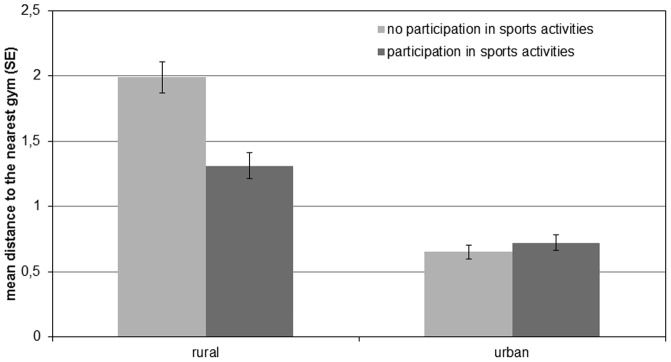
The logistic regression analyses showed that girls residing longer distances from the nearest gym were less likely to engage in indoor sports activities; a significant interaction between distances to gyms and level of urbanization was identified. Decomposition of the interaction term showed that for adolescent girls living in rural areas participation in indoor sports activities was positively associated with gym proximity. Proximity to tennis courts and indoor pools was not associated with participation in tennis or water sports, respectively.
Improved proximity to gyms is likely to be more important for female adolescents living in rural areas.
评估德国青少年居住距离特定体育设施的远近与参与相应体育活动之间的关系。
对居住在德国161个社区的1768名11 - 17岁青少年进行抽样调查。使用地理信息系统(GIS)计算到最近体育设施的距离,以此作为接近体育设施的指标。通过自我报告问卷评估青少年在体育俱乐部参与特定休闲体育活动的情况,并从家长问卷中获取个人层面的社会人口学变量。从INKAR数据库中选取社区层面的社会人口学变量作为协变量,特别是从土地开发指标和地图中选取。进行逻辑回归分析,以检验到最近体育设施的距离与参与相应体育活动之间的关联。
逻辑回归分析表明,居住距离最近健身房较远的女孩参与室内体育活动的可能性较小;发现到健身房的距离与城市化水平之间存在显著交互作用。对交互项的分解表明,对于居住在农村地区的青少年女孩,参与室内体育活动与接近健身房呈正相关。接近网球场和室内游泳池分别与参与网球或水上运动无关。
对于居住在农村地区的女性青少年来说,改善接近健身房的程度可能更为重要。