Li Ryan, Ochs Michael F, Ahn Sun Mi, Hennessey Patrick, Tan Marietta, Soudry Ethan, Gaykalova Daria A, Uemura Mamoru, Brait Mariana, Shao Chunbo, Westra William, Bishop Justin, Fertig Elana J, Califano Joseph A
Department of Otolaryngology-Head and Neck Surgery, Johns Hopkins Medical Institutions, Baltimore, Maryland, United States of America.
Division of Oncology Biostatistics, Department of Oncology, Johns Hopkins Medical Institutions, Baltimore, Maryland, United States of America; Department of Mathematics and Statistics, The College of New Jersey, Ewing, New Jersey, United States of America.
PLoS One. 2014 Mar 27;9(3):e91263. doi: 10.1371/journal.pone.0091263. eCollection 2014.
Prior studies have demonstrated tumor-specific alternative splicing events in various solid tumor types. The role of alternative splicing in the development and progression of head and neck squamous cell carcinoma (HNSCC) is unclear. Our study queried exon-level expression to implicate splice variants in HNSCC tumors.
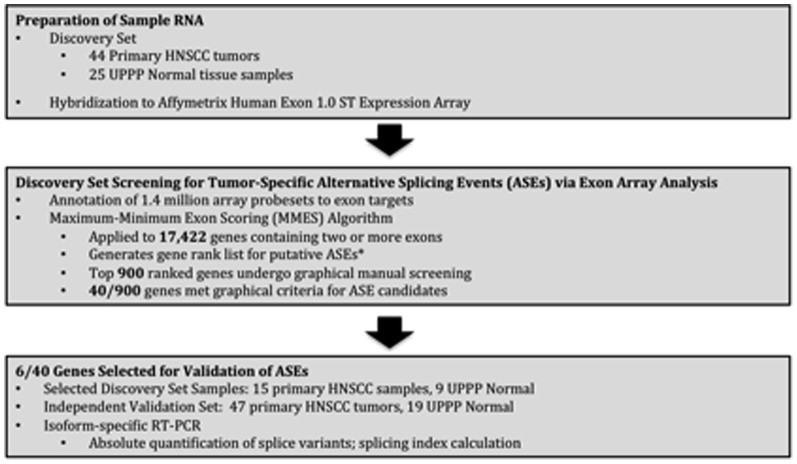
We performed a comparative genome-wide analysis of 44 HNSCC tumors and 25 uvulopalatopharyngoplasty (UPPP) tissue samples at an exon expression level. In our comparison we ranked genes based upon a novel score-the Maximum-Minimum Exon Score (MMES)--designed to predict the likelihood of an alternative splicing event occurring. We validated predicted alternative splicing events using quantitative RT-PCR on an independent cohort.
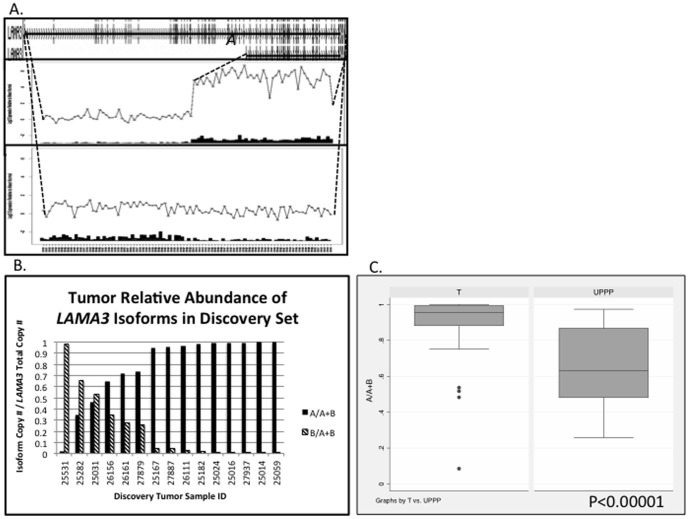
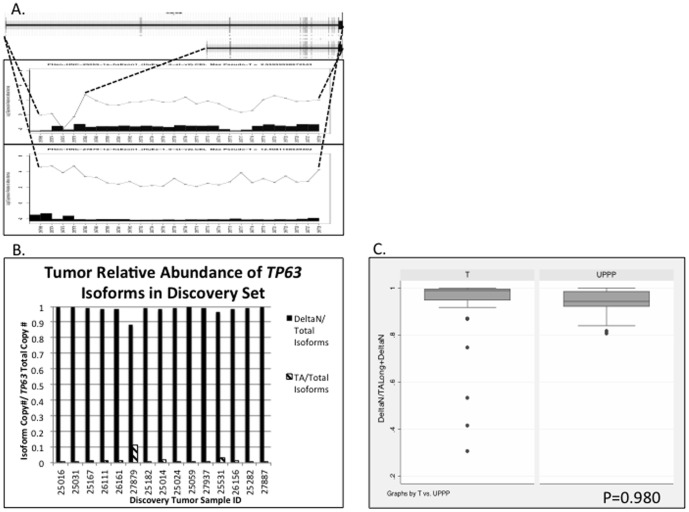
After MMES scoring of 17,422 genes, the top 900 genes with the highest scores underwent additional manual inspection of expression patterns in a graphical analysis. The genes LAMA3, DST, VEGFC, SDHA, RASIP1, and TP63 were selected for further validation studies because of a high frequency of alternative splicing suggested in our graphical analysis, and literature review showing their biological relevance and known splicing patterns. We confirmed TP63 as having dominant expression of the short DeltaNp63 isoform in HNSCC tumor samples, consistent with prior reports. Two of the six genes (LAMA3 and DST) validated by quantitative RT-PCR for tumor-specific alternative splicing events (Student's t test, P<0.001).
Alternative splicing events of oncologically relevant proteins occur in HNSCC. The number of genes expressing tumor-specific splice variants needs further elucidation, as does the functional significance of selective isoform expression.
先前的研究已在多种实体瘤类型中证实了肿瘤特异性可变剪接事件。可变剪接在头颈部鳞状细胞癌(HNSCC)发生发展中的作用尚不清楚。我们的研究查询了外显子水平的表达,以探究HNSCC肿瘤中的剪接变体。
我们在44例HNSCC肿瘤和25例悬雍垂腭咽成形术(UPPP)组织样本中进行了全基因组外显子表达水平的比较分析。在我们的比较中,我们基于一种新的评分——最大-最小外显子评分(MMES)对基因进行排名,该评分旨在预测可变剪接事件发生的可能性。我们在一个独立队列中使用定量RT-PCR验证了预测的可变剪接事件。
对17422个基因进行MMES评分后,对得分最高的前900个基因在图形分析中进行了额外的表达模式人工检查。由于我们的图形分析显示可变剪接频率较高,且文献综述表明它们具有生物学相关性和已知的剪接模式,因此选择了LAMA3、DST、VEGFC、SDHA、RASIP1和TP63基因进行进一步的验证研究。我们证实TP63在HNSCC肿瘤样本中主要表达短的DeltaNp63异构体,这与先前的报道一致。通过定量RT-PCR验证的六个基因中有两个(LAMA3和DST)存在肿瘤特异性可变剪接事件(学生t检验,P<0.001)。
HNSCC中存在与肿瘤学相关蛋白质的可变剪接事件。表达肿瘤特异性剪接变体的基因数量以及选择性异构体表达的功能意义都需要进一步阐明。