Lyte Mark
Department of Immunotherapeutics and Biotechnology; School of Pharmacy; Texas Tech University Health Sciences Center; Abilene, TX USA.
Gut Microbes. 2014 May-Jun;5(3):381-9. doi: 10.4161/gmic.28682. Epub 2014 Apr 1.
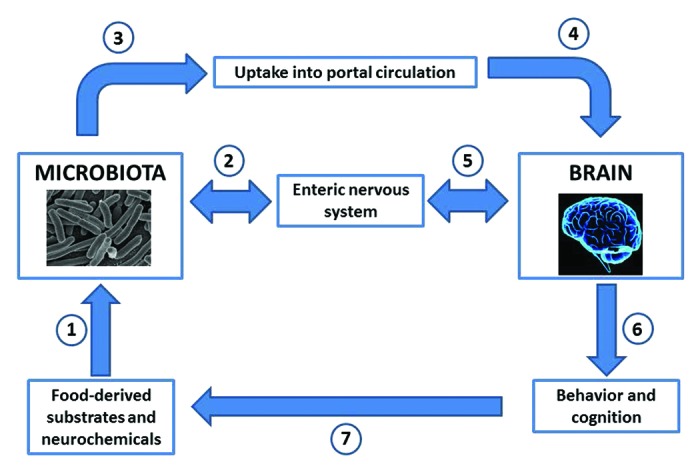
The ability of microorganisms, whether present as commensals within the microbiota or introduced as part of a therapeutic regimen, to influence behavior has been demonstrated by numerous laboratories over the last few years. Our understanding of the mechanisms that are responsible for microbiota-gut-brain interactions is, however, lacking. The complexity of the microbiota is, of course, a contributing factor. Nonetheless, while microbiologists approaching the issue of microbiota-gut-brain interactions in the behavior well recognize such complexity, what is often overlooked is the equal complexity of the host neurophysiological system, especially within the gut which is differentially innervated by the enteric nervous system. As such, in the search for common mechanisms by which the microbiota may influence behavior one may look for mechanisms which are shared by both host and microbiota. Such interkingdom signaling can be found in the shared production of neurochemical mediators that are found in both eukaryotes and prokaryotes. The study of the production and recognition of neurochemicals that are exactly the same in structure to those produced in the vertebrate organisms is known as microbial endocrinology. The examination of the microbiota from the vantage point of host-microbiota neuroendocrine interactions cannot only identify new microbial endocrinology-based mechanisms by which the microbiota can influence host behavior, but also lead to the design of interventions in which the composition of the microbiota may be modulated in order to achieve a specific microbial endocrinology-based profile beneficial to overall host behavior.
在过去几年中,众多实验室已证明,微生物无论是作为微生物群中的共生菌存在,还是作为治疗方案的一部分被引入,都具有影响行为的能力。然而,我们对负责微生物群-肠道-大脑相互作用的机制仍缺乏了解。微生物群的复杂性当然是一个促成因素。尽管如此,在行为学领域研究微生物群-肠道-大脑相互作用问题的微生物学家们虽深知这种复杂性,但往往被忽视的是宿主神经生理系统同样复杂,尤其是在由肠神经系统进行不同神经支配的肠道内。因此,在探寻微生物群可能影响行为的共同机制时,人们可能会寻找宿主和微生物群共有的机制。这种跨界信号传导可在真核生物和原核生物中都存在的神经化学介质的共同产生中找到。对与脊椎动物产生的结构完全相同的神经化学物质的产生和识别的研究被称为微生物内分泌学。从宿主-微生物群神经内分泌相互作用的角度审视微生物群,不仅能够识别微生物群影响宿主行为的基于微生物内分泌学的新机制,还能促成干预措施的设计,通过调节微生物群的组成,以实现有利于宿主整体行为的特定基于微生物内分泌学的特征。