Sridhar Adithya, de Boer Hans L, van den Berg Albert, Le Gac Séverine
BIOS Lab on a Chip Group, MESA+ Institute of Nanotechnology, University of Twente, Enschede, The Netherlands.
PLoS One. 2014 Apr 1;9(4):e93618. doi: 10.1371/journal.pone.0093618. eCollection 2014.
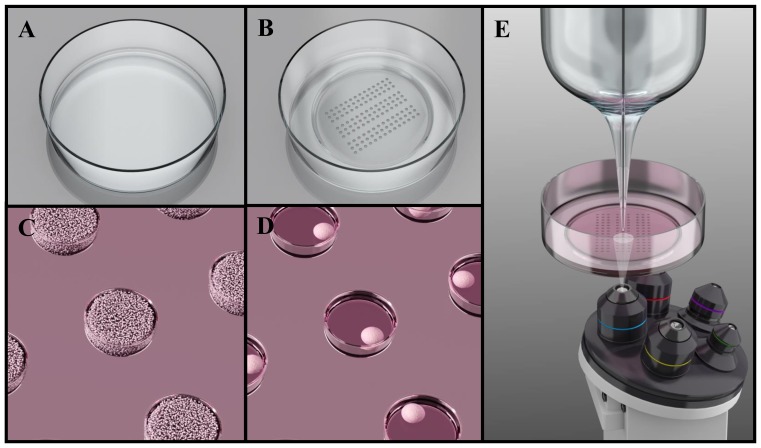
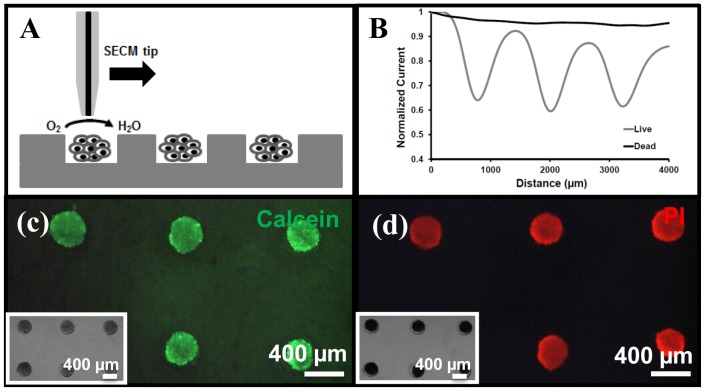
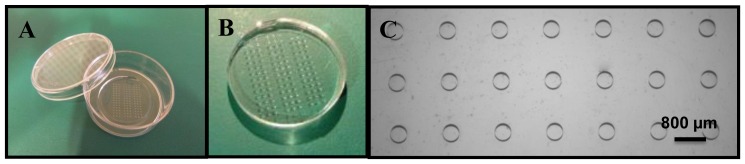
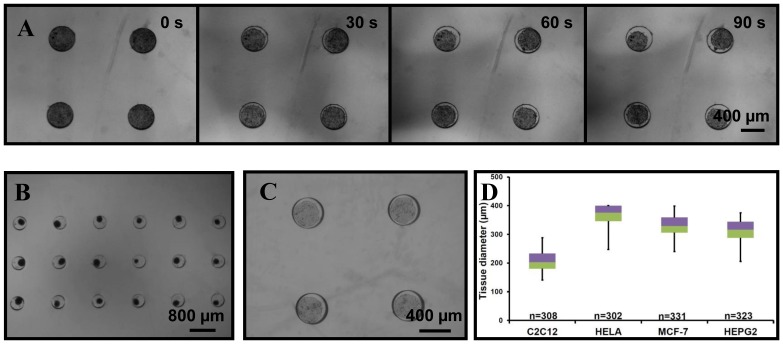
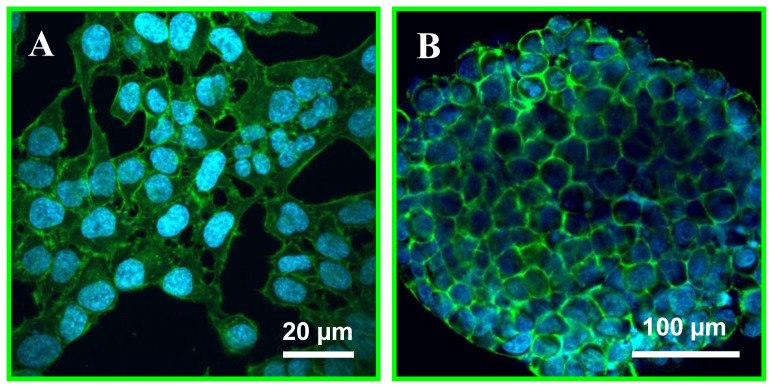
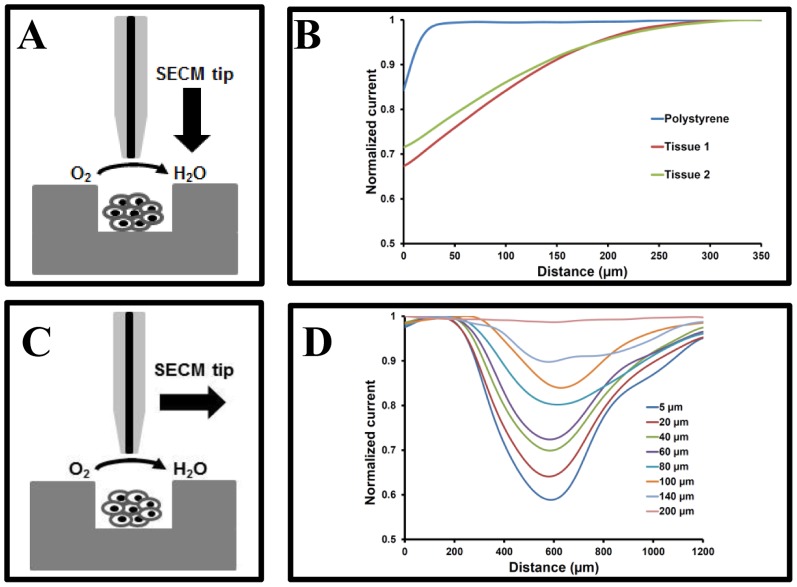
While scanning electrochemical microscopy (SECM) is a powerful technique for non-invasive analysis of cells, SECM-based assays remain scarce and have been mainly limited so far to single cells, which is mostly due to the absence of suitable platform for experimentation on 3D cellular aggregates or microtissues. Here, we report stamping of a Petri dish with a microwell array for large-scale production of microtissues followed by their in situ analysis using SECM. The platform is realized by hot embossing arrays of microwells (200 μm depth; 400 μm diameter) in commercially available Petri dishes, using a PDMS stamp. Microtissues form spontaneously in the microwells, which is demonstrated here using various cell lines (e.g., HeLa, C2C12, HepG2 and MCF-7). Next, the respiratory activity of live HeLa microtissues is assessed by monitoring the oxygen reduction current in constant height mode and at various distances above the platform surface. Typically, at a 40 μm distance from the microtissue, a 30% decrease in the oxygen reduction current is measured, while above 250 μm, no influence of the presence of the microtissues is detected. After exposure to a model drug (50% ethanol), no such changes in oxygen concentration are found at any height in solution, which reflects that microtissues are not viable anymore. This is furthermore confirmed using conventional live/dead fluorescent stains. This live/dead assay demonstrates the capability of the proposed approach combining SECM and microtissue arrays formed in a stamped Petri dish for conducting cellular assays in a non-invasive way on 3D cellular models.
扫描电化学显微镜(SECM)是一种用于细胞非侵入性分析的强大技术,但基于SECM的检测方法仍然很少,到目前为止主要局限于单细胞检测,这主要是由于缺乏适用于三维细胞聚集体或微组织实验的合适平台。在此,我们报道了一种在培养皿上冲压微孔阵列以大规模生产微组织,然后使用SECM对其进行原位分析的方法。该平台是通过使用聚二甲基硅氧烷(PDMS)印章在市售培养皿上热压印微孔阵列(深度200μm;直径400μm)来实现的。微组织在微孔中自发形成,这里使用多种细胞系(例如,HeLa、C2C12、HepG2和MCF-7)进行了证明。接下来,通过在恒定高度模式下监测平台表面上方不同距离处的氧还原电流,评估活HeLa微组织的呼吸活性。通常,在距微组织40μm的距离处,测量到氧还原电流降低了30%,而在250μm以上,未检测到微组织存在的影响。在暴露于模型药物(50%乙醇)后,在溶液中的任何高度都未发现氧浓度有此类变化,这表明微组织不再具有活力。使用传统的活/死荧光染色进一步证实了这一点。这种活/死检测证明了所提出的方法结合SECM和在冲压培养皿中形成的微组织阵列以对三维细胞模型进行非侵入性细胞检测的能力。