Khan Muhammad Talha, Franco Rose Amy
Division of Pulmonary, Critical Care and Sleep Medicine, Medical College of Wisconsin, 9200 W. Wisconsin Avenue, Milwaukee, WI 53226, USA.
Sleep Disord. 2014;2014:798487. doi: 10.1155/2014/798487. Epub 2014 Feb 16.
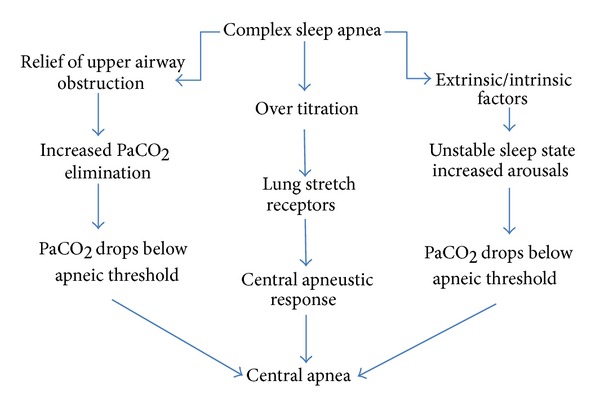
Complex sleep apnea is the term used to describe a form of sleep disordered breathing in which repeated central apneas (>5/hour) persist or emerge when obstructive events are extinguished with positive airway pressure (PAP) and for which there is not a clear cause for the central apneas such as narcotics or systolic heart failure. The driving forces in the pathophysiology are felt to be ventilator instability associated oscillation in PaCO2 arterial partial pressure of Carbon Dioxide, continuous cositive airway pressure (CPAP) related increased CO2 carbon dioxide elimination, and activation of airway and pulmonary stretch receptors triggering these central apneas. The prevalence ranges from 0.56% to 18% with no clear predictive characteristics as compared to simple obstructive sleep apnea. Prognosis is similar to obstructive sleep apnea. The central apnea component in most patients on followup using CPAP therap, has resolved. For those with continued central apneas on simple CPAP therapy, other treatment options include bilevel PAP, adaptive servoventilation, permissive flow limitation and/or drugs.
复杂性睡眠呼吸暂停是用于描述一种睡眠呼吸障碍形式的术语,在这种形式中,当阻塞性事件通过气道正压通气(PAP)消除时,反复出现的中枢性呼吸暂停(>5次/小时)持续存在或出现,且中枢性呼吸暂停没有明确的原因,如使用麻醉剂或收缩性心力衰竭。病理生理学中的驱动因素被认为是与二氧化碳动脉分压(PaCO2)振荡相关的呼吸机不稳定、持续气道正压通气(CPAP)相关的二氧化碳清除增加,以及气道和肺牵张感受器的激活引发这些中枢性呼吸暂停。与单纯阻塞性睡眠呼吸暂停相比,其患病率范围为0.56%至18%,且没有明确的预测特征。预后与阻塞性睡眠呼吸暂停相似。在大多数接受CPAP治疗的患者中,随访时中枢性呼吸暂停成分已消失。对于单纯CPAP治疗后仍有持续中枢性呼吸暂停的患者,其他治疗选择包括双水平气道正压通气、适应性伺服通气、允许性流量限制和/或药物。