Pilati Stefania, Brazzale Daniele, Guella Graziano, Milli Alberto, Ruberti Cristina, Biasioli Franco, Zottini Michela, Moser Claudio
Research and Innovation Centre, Fondazione Edmund Mach, via E, Mach 1, 38010 San Michele a/Adige, TN, Italy.
BMC Plant Biol. 2014 Apr 2;14:87. doi: 10.1186/1471-2229-14-87.
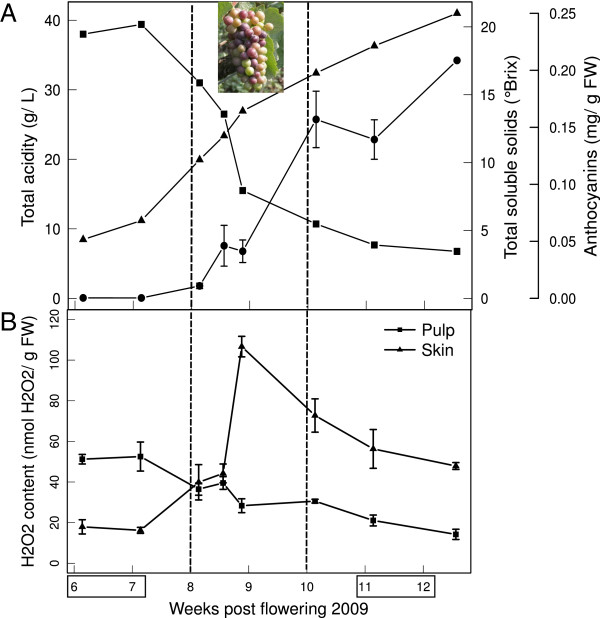
The ripening of fleshy fruits is a complex developmental program characterized by extensive transcriptomic and metabolic remodeling in the pericarp tissues (pulp and skin) making unripe green fruits soft, tasteful and colored. The onset of ripening is regulated by a plethora of endogenous signals tuned to external stimuli. In grapevine and tomato, which are classified as non-climacteric and climacteric species respectively, the accumulation of hydrogen peroxide (H2O2) and extensive modulation of reactive oxygen species (ROS) scavenging enzymes at the onset of ripening has been reported, suggesting that ROS could participate to the regulatory network of fruit development. In order to investigate this hypothesis, a comprehensive biochemical study of the oxidative events occurring at the beginning of ripening in Vitis vinifera cv. Pinot Noir has been undertaken.
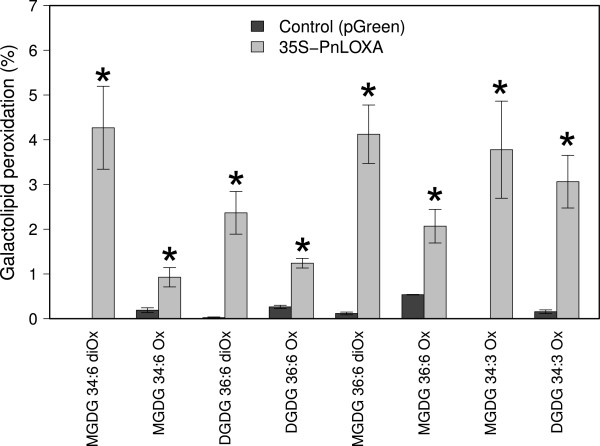
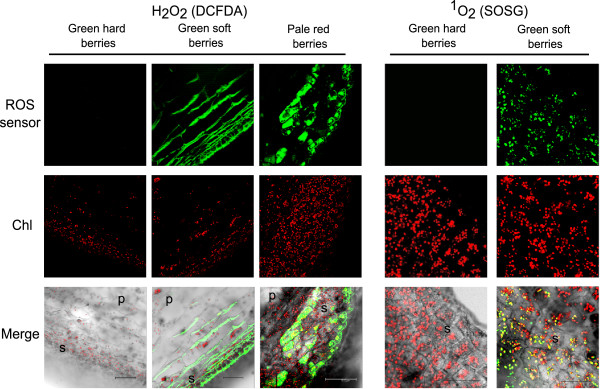
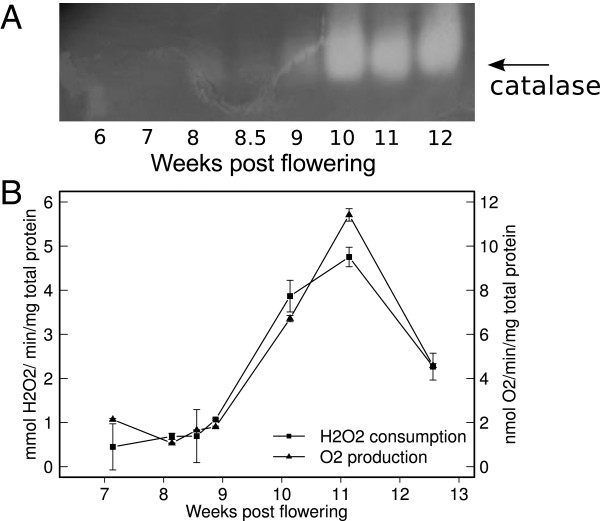
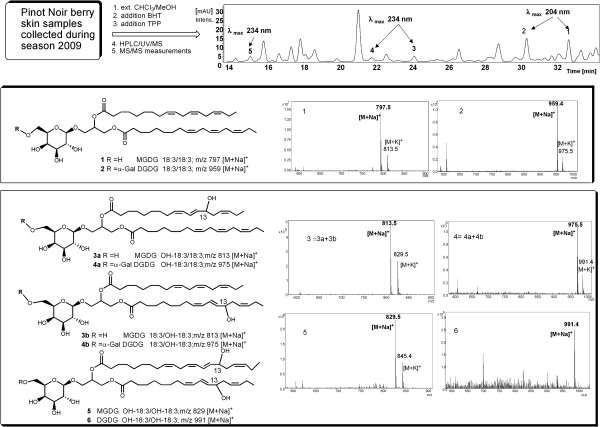
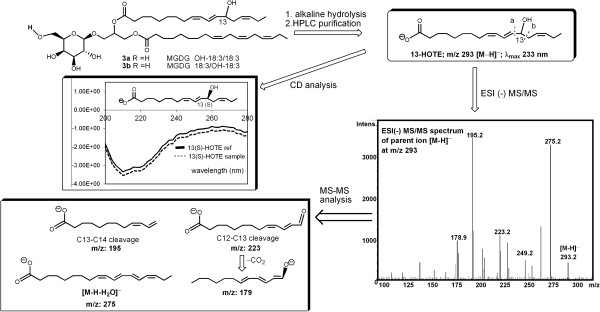
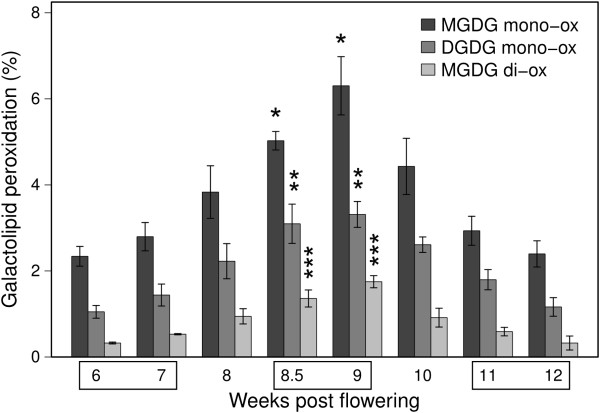
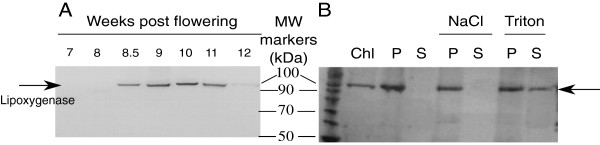
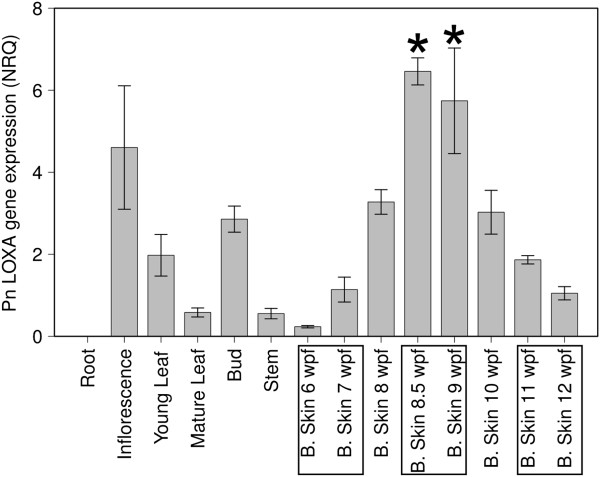
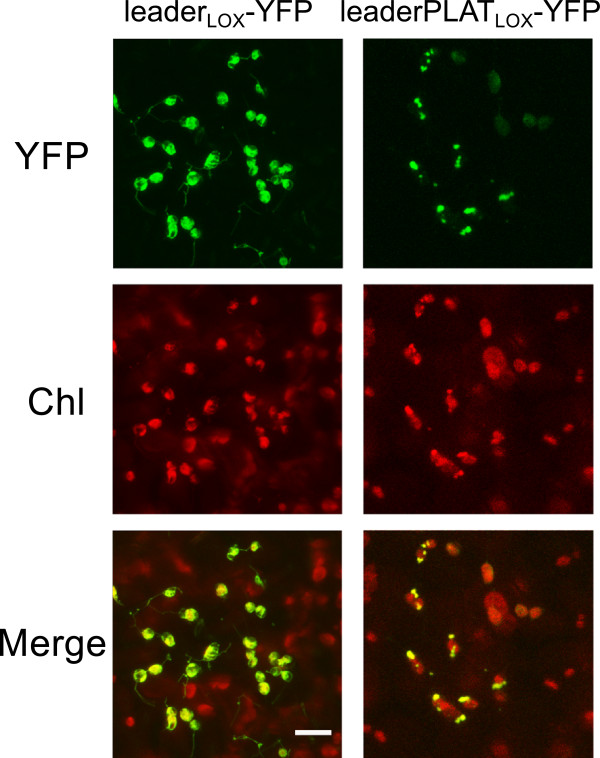
ROS-specific staining allowed to visualize not only H2O2 but also singlet oxygen (1O2) in berry skin cells just before color change in distinct subcellular locations, i.e. cytosol and plastids. H2O2 peak in sample skins at véraison was confirmed by in vitro quantification and was supported by the concomitant increase of catalase activity. Membrane peroxidation was also observed by HPLC-MS on galactolipid species at véraison. Mono- and digalactosyl diacylglycerols were found peroxidized on one or both α-linolenic fatty acid chains, with a 13(S) absolute configuration implying the action of a specific enzyme. A lipoxygenase (PnLOXA), expressed at véraison and localizing inside the chloroplasts, was indeed able to catalyze membrane galactolipid peroxidation when overexpressed in tobacco leaves.
The present work demonstrates the controlled, harmless accumulation of specific ROS in distinct cellular compartments, i.e. cytosol and chloroplasts, at a definite developmental stage, the onset of grape berry ripening. These features strongly candidate ROS as cellular signals in fruit ripening and encourage further studies to identify downstream elements of this cascade. This paper also reports the transient galactolipid peroxidation carried out by a véraison-specific chloroplastic lipoxygenase. The function of peroxidized membranes, likely distinct from that of free fatty acids due to their structural role and tight interaction with photosynthesis protein complexes, has to be ascertained.
肉质果实的成熟是一个复杂的发育过程,其特征是果皮组织(果肉和果皮)中广泛的转录组和代谢重塑,使未成熟的绿色果实变得柔软、美味且有颜色。成熟的开始受大量与外部刺激相协调的内源信号调控。在分别被归类为非跃变型和跃变型的葡萄和番茄中,已报道在成熟开始时过氧化氢(H2O2)的积累以及活性氧(ROS)清除酶的广泛调节,这表明ROS可能参与果实发育的调控网络。为了研究这一假设,对酿酒葡萄品种黑皮诺成熟开始时发生的氧化事件进行了全面的生化研究。
ROS特异性染色不仅能在浆果表皮细胞颜色变化前的不同亚细胞位置(即细胞质和质体)可视化H2O2,还能可视化单线态氧(1O2)。通过体外定量证实了转色期样品表皮中H2O2的峰值,并得到过氧化氢酶活性同时增加的支持。通过HPLC-MS在转色期对半乳糖脂类物质也观察到了膜过氧化作用。单半乳糖基二酰基甘油和双半乳糖基二酰基甘油在一个或两个α-亚麻酸脂肪酸链上被过氧化,其13(S)绝对构型意味着有特定酶的作用。一种在转色期表达且定位于叶绿体内部的脂氧合酶(PnLOXA),当在烟草叶片中过表达时确实能够催化膜半乳糖脂过氧化。
本研究表明,在葡萄浆果成熟开始这一特定发育阶段,特定的ROS在不同细胞区室(即细胞质和叶绿体)中受到控制且无害地积累。这些特征有力地表明ROS是果实成熟过程中的细胞信号,并鼓励进一步研究以确定该级联反应的下游元件。本文还报道了由转色期特异性叶绿体脂氧合酶进行的瞬时半乳糖脂过氧化作用。由于过氧化膜的结构作用及其与光合作用蛋白复合物的紧密相互作用,其功能可能与游离脂肪酸不同,这还有待确定。