Øymar Knut, Skjerven Håvard Ove, Mikalsen Ingvild Bruun
Department of Paediatrics, Stavanger University Hospital, PO Box 8100, N-4068 Stavanger, Norway.
Scand J Trauma Resusc Emerg Med. 2014 Apr 3;22:23. doi: 10.1186/1757-7241-22-23.
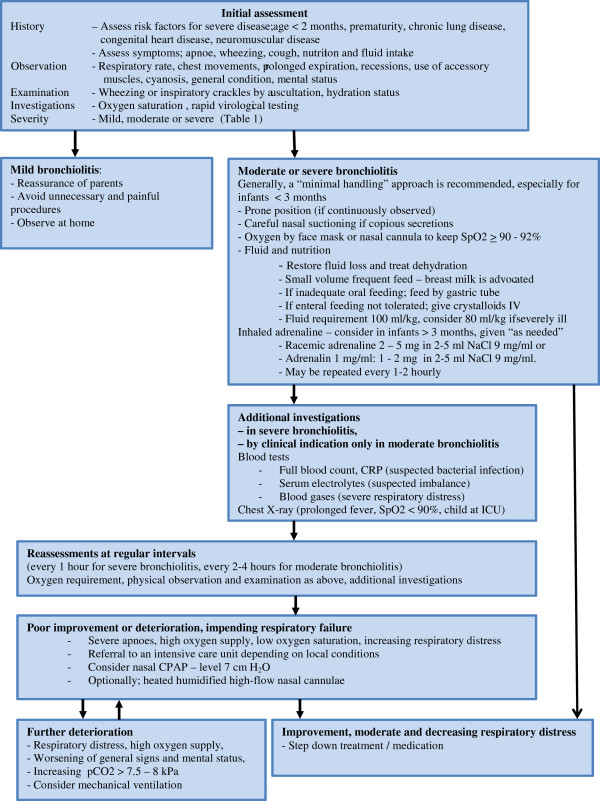
Acute viral bronchiolitis is one of the most common medical emergency situations in infancy, and physicians caring for acutely ill children will regularly be faced with this condition. In this article we present a summary of the epidemiology, pathophysiology and diagnosis, and focus on guidelines for the treatment of bronchiolitis in infants. The cornerstones of the management of viral bronchiolitis are the administration of oxygen and appropriate fluid therapy, and overall a "minimal handling approach" is recommended. Inhaled adrenaline is commonly used in some countries, but the evidences are sparse. Recently, inhalation with hypertonic saline has been suggested as an optional treatment. When medical treatment fails to stabilize the infants, non-invasive and invasive ventilation may be necessary to prevent and support respiratory failure. It is important that relevant treatment algorithms exist, applicable to all levels of the treatment chain and reflecting local considerations and circumstances.
急性病毒性细支气管炎是婴儿期最常见的医疗紧急情况之一,照料急症患儿的医生会经常遇到这种病症。在本文中,我们对细支气管炎的流行病学、病理生理学及诊断进行了总结,并重点关注婴儿细支气管炎的治疗指南。病毒性细支气管炎治疗的基石是吸氧和适当的液体疗法,总体上推荐采用“最小干预方法”。吸入肾上腺素在一些国家常用,但相关证据较少。最近,有人建议用高渗盐水吸入作为一种可选治疗方法。当药物治疗无法使婴儿病情稳定时,可能需要无创和有创通气来预防和支持呼吸衰竭。重要的是要有适用于治疗链各层面并反映当地情况的相关治疗算法。