Université catholique de Louvain, Earth and Life Institute, Biodiversity Research Centre, Louvain-la-Neuve, Belgium; Insect Pest Control Laboratory, International Atomic Energy Agency, Vienna, Austria.
Université catholique de Louvain, Earth and Life Institute, Biodiversity Research Centre, Louvain-la-Neuve, Belgium.
PLoS One. 2014 Apr 2;9(4):e89358. doi: 10.1371/journal.pone.0089358. eCollection 2014.
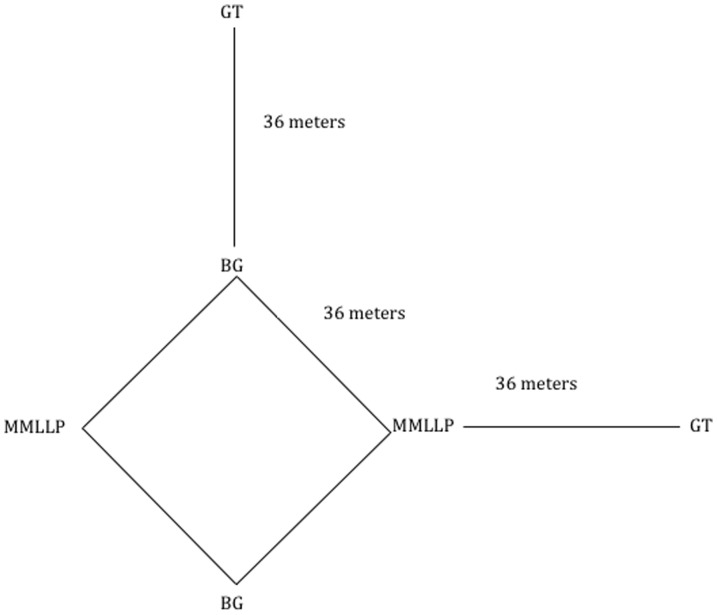
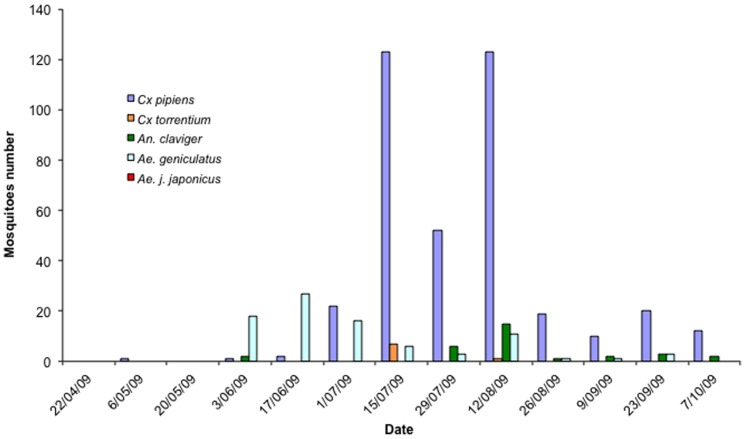
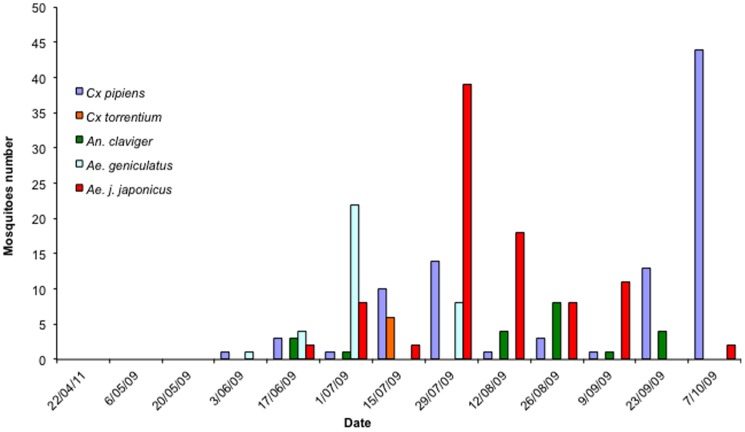
When accidentally introduced in a new location, a species does not necessarily readily become invasive, but it usually needs several years to adapt to its new environment. In 2009, a national mosquito survey (MODIRISK) reported the introduction and possible establishment of an invasive mosquito species, Aedes j. japonicus, in Belgium. First collected in 2002 in the village of Natoye from a second-hand tire company, then sampled in 2003 and 2004, the presence of adults and larvae was confirmed in 2007 and 2008. A repeated cross-sectional survey of Ae. j. japonicus was then conducted in 2009 in Natoye to study the phenology of the species on two different sites using three kinds of traps: Mosquito Magnet Liberty Plus traps, BG sentinel traps and CDC Gravid traps. An analysis of the blood meals was done on females to assess the epidemiological risks. Five species of mosquitos were caught using the different kind of traps: Culex pipiens, Cx. torrentium, Anopheles claviger, Aedes geniculatus and Ae. j. japonicus, Cx. pipiens being the most abundant. The CDC gravid traps gave the best results. Surprisingly Ae. j. japonicus was only found on one site although both sites seem similar and are only distant of 2.5 km. Its population peak was reached in July. Most of the engorged mosquitoes tested acquired blood meals from humans (60%). No avian blood meals were unambiguously identified. Larvae were also collected, mostly from tires but also from buckets and from one tree hole. Only one larva was found in a puddle at 100 m of the tire storage. A first local treatment of Ae. j. japonicus larvae population was done in May 2012 using Bacillus thuringiensis subsp. israelensis (Bti) and was followed by preventive actions and public information. A monitoring is also presently implemented.
当一个物种意外引入一个新的地点时,它并不一定会迅速成为入侵物种,但它通常需要几年的时间来适应新的环境。2009 年,一项全国性的蚊子调查(MODIRISK)报告称,一种入侵性蚊子物种——白纹伊蚊,在比利时被引入并可能已经建立了种群。该物种于 2002 年首次在纳托伊村的一家二手轮胎公司采集到,随后在 2003 年和 2004 年进行了采样,2007 年和 2008 年确认了成虫和幼虫的存在。随后,在 2009 年对纳托伊村的白纹伊蚊进行了反复的横断面调查,使用三种诱捕器(Mosquito Magnet Liberty Plus 诱捕器、BG 哨兵诱捕器和 CDC 诱捕器)在两个不同的地点研究该物种的物候学。对雌性进行了血液分析,以评估其流行病学风险。使用不同的诱捕器捕获了 5 种蚊子:库蚊、库蚊、疟蚊、致倦库蚊和白纹伊蚊,其中库蚊最为丰富。CDC 诱捕器的效果最好。令人惊讶的是,尽管两个地点似乎相似,且相距仅 2.5 公里,但只在一个地点发现了白纹伊蚊。其种群高峰出现在 7 月。大多数饱食血的蚊子(60%)来自人类。没有明确鉴定到禽血。还收集了幼虫,主要来自轮胎,但也来自水桶和一个树洞。在距离轮胎存放处 100 米的一个水坑中只发现了一只幼虫。2012 年 5 月,首次对白纹伊蚊幼虫种群进行了局部处理,使用苏云金芽孢杆菌亚种以色列亚种(Bti),并随后采取了预防措施和公众宣传。目前还在进行监测。