MMWR Morb Mortal Wkly Rep. 2014 Apr 4;63(13):281-4.
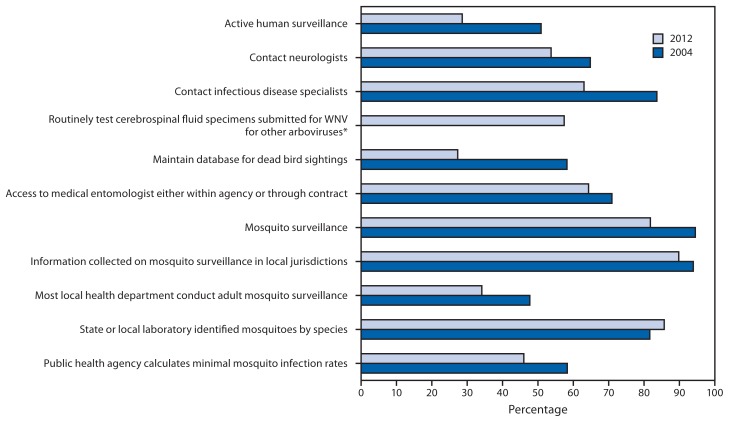
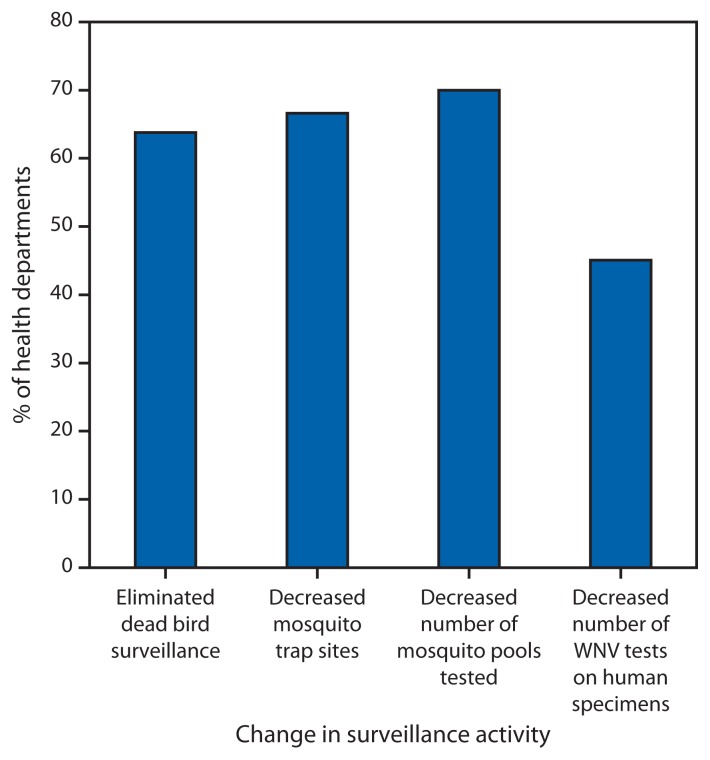
In the first 5 years after its introduction in the United States in 1999, West Nile virus (WNV) spread to the 48 contiguous states, resulting in 667 reported deaths. To establish detection and response capacity, WNV surveillance and prevention was supported through CDC Epidemiology and Laboratory Capacity (ELC) cooperative agreements with all 50 states and six large cities/counties. In 2005, the Council of State and Territorial Epidemiologists (CSTE) conducted an assessment of ELC recipients and determined that, since 1999, all had developed WNV surveillance and control programs, resulting in a national arboviral surveillance infrastructure. From 2004 to 2012, ELC funding for WNV surveillance decreased by 61%. In 2012, the United States had its most severe WNV season since 2003, prompting a follow-up assessment of the capacity of ELC-supported WNV programs. Since the first assessment, 22% of jurisdictions had stopped conducting active human surveillance, 13% had stopped mosquito surveillance, 70% had reduced mosquito trapping and testing, and 64% had eliminated avian mortality surveillance. Reduction in early detection capacity compromises local and national ability to rapidly detect changes in WNV and other arboviral activity and to initiate prevention measures. Each jurisdiction is encouraged to review its current surveillance systems in light of the local threat of WNV and emerging arboviruses (e.g., dengue and chikungunya) and ensure it is able to rapidly detect and respond to critical changes in arbovirus activity.
在美国于 1999 年引入该病毒后的头 5 年里,西尼罗河病毒(WNV)传播到了 48 个相邻的州,导致 667 人报告死亡。为了建立检测和应对能力,通过疾病预防控制中心与所有 50 个州和 6 个大城市/县的流行病学和实验室能力(ELC)合作协议,WNV 监测和预防工作得到了支持。2005 年,州和地区流行病学家理事会(CSTE)对 ELC 受援者进行了评估,结果表明,自 1999 年以来,所有州都制定了 WNV 监测和控制计划,从而建立了国家虫媒病毒监测基础设施。2004 年至 2012 年,ELC 用于 WNV 监测的资金减少了 61%。2012 年,美国经历了自 2003 年以来最严重的 WNV 季节,促使对 ELC 支持的 WNV 计划的能力进行了后续评估。自第一次评估以来,22%的司法管辖区停止了主动的人类监测,13%停止了蚊虫监测,70%减少了蚊虫诱捕和检测,64%消除了鸟类死亡率监测。早期检测能力的下降危及地方和国家迅速发现 WNV 和其他虫媒病毒活动变化并启动预防措施的能力。每个司法管辖区都应根据当地 WNV 和新兴虫媒病毒(例如登革热和基孔肯雅热)的威胁,审查其当前的监测系统,并确保其能够迅速发现和应对虫媒病毒活动的重大变化。