School of Psychological Sciences, University of Melbourne, Parkville, Victoria, Australia.
PLoS One. 2014 Apr 4;9(4):e93927. doi: 10.1371/journal.pone.0093927. eCollection 2014.
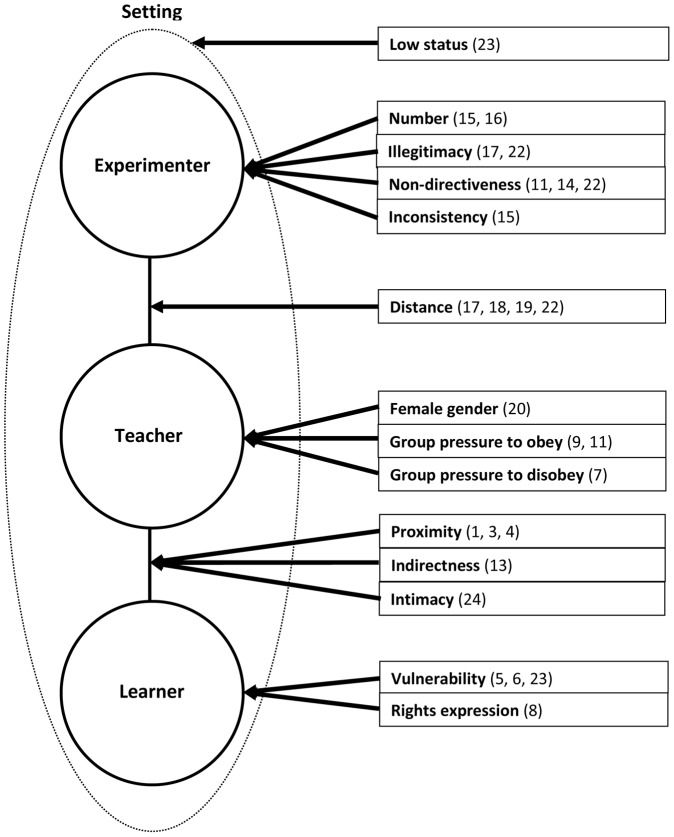
Milgram's famous experiment contained 23 small-sample conditions that elicited striking variations in obedient responding. A synthesis of these diverse conditions could clarify the factors that influence obedience in the Milgram paradigm. We assembled data from the 21 conditions (N = 740) in which obedience involved progression to maximum voltage (overall rate 43.6%) and coded these conditions on 14 properties pertaining to the learner, the teacher, the experimenter, the learner-teacher relation, the experimenter-teacher relation, and the experimental setting. Logistic regression analysis indicated that eight factors influenced the likelihood that teachers continued to the 450 volt shock: the experimenter's directiveness, legitimacy, and consistency; group pressure on the teacher to disobey; the indirectness, proximity, and intimacy of the relation between teacher and learner; and the distance between the teacher and the experimenter. Implications are discussed.
米尔格拉姆的著名实验包含 23 个小样本条件,这些条件引发了服从反应的惊人变化。对这些不同条件的综合分析可以澄清影响米尔格拉姆范式中服从的因素。我们从涉及到最大电压(整体率为 43.6%)的 21 个条件中汇总数据(N=740),并对涉及学习者、教师、实验者、学习者-教师关系、实验者-教师关系和实验环境的 14 个属性对这些条件进行编码。逻辑回归分析表明,有八个因素影响教师继续进行 450 伏电击的可能性:实验者的直接性、合法性和一致性;群体对教师的压力要求其不服从;教师和学习者之间关系的间接性、接近性和亲密性;以及教师和实验者之间的距离。讨论了其影响。