Geng Qian, Zhang Tao, Ding Yunfang, Tao Yunzhen, Lin Yuzun, Wang Yunzhong, Black Steven, Zhao Genming
Department of Epidemiology, School of Public Health, Fudan University, Key Laboratory of Public Health Safety, Ministry of Education, Shanghai, China.
Soochow University Affiliated Children's Hospital, Suzhou, China.
PLoS One. 2014 Apr 7;9(4):e93752. doi: 10.1371/journal.pone.0093752. eCollection 2014.
Dissemination of antibiotic resistant clones is recognized as an important factor in the emergence and prevalence of resistance in pneumococcus. This study was undertaken to survey the antimicrobial susceptibility and serotypes distribution of pneumococci and to explore the circulating clones in hospitalized children in Suzhou, China.
The pneumococci were isolated from the nasopharyngeal aspirates of children less than 5 years of age admitted to Soochow-University-Affiliated-Children's-Hospital with respiratory infections. The capsular serotypes were identified by multiplex polymerase chain reaction (PCR). Antimicrobial susceptibility was tested by E-test. The presence of ermB, mefA/E genes were detected by PCR and the genotypes were explored by Multilocus sequence typing (MLST).
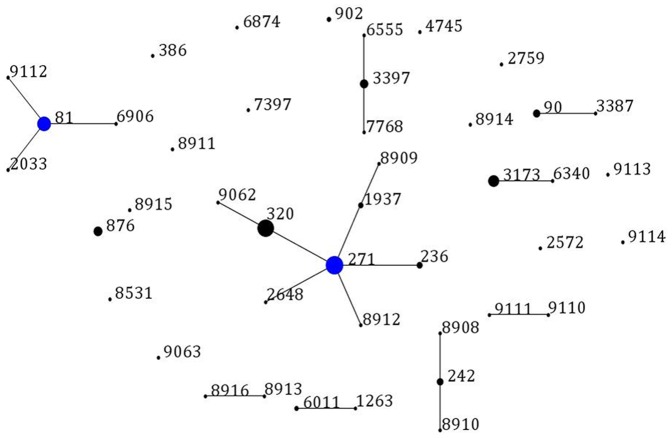
From July 2012 to July 2013, a total of 175 pneumococcal isolates were collected and all strains were resistant to erythromycin and clindamycin, about 39.4% strains were non-susceptible to penicillin G. Overall, 174 (99.4%) isolates were resistant to ≥ 3 types of antibiotics. Serotypes 19F (28.1%), 6B (19.7%), 19A (18.0%), and 23F (17.4%) were the most common serotypes in all identified strains. The serotypes coverage of PCV7 and PCV13 were 71.9% and 89.9%, respectively. Four international antibiotic-resistant clones, including Taiwan19F-14 (n = 79), Spain23F-1(n = 25), Taiwan23F-15(n = 7) and Spain6B-2(n = 7), were identified. The Taiwan19F-14 clones have a higher non-susceptibility rate in β-lactams than other clones and non-clone isolates (p<0.001). In addition, 98.7% Taiwan19F-14 clones were positive of both ermB and mefA/E genes, compare to 33.3% in other clones and non-clone strains.
The spread of international antibiotic-resistant clones, especially Taiwan19F-14 clones, played a predominant role in the dissemination of antimicrobial resistant isolates in Suzhou, China. Considering the high prevalence of PCV7 serotypes and serotype 19A, the introduction of PCV13 may be a promising preventive strategy to control the increasing trend of clonal spread in China.
抗生素耐药克隆的传播被认为是肺炎球菌耐药性出现和流行的一个重要因素。本研究旨在调查肺炎球菌的抗菌药物敏感性和血清型分布,并探索中国苏州住院儿童中流行的克隆株。
从苏州大学附属儿童医院收治的5岁以下患有呼吸道感染的儿童鼻咽吸出物中分离肺炎球菌。通过多重聚合酶链反应(PCR)鉴定荚膜血清型。采用E-test法检测抗菌药物敏感性。通过PCR检测ermB、mefA/E基因的存在,并通过多位点序列分型(MLST)探索基因型。
2012年7月至2013年7月,共收集175株肺炎球菌分离株,所有菌株均对红霉素和克林霉素耐药,约39.4%的菌株对青霉素G不敏感。总体而言,174株(99.4%)分离株对≥3种抗生素耐药。19F型(28.1%)、6B型(19.7%)、19A型(18.0%)和23F型(17.4%)是所有鉴定菌株中最常见的血清型。PCV7和PCV13的血清型覆盖率分别为71.9%和89.9%。鉴定出4种国际耐药克隆株,包括台湾19F-14(n = 79)、西班牙23F-1(n = 25)、台湾23F-15(n = 7)和西班牙6B-2(n = 7)。台湾19F-14克隆株对β-内酰胺类药物的不敏感率高于其他克隆株和非克隆株分离株(p<0.001)。此外,98.7%的台湾19F-14克隆株ermB和mefA/E基因均为阳性,而其他克隆株和非克隆株菌株中这一比例为33.3%。
国际耐药克隆株,尤其是台湾19F-14克隆株的传播,在中国苏州抗菌药物耐药分离株的传播中起主要作用。考虑到PCV7血清型和19A型的高流行率,引入PCV13可能是控制中国克隆传播上升趋势的一种有前景的预防策略。