Yin Ning, Ma Wenzhe, Pei Jianfeng, Ouyang Qi, Tang Chao, Lai Luhua
Center for Quantitative Biology, Peking University, Beijing, China.
Department of Systems Biology, Harvard Medical School, Boston, Massachusetts, United States of America.
PLoS One. 2014 Apr 8;9(4):e93960. doi: 10.1371/journal.pone.0093960. eCollection 2014.
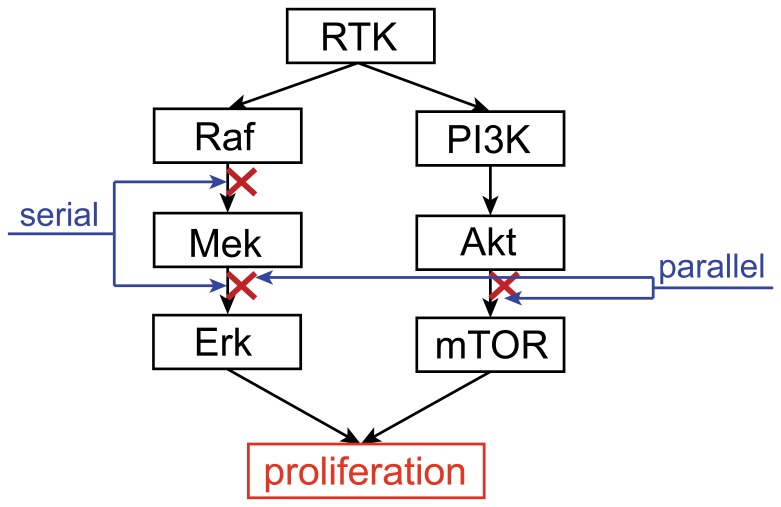
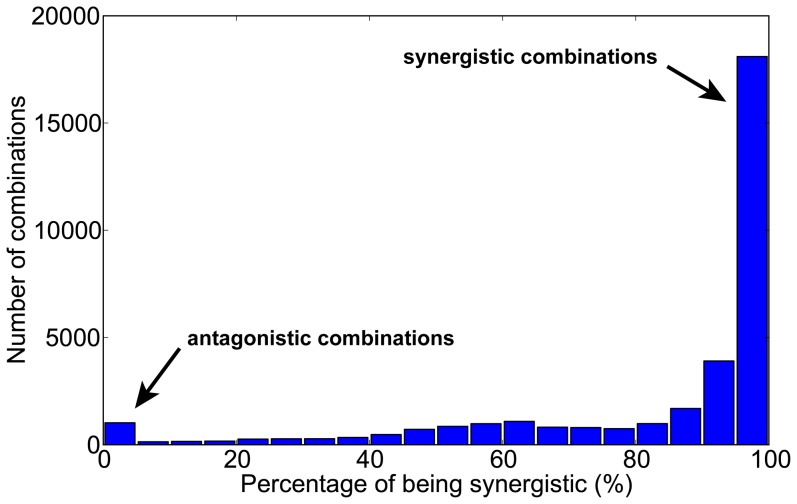
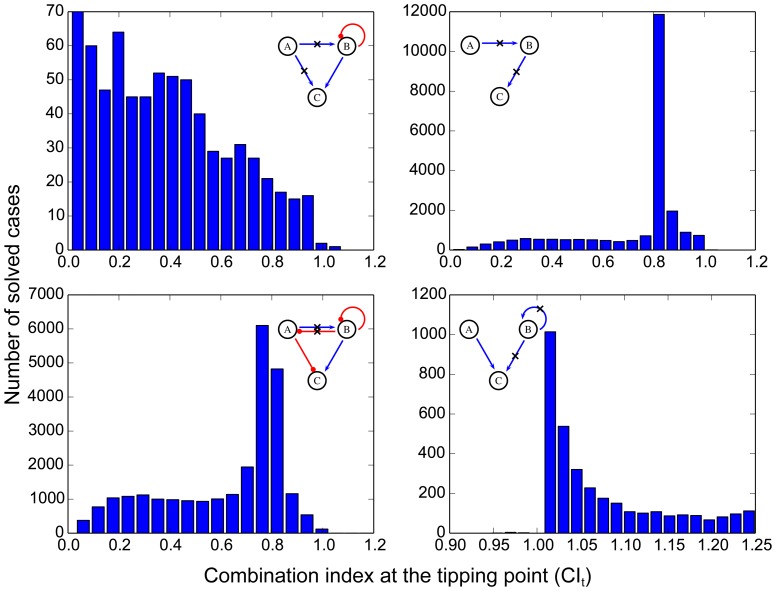
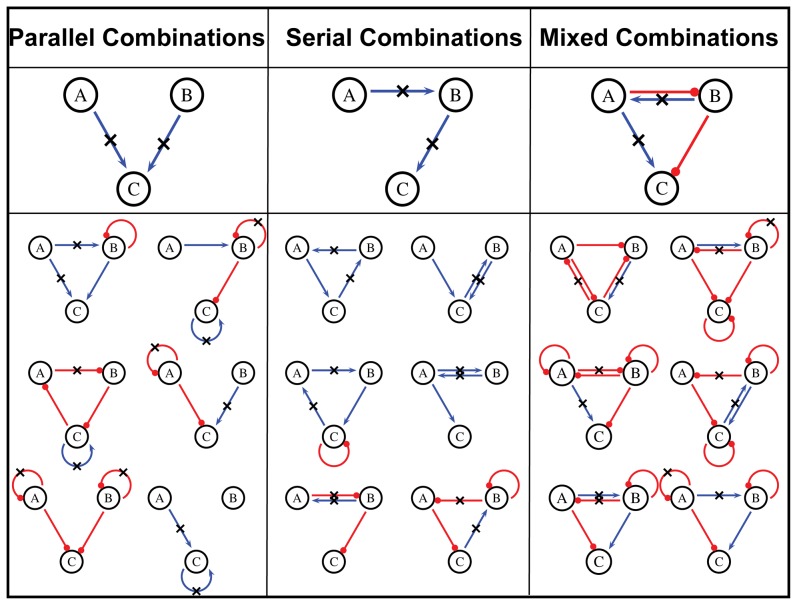
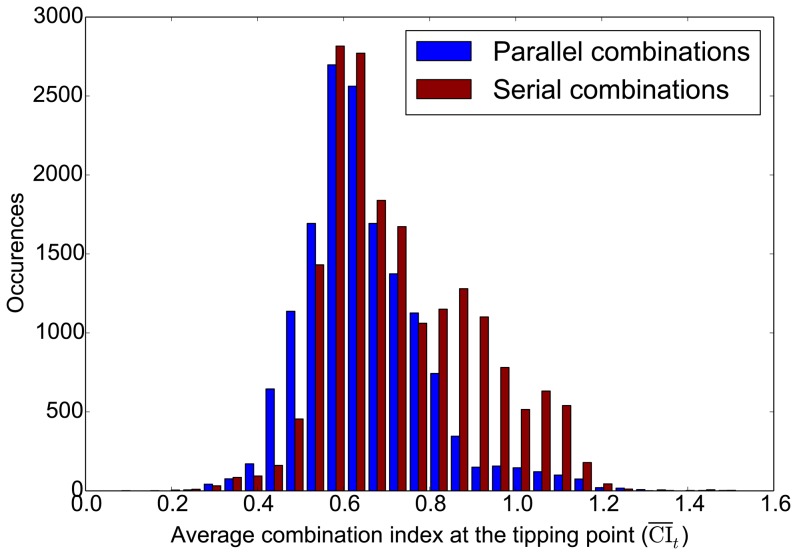
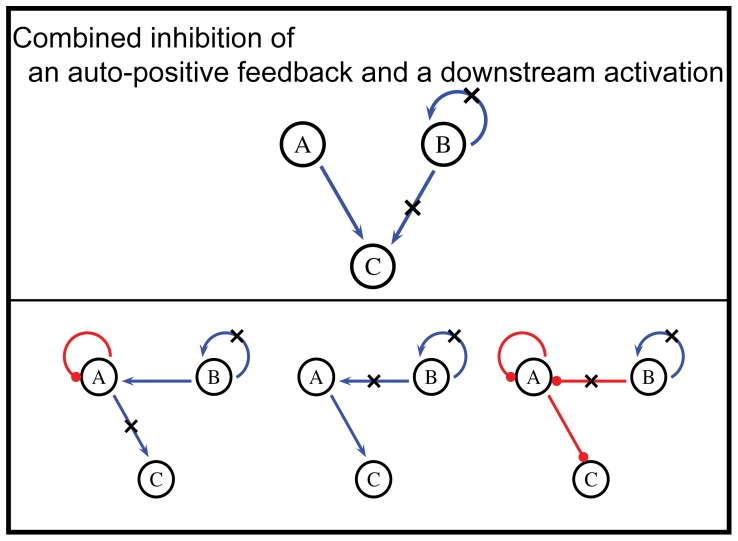
Drug combinations may exhibit synergistic or antagonistic effects. Rational design of synergistic drug combinations remains a challenge despite active experimental and computational efforts. Because drugs manifest their action via their targets, the effects of drug combinations should depend on the interaction of their targets in a network manner. We therefore modeled the effects of drug combinations along with their targets interacting in a network, trying to elucidate the relationships between the network topology involving drug targets and drug combination effects. We used three-node enzymatic networks with various topologies and parameters to study two-drug combinations. These networks can be simplifications of more complex networks involving drug targets, or closely connected target networks themselves. We found that the effects of most of the combinations were not sensitive to parameter variation, indicating that drug combinational effects largely depend on network topology. We then identified and analyzed consistent synergistic or antagonistic drug combination motifs. Synergistic motifs encompass a diverse range of patterns, including both serial and parallel combinations, while antagonistic combinations are relatively less common and homogenous, mostly composed of a positive feedback loop and a downstream link. Overall our study indicated that designing novel synergistic drug combinations based on network topology could be promising, and the motifs we identified could be a useful catalog for rational drug combination design in enzymatic systems.
药物组合可能表现出协同或拮抗作用。尽管进行了积极的实验和计算工作,但合理设计协同药物组合仍然是一项挑战。由于药物通过其靶点发挥作用,药物组合的效果应以网络方式取决于其靶点的相互作用。因此,我们对药物组合及其在网络中相互作用的靶点的效果进行建模,试图阐明涉及药物靶点的网络拓扑结构与药物组合效果之间的关系。我们使用具有各种拓扑结构和参数的三节点酶网络来研究双药组合。这些网络可以是涉及药物靶点的更复杂网络的简化形式,或者本身就是紧密连接的靶点网络。我们发现大多数组合的效果对参数变化不敏感,这表明药物组合效果在很大程度上取决于网络拓扑结构。然后,我们识别并分析了一致的协同或拮抗药物组合基序。协同基序包含多种模式,包括串联和平行组合,而拮抗组合相对较少且较为单一,主要由正反馈回路和下游连接组成。总体而言,我们的研究表明,基于网络拓扑结构设计新型协同药物组合可能是有前景的,我们识别出的基序可为酶系统中合理的药物组合设计提供有用的目录。