Mak Alan S
Department of Biomedical and Molecular Sciences; Queen's University; Kingston, ON Canada.
Cell Adh Migr. 2014;8(3):205-14. doi: 10.4161/cam.27841.
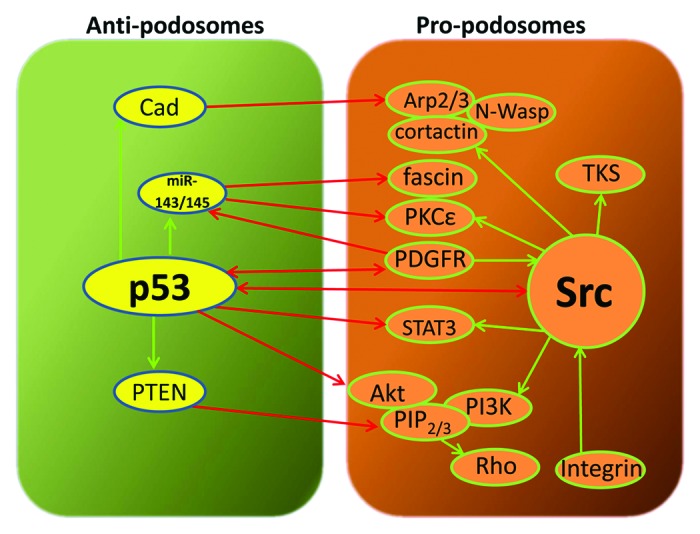
Cell invasion of the extracellular matrix is prerequisite to cross tissue migration of tumor cells in cancer metastasis, and vascular smooth muscle cells in atherosclerosis. The tumor suppressor p53, better known for its roles in the regulation of cell cycle and apoptosis, has ignited much interest in its function as a suppressor of cell migration and invasion. How p53 and its gain-of-function mutants regulate cell invasion remains a puzzle and a challenge for future studies. In recent years, podosomes and invadopodia have also gained center stage status as veritable apparatus specialized in cell invasion. It is not clear, however, whether p53 regulates cell invasion through podosomes and invadopodia. In this review, evidence supporting a negative role of p53 in podosomes formation in vascular smooth muscle cells will be surveyed, and signaling nodes that may mediate this regulation in other cell types will be explored.
在癌症转移过程中肿瘤细胞跨组织迁移以及动脉粥样硬化中血管平滑肌细胞迁移时,细胞对细胞外基质的侵袭是其前提条件。肿瘤抑制因子p53,因其在细胞周期调控和凋亡中的作用而广为人知,其作为细胞迁移和侵袭抑制因子的功能也引发了人们极大的兴趣。p53及其功能获得性突变体如何调控细胞侵袭仍是一个谜题,也是未来研究的一项挑战。近年来,足体和侵袭性伪足作为专门负责细胞侵袭的名副其实的细胞器,也备受关注。然而,尚不清楚p53是否通过足体和侵袭性伪足来调控细胞侵袭。在这篇综述中,我们将审视支持p53在血管平滑肌细胞足体形成中起负向作用的证据,并探索在其他细胞类型中可能介导这种调控的信号节点。