Zhu Fen, Wang Weige, Hou Yingyong, Shi Jindong, Liu Zilong, He Deming, Bai Chunxue, Li Shanqun, Jiang Liyan
Department of Pulmonary Medicine, Zhongshan Hospital, Fudan University, Shanghai, China.
Department of Pathology, Fudan University Shanghai Cancer Center, Shanghai, China; Department of Oncology, Shanghai Medical College, Fudan University, Shanghai, China.
PLoS One. 2014 Apr 8;9(4):e94399. doi: 10.1371/journal.pone.0094399. eCollection 2014.
Primary pulmonary mucoepidermoid carcinoma (PMEC) is an uncommon neoplasm with remarkable resemblance to mucoepidermoid carcinoma of the salivary glands. The latter has been shown to harbor t(11,19) resulting in MECT1-MAML2 fusion, which may be of diagnostic and prognostic values. However, the importance of such feature in PMEC has not been well studied.
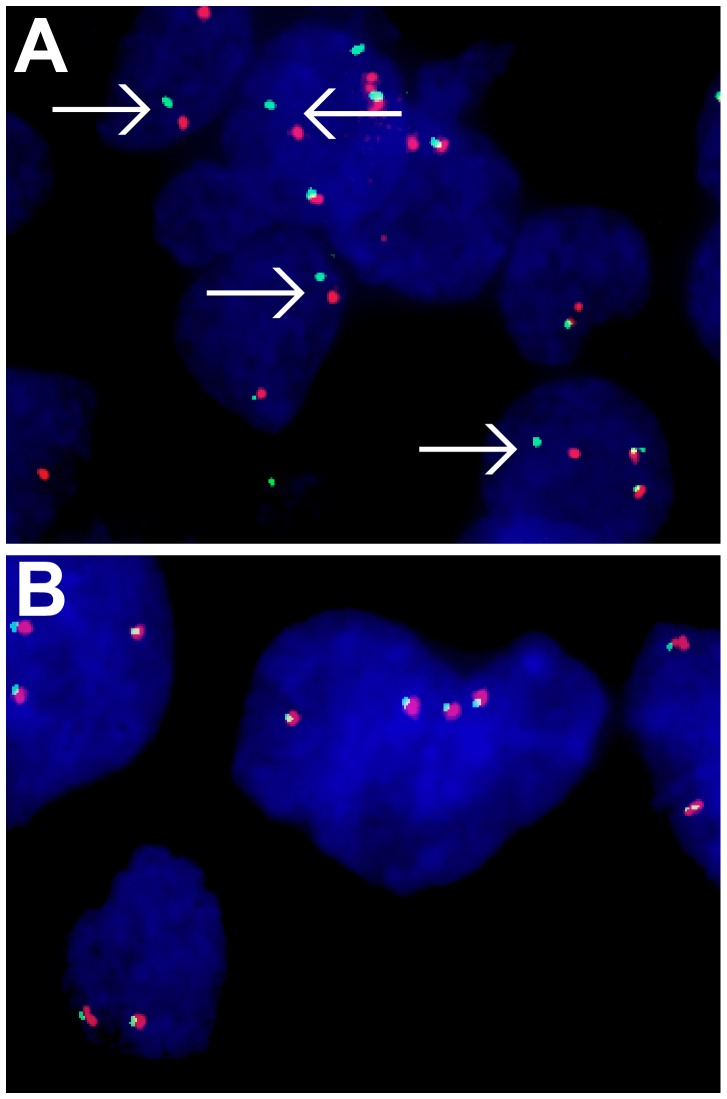
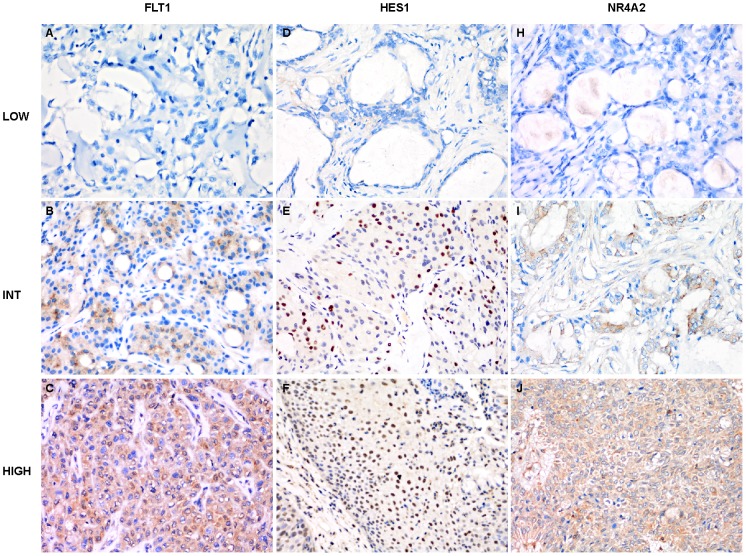
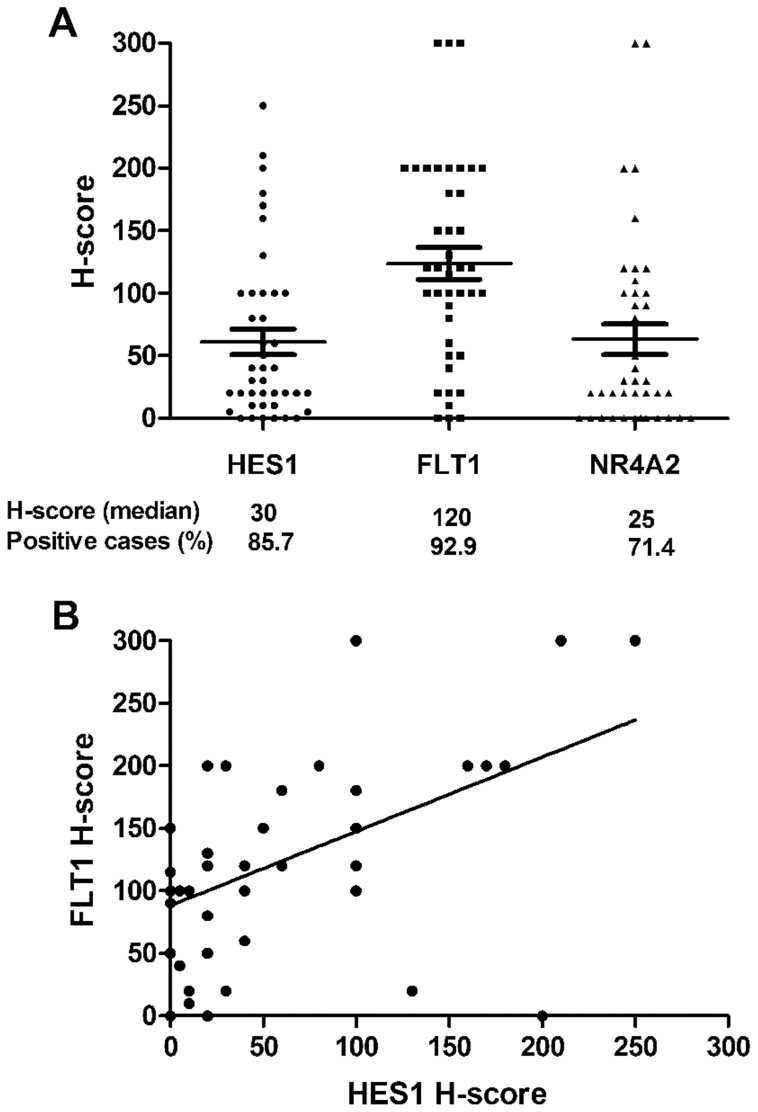
We detected MAML2 rearrangement using fluorescence in situ hybridization (FISH) in tissue samples from 42 cases of PMEC and 40 of adenosquamous carcinoma (ASC), and the expression of potential downstream targets of MECT1-MAML2, including HES1, FLT1 and NR4A2 with immunohistochemistry (IHC). The findings were then examined regarding the clinicopathological parameters and patient outcomes.
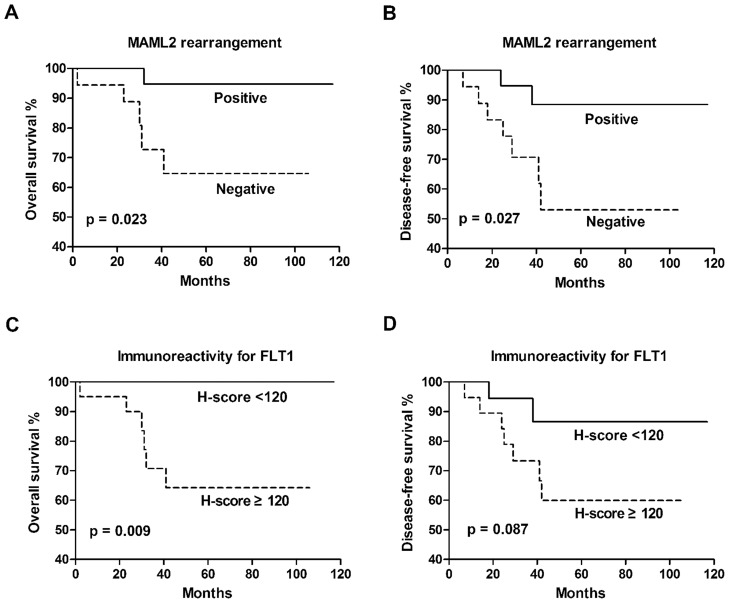
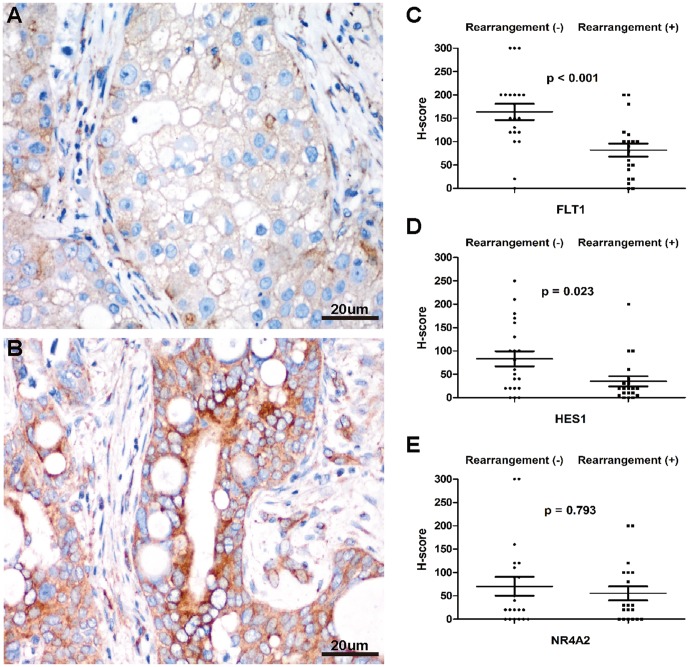
FISH analysis revealed MAML2 rearrangement in 50% of the PMEC cases, and such property was prominent in considerable younger patients (33 versus 60 years; p = 0.001) and restricted to cases of low and intermediate grades. IHC analysis showed that FLT1 and HES1 were expressed at lower level in MAML2 rearranged group than MAML2 non-rearranged group (p<0.001 and p = 0.023, respectively). Survival analysis showed significant correlation between MAML2 rearrangement and overall survival (p = 0.023) or disease-free survival (p = 0.027) as well as correlation between FLT1 and overall survival (p = 0.009).
MAML2 rearrangement appears frequent in PMEC and specific with this tumor. Both the presence of MAML2 rearrangement and absence of FLT1 tend to confer a favorable clinical outcome. These findings suggest that molecular detection of MAML2 rearrangement combined with FLT1 may be of important clinical value for PMEC.
原发性肺黏液表皮样癌(PMEC)是一种罕见的肿瘤,与涎腺黏液表皮样癌极为相似。后者已被证明存在t(11,19),导致MECT1-MAML2融合,这可能具有诊断和预后价值。然而,这种特征在PMEC中的重要性尚未得到充分研究。
我们使用荧光原位杂交(FISH)检测了42例PMEC和40例腺鳞癌(ASC)组织样本中的MAML2重排,并通过免疫组织化学(IHC)检测了MECT1-MAML2潜在下游靶点包括HES1、FLT1和NR4A2的表达。然后根据临床病理参数和患者预后对结果进行了检查。
FISH分析显示50%的PMEC病例存在MAML2重排,这种特征在相当年轻的患者中更为突出(33岁对60岁;p = 0.001),且仅限于低级别和中级别的病例。IHC分析显示,与MAML2未重排组相比,MAML2重排组中FLT1和HES1的表达水平较低(分别为p<0.001和p = 0.023)。生存分析显示MAML2重排与总生存期(p = 0.023)或无病生存期(p = 0.027)之间存在显著相关性,以及FLT1与总生存期之间存在相关性(p = 0.009)。
MAML2重排在PMEC中似乎很常见且具有肿瘤特异性。MAML2重排的存在和FLT1的缺失都倾向于带来良好的临床结果。这些发现表明,MAML2重排与FLT1的分子检测相结合可能对PMEC具有重要的临床价值。