De Roo Maaike L, Miccinesi Guido, Onwuteaka-Philipsen Bregje D, Van Den Noortgate Nele, Van den Block Lieve, Bonacchi Andrea, Donker Gé A, Lozano Alonso Jose E, Moreels Sarah, Deliens Luc, Francke Anneke L
Department of Public and Occupational Health, Expertise Center of Palliative Care, VU University medical center, EMGO Institute for Health and Care Research, Amsterdam, the Netherlands.
Clinical and Descriptive Epidemiology Unit, Cancer Prevention and Research Institute (L'Istituto per lo Studio e la Prevenzione Oncologica, ISPO), Florence, Italy.
PLoS One. 2014 Apr 8;9(4):e93762. doi: 10.1371/journal.pone.0093762. eCollection 2014.
Dying at home and dying at the preferred place of death are advocated to be desirable outcomes of palliative care. More insight is needed in their usefulness as quality indicators. Our objective is to describe whether "the percentage of patients dying at home" and "the percentage of patients who died in their place of preference" are feasible and informative quality indicators.
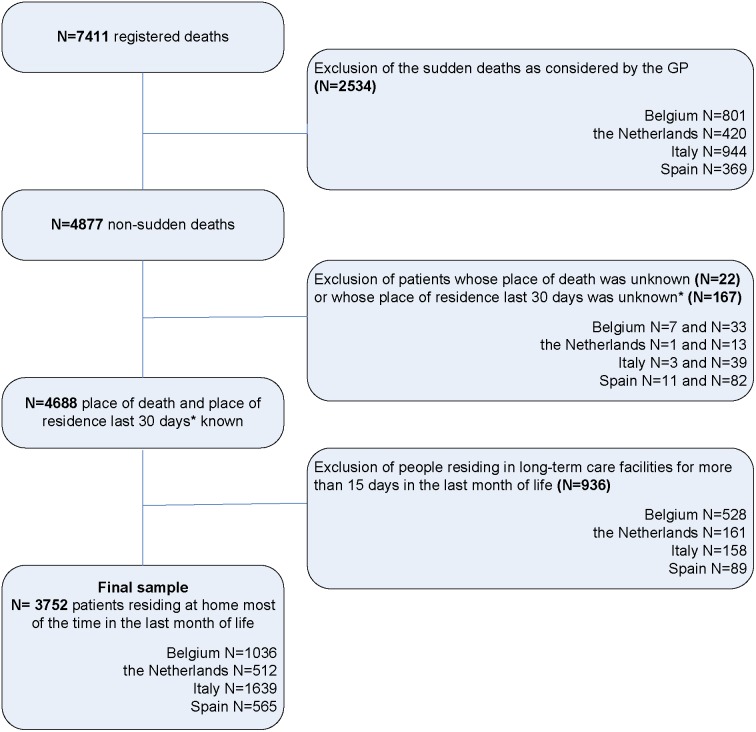
A mortality follow-back study was conducted, based on data recorded by representative GP networks regarding home-dwelling patients who died non-suddenly in Belgium (n = 1036), The Netherlands (n = 512), Italy (n = 1639) or Spain (n = 565). "The percentage of patients dying at home" ranged between 35.3% (Belgium) and 50.6% (The Netherlands) in the four countries, while "the percentage of patients dying at their preferred place of death" ranged between 67.8% (Italy) and 86.0% (Spain). Both indicators were strongly associated with palliative care provision by the GP (odds ratios of 1.55-13.23 and 2.30-6.63, respectively). The quality indicator concerning the preferred place of death offers a broader view than the indicator concerning home deaths, as it takes into account all preferences met in all locations. However, GPs did not know the preferences for place of death in 39.6% (The Netherlands) to 70.3% (Italy), whereas the actual place of death was known in almost all cases.
GPs know their patients' actual place of death, making the percentage of home deaths a feasible indicator for collection by GPs. However, patients' preferred place of death was often unknown to the GP. We therefore recommend using information from relatives as long as information from GPs on the preferred place of death is lacking. Timely communication about the place where patients want to be cared for at the end of life remains a challenge for GPs.
在家中死亡以及在首选的死亡地点死亡被倡导为姑息治疗的理想结果。对于它们作为质量指标的有用性,需要有更多的了解。我们的目标是描述“在家中死亡的患者百分比”和“在其首选地点死亡的患者百分比”是否为可行且具有信息量的质量指标。
开展了一项死亡率回溯研究,基于比利时(n = 1036)、荷兰(n = 512)、意大利(n = 1639)或西班牙(n = 565)具有代表性的全科医生网络记录的关于在家居住的非突然死亡患者的数据。在这四个国家中,“在家中死亡的患者百分比”在35.3%(比利时)至50.6%(荷兰)之间,而“在其首选死亡地点死亡的患者百分比”在67.8%(意大利)至86.0%(西班牙)之间。这两个指标都与全科医生提供的姑息治疗密切相关(优势比分别为1.55 - 13.23和2.30 - 6.63)。关于首选死亡地点的质量指标比关于在家中死亡的指标提供了更广泛的视角,因为它考虑了在所有地点满足的所有偏好。然而,全科医生不知道39.6%(荷兰)至70.3%(意大利)的患者对死亡地点的偏好,而几乎在所有情况下都知道实际的死亡地点。
全科医生知道其患者的实际死亡地点,使得在家中死亡的患者百分比成为全科医生收集的可行指标。然而,全科医生通常不知道患者首选的死亡地点。因此,我们建议在缺乏全科医生关于首选死亡地点的信息时,使用亲属提供的信息。对于全科医生来说,及时沟通患者在生命末期希望接受护理的地点仍然是一项挑战。