Department of Molecular and Cellular Biology, Harvard University Cambridge, MA, USA.
Front Syst Neurosci. 2014 Mar 25;8:39. doi: 10.3389/fnsys.2014.00039. eCollection 2014.
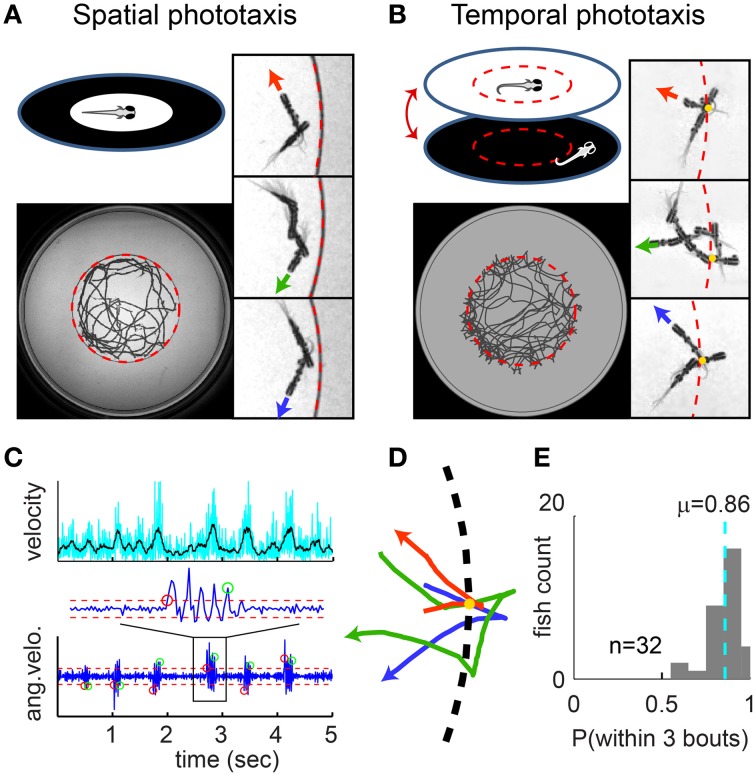
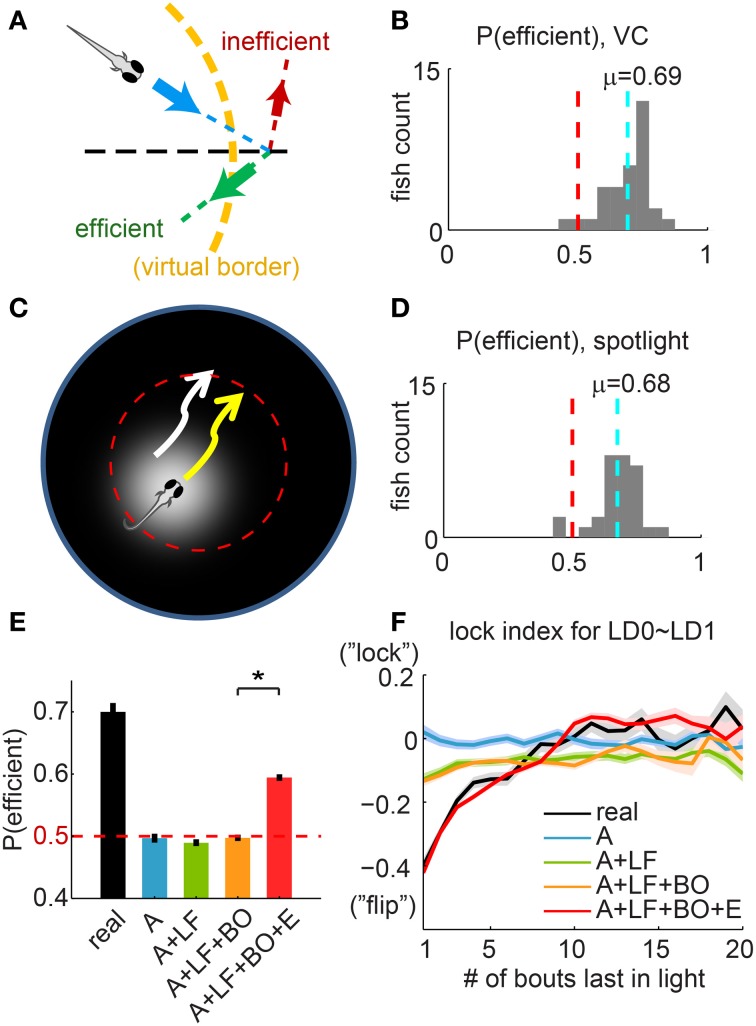
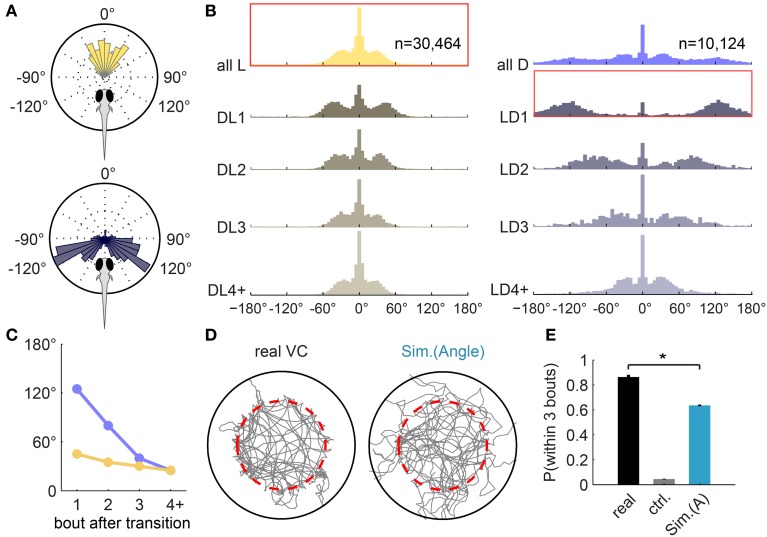
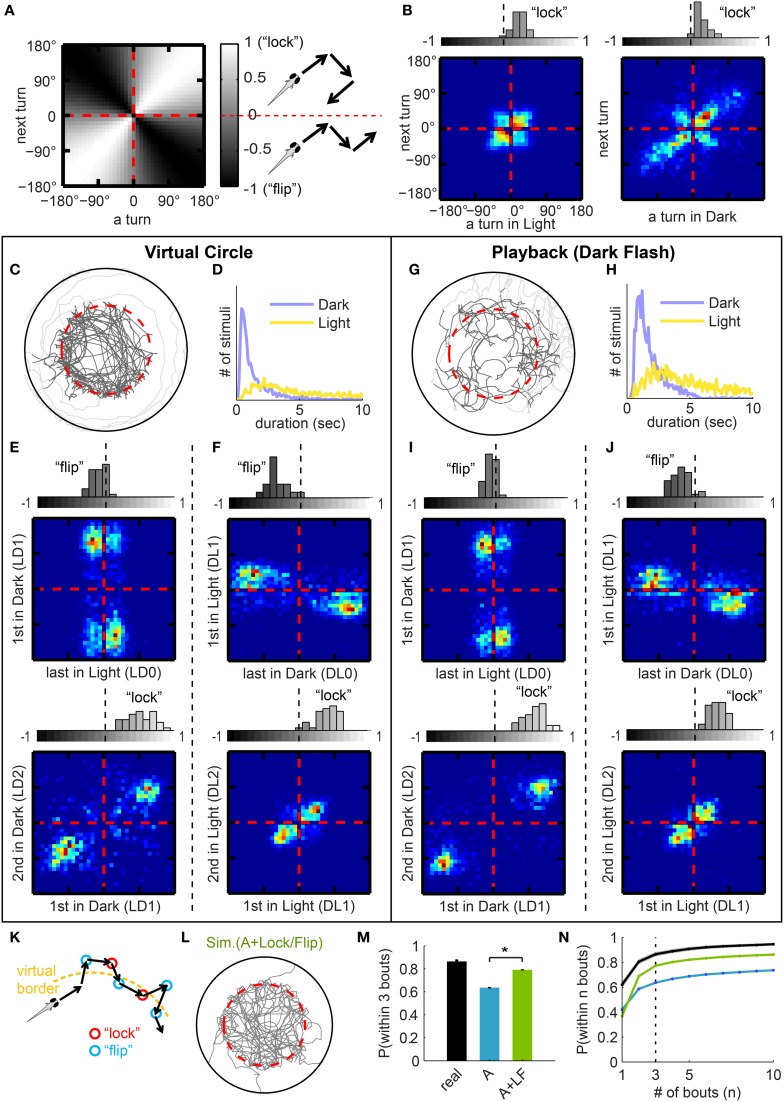
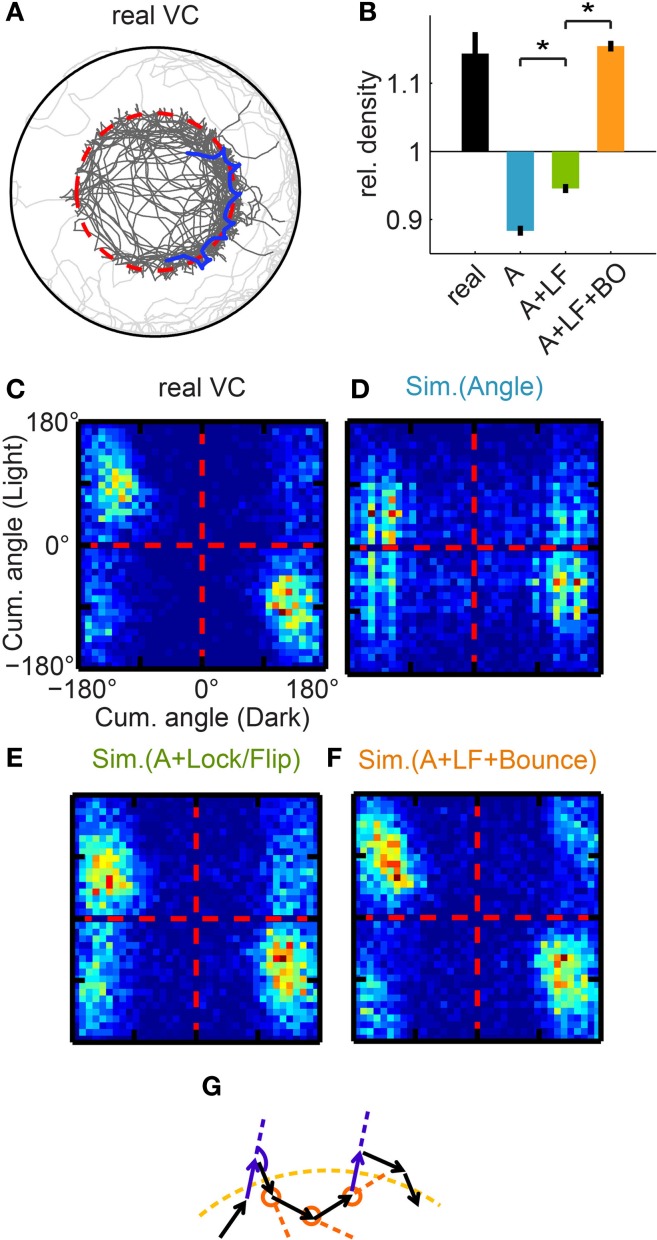
Understanding how the brain transforms sensory input into complex behavior is a fundamental question in systems neuroscience. Using larval zebrafish, we study the temporal component of phototaxis, which is defined as orientation decisions based on comparisons of light intensity at successive moments in time. We developed a novel "Virtual Circle" assay where whole-field illumination is abruptly turned off when the fish swims out of a virtually defined circular border, and turned on again when it returns into the circle. The animal receives no direct spatial cues and experiences only whole-field temporal light changes. Remarkably, the fish spends most of its time within the invisible virtual border. Behavioral analyses of swim bouts in relation to light transitions were used to develop four discrete temporal algorithms that transform the binary visual input (uniform light/uniform darkness) into the observed spatial behavior. In these algorithms, the turning angle is dependent on the behavioral history immediately preceding individual turning events. Computer simulations show that the algorithms recapture most of the swim statistics of real fish. We discovered that turning properties in larval zebrafish are distinctly modulated by temporal step functions in light intensity in combination with the specific motor history preceding these turns. Several aspects of the behavior suggest memory usage of up to 10 swim bouts (~10 sec). Thus, we show that a complex behavior like spatial navigation can emerge from a small number of relatively simple behavioral algorithms.
理解大脑如何将感觉输入转化为复杂的行为是系统神经科学的一个基本问题。我们使用幼虫斑马鱼研究光趋性的时间成分,光趋性定义为基于连续时间点的光强度比较的定向决策。我们开发了一种新颖的“虚拟圆”测定法,当鱼游出虚拟定义的圆形边界时,整个视野的照明会突然关闭,当它返回圆内时再次打开。动物没有接收到任何直接的空间线索,只经历全视野的时间光变化。值得注意的是,鱼大部分时间都在看不见的虚拟边界内。对与光转换相关的游泳冲刺的行为分析用于开发四个离散的时间算法,将二进制视觉输入(均匀光/均匀暗)转换为观察到的空间行为。在这些算法中,转弯角度取决于个体转弯事件之前的行为历史。计算机模拟表明,这些算法可以捕捉到真实鱼游泳统计数据的大部分。我们发现,幼虫斑马鱼的转弯特性明显受到光强度的时间阶跃函数和这些转弯之前的特定运动历史的调制。行为的几个方面表明,记忆的使用时间长达 10 个游泳冲刺(约 10 秒)。因此,我们表明,像空间导航这样的复杂行为可以从少数相对简单的行为算法中产生。