Division of Public Health Sciences, Department of Surgery, Washington University School of Medicine, St. Louis, MO, USA; Alvin J. Siteman Cancer Center, Department of Surgery, Washington University School of Medicine, St. Louis, MO, USA.
BJU Int. 2014 Dec;114(6):916-25. doi: 10.1111/bju.12778. Epub 2014 Aug 11.
To describe the full range of symptom exacerbations defined by people with interstitial cystitis/bladder pain syndrome and chronic prostatitis/chronic pelvic pain syndrome as 'flares', and to investigate their associated healthcare utilization and bother at two sites of the Multidisciplinary Approach to the Study of Chronic Pelvic Pain (MAPP) Epidemiology and Phenotyping study.
Participants completed a flare survey that asked them: 1) whether they had ever had flares ('symptoms that are much worse than usual') that lasted <1 h, >1 h and <1 day, and >1 day; and 2) for each duration of flare, to report: their average length and frequency; their typical levels of urological and pelvic pain symptoms; and their levels of healthcare utilization and bother. We compared participants' responses to their non-flare MAPP values and by duration of flare using generalized linear mixed models.
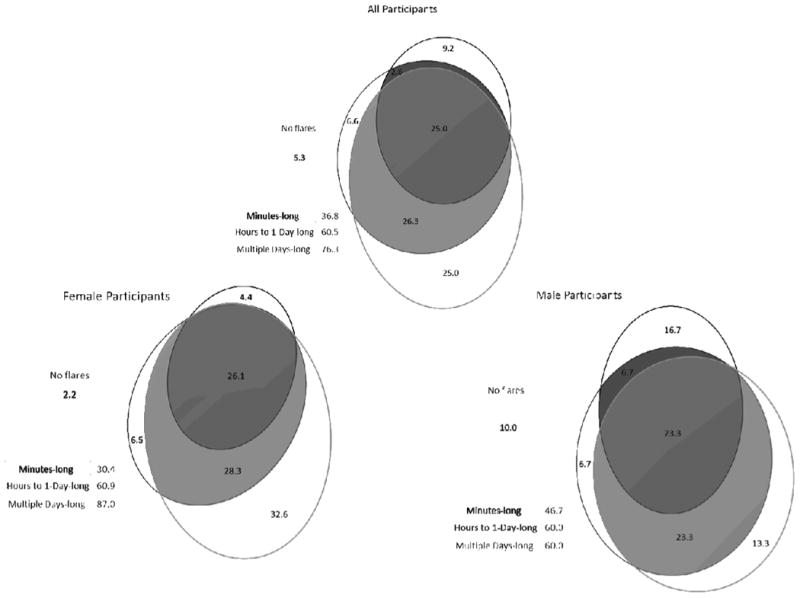
Of 85 participants, 76 (89.4%) completed the flare survey, 72 (94.7%) of whom reported experiencing flares. Flares varied widely in terms of their duration (seconds to months), frequency (several times per day to once per year or less), and intensity and type of symptoms (e.g. pelvic pain vs urological symptoms). Flares of all durations were associated with greater pelvic pain, urological symptoms, disruption to participants' activities and bother, with increasing severity of each of these factors as the duration of flares increased. Days-long flares were also associated with greater healthcare utilization. In addition to duration, symptoms (pelvic pain, in particular) were also significant determinants of flare-related bother.
Our findings suggest that flares are common and associated with greater symptoms, healthcare utilization, disruption and bother. Our findings also show the characteristics of flares most bothersome to patients (i.e. increased pelvic pain and duration), and thus of greatest importance to consider in future research on flare prevention and treatment.
描述间质性膀胱炎/膀胱疼痛综合征和慢性前列腺炎/慢性盆腔疼痛综合征患者所定义的“发作”的所有症状加重范围,并在多学科慢性盆腔疼痛研究(MAPP)的两个研究点调查其相关的医疗保健利用和困扰。
参与者完成了一项发作调查,询问他们:1)他们是否曾经有过持续时间<1 小时、>1 小时且<1 天和>1 天的发作(“症状比平时严重得多”);2)对于每种发作持续时间,报告:他们的平均长度和频率;他们的典型泌尿系统和盆腔疼痛症状水平;以及他们的医疗保健利用和困扰水平。我们使用广义线性混合模型比较了参与者对其非发作 MAPP 值和发作持续时间的反应。
在 85 名参与者中,有 76 名(89.4%)完成了发作调查,其中 72 名(94.7%)报告经历过发作。发作在持续时间(从几秒钟到几个月)、频率(每天数次到每年一次或更少)以及症状的强度和类型(例如盆腔疼痛与泌尿系统症状)方面差异很大。所有持续时间的发作均与更大的盆腔疼痛、泌尿系统症状、参与者活动中断和困扰有关,随着发作持续时间的增加,这些因素中的每一个因素的严重程度都在增加。持续时间较长的发作也与更多的医疗保健利用有关。除了持续时间外,症状(特别是盆腔疼痛)也是发作相关困扰的重要决定因素。
我们的研究结果表明,发作很常见,并与更大的症状、医疗保健利用、中断和困扰有关。我们的研究结果还显示了对患者最困扰的发作特征(即增加的盆腔疼痛和持续时间),因此对未来的发作预防和治疗研究具有重要意义。