Department of Immunology, Rheumatology and Allergy, Medical University of Łódź, ul, Pomorska 251, bud, C-5, Łódź 92-213, Poland.
Respir Res. 2014 Apr 15;15(1):45. doi: 10.1186/1465-9921-15-45.
Respiratory epithelium integrity impairment caused by intensive exercise may lead to exercise-induced bronchoconstriction. Clara cell protein (CC16) has anti-inflammatory properties and its serum level reflects changes in epithelium integrity and airway inflammation. This study aimed to investigate serum CC16 in elite athletes and to seek associations of CC16 with asthma or allergy, respiratory tract infections (RTIs) and immune response to respiratory pathogens.
The study was performed in 203 Olympic athletes. Control groups comprised 53 healthy subjects and 49 mild allergic asthmatics. Serum levels of CC16 and IgG against respiratory viruses and Mycoplasma pneumoniae were assessed. Allergy questionnaire for athletes was used to determine symptoms and exercise pattern. Current versions of ARIA and GINA guidelines were used when diagnosing allergic rhinitis and asthma, respectively.
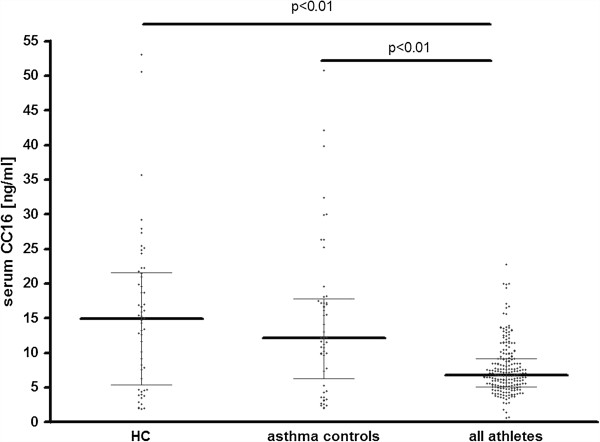
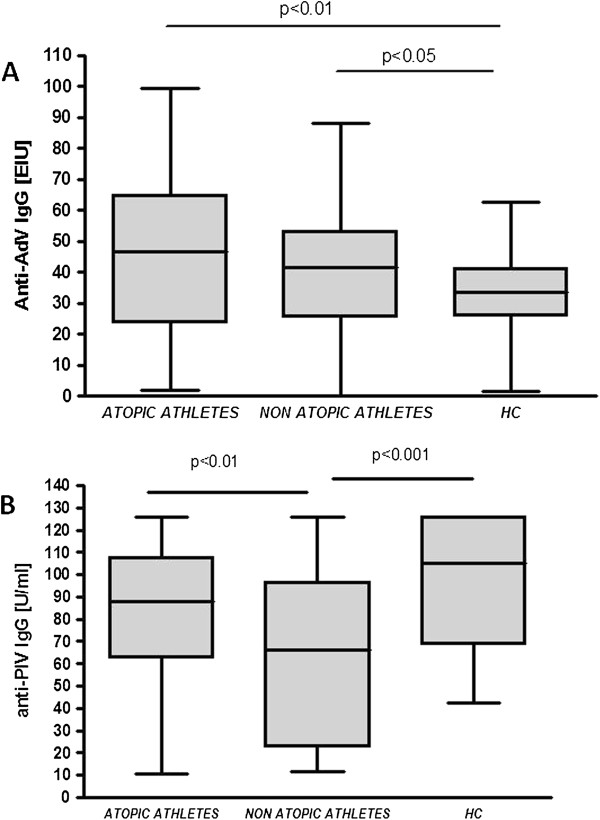
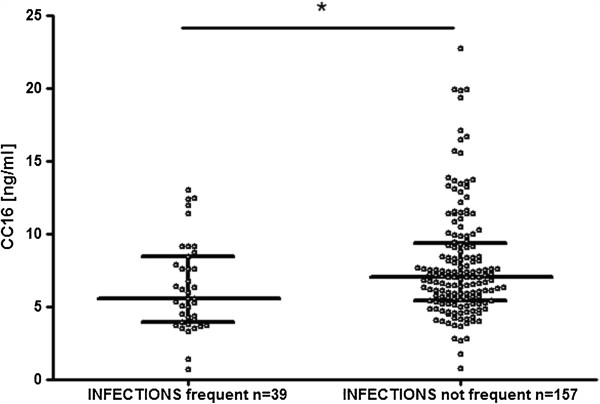
Asthma was diagnosed in 13.3% athletes, of whom 55.6% had concomitant allergic rhinitis. Allergic rhinitis without asthma was diagnosed in 14.8% of athletes. Mean CC16 concentration was significantly lower in athletes versus healthy controls and mild asthmatics. Athletes reporting frequent RTIs had significantly lower serum CC16 and the risk of frequent RTIs was more than 2-fold higher in athletes with low serum CC16 (defined as equal to or less than 4.99 ng/ml). Athletes had significantly higher anti-adenovirus IgG than healthy controls while only non-atopic athletes had anti-parainfluenza virus IgG significantly lower than controls. In all athletes weak correlation of serum CC16 and anti-parainfluenza virus IgG was present (R = 0.20, p < 0.01). In atopic athletes a weak positive correlations of CC16 with IgG specific for respiratory syncytial virus (R = 0.29, p = 0.009), parainfluenza virus (R = 0.31, p = 0.01) and adenovirus (R = 0.27, p = 0.02) were seen as well.
Regular high-load exercise is associated with decrease in serum CC16 levels. Athletes with decreased CC16 are more susceptible to respiratory infections. Atopy may be an additional factor modifying susceptibility to infections in subjects performing regular high-load exercise.
剧烈运动导致的呼吸上皮完整性受损可能导致运动性支气管收缩。克拉拉细胞蛋白(CC16)具有抗炎特性,其血清水平反映了上皮完整性和气道炎症的变化。本研究旨在调查精英运动员的血清 CC16,并寻找 CC16 与哮喘或过敏、呼吸道感染(RTI)以及对呼吸道病原体的免疫反应之间的关联。
该研究在 203 名奥运运动员中进行。对照组包括 53 名健康受试者和 49 名轻度过敏性哮喘患者。评估了血清 CC16 和针对呼吸道病毒和肺炎支原体的 IgG 水平。使用运动员过敏问卷确定症状和运动方式。当诊断变应性鼻炎和哮喘时,分别使用当前版本的 ARIA 和 GINA 指南。
13.3%的运动员被诊断为哮喘,其中 55.6%同时患有过敏性鼻炎。14.8%的运动员被诊断为过敏性鼻炎而无哮喘。与健康对照组和轻度哮喘患者相比,运动员的 CC16 浓度明显较低。报告频繁 RTI 的运动员的血清 CC16 水平明显较低,血清 CC16 水平较低的运动员发生频繁 RTI 的风险是对照组的两倍多(定义为等于或低于 4.99ng/ml)。运动员的抗腺病毒 IgG 水平明显高于健康对照组,而只有非变应性运动员的抗副流感病毒 IgG 水平明显低于对照组。在所有运动员中,血清 CC16 与抗副流感病毒 IgG 之间存在弱相关性(R=0.20,p<0.01)。在变应性运动员中,CC16 与呼吸道合胞病毒(R=0.29,p=0.009)、副流感病毒(R=0.31,p=0.01)和腺病毒(R=0.27,p=0.02)特异性 IgG 之间存在弱正相关。
定期进行高负荷运动与血清 CC16 水平下降有关。CC16 降低的运动员更容易发生呼吸道感染。变应性可能是影响进行定期高负荷运动的受试者对感染易感性的另一个因素。