mBio. 2014 Apr 15;5(2):e00025. doi: 10.1128/mBio.00025-14.
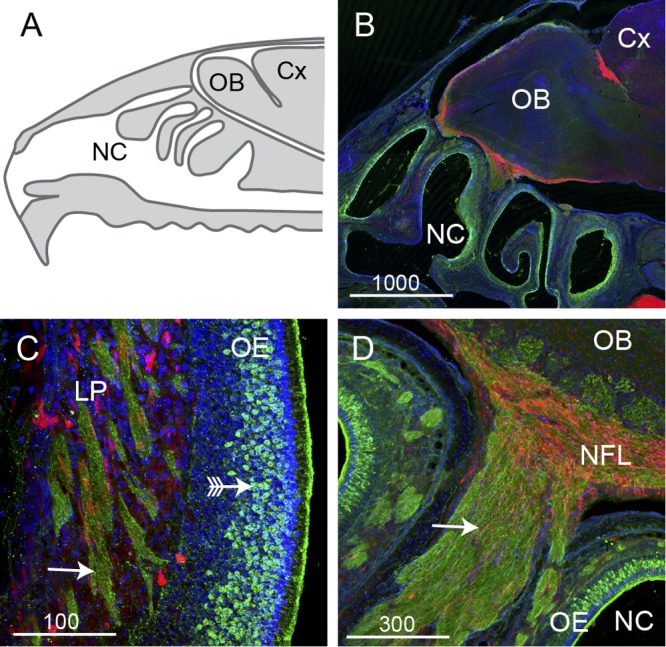
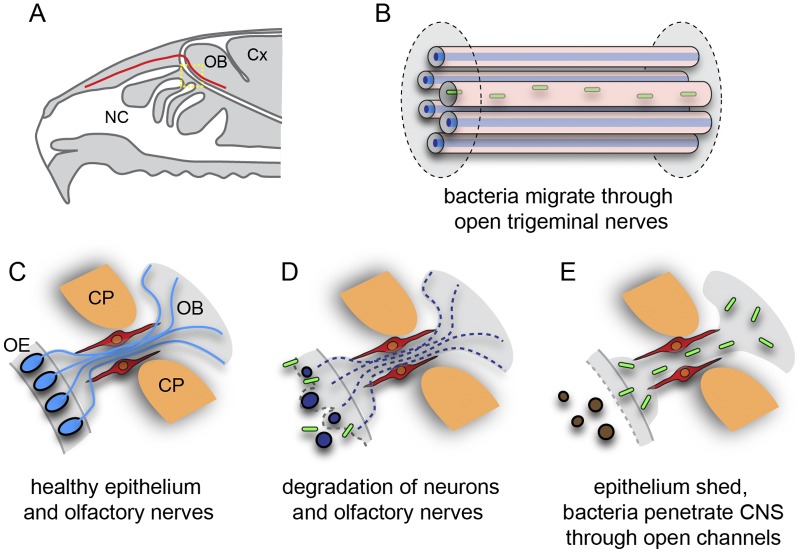
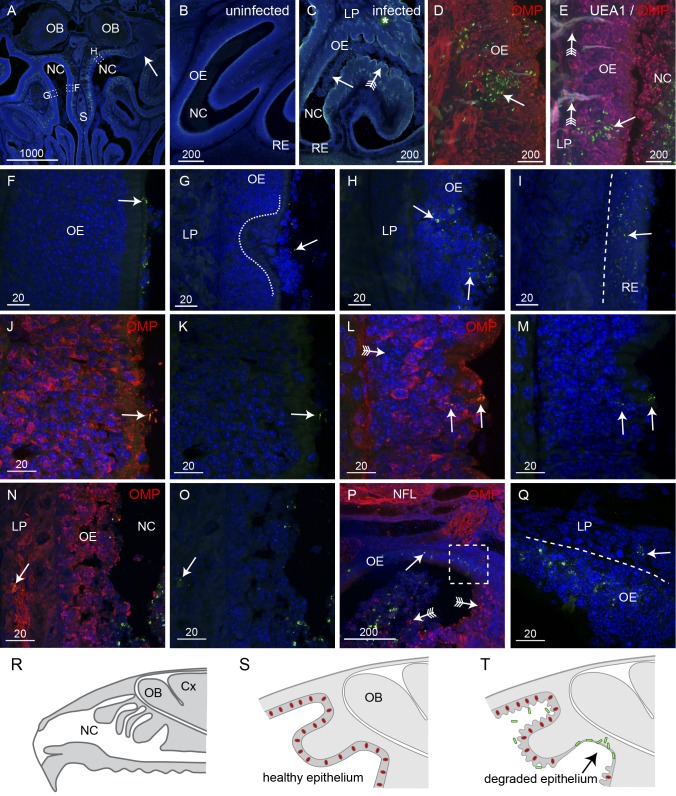
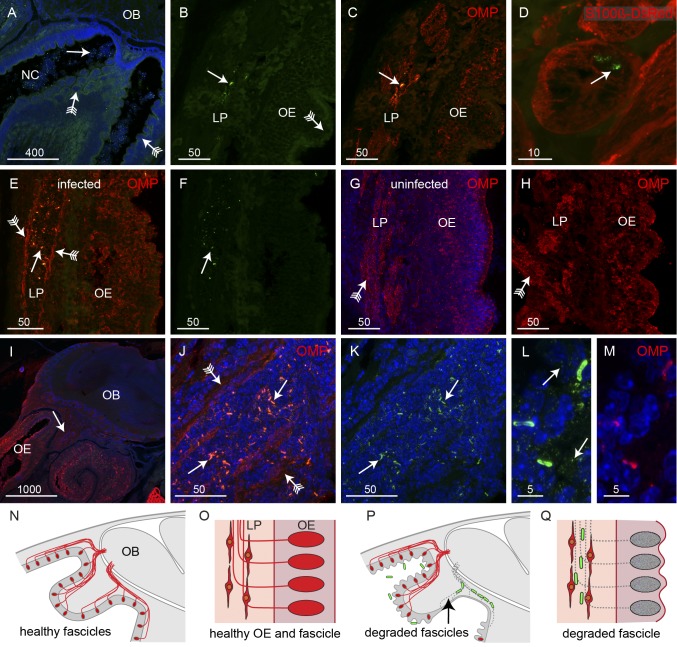
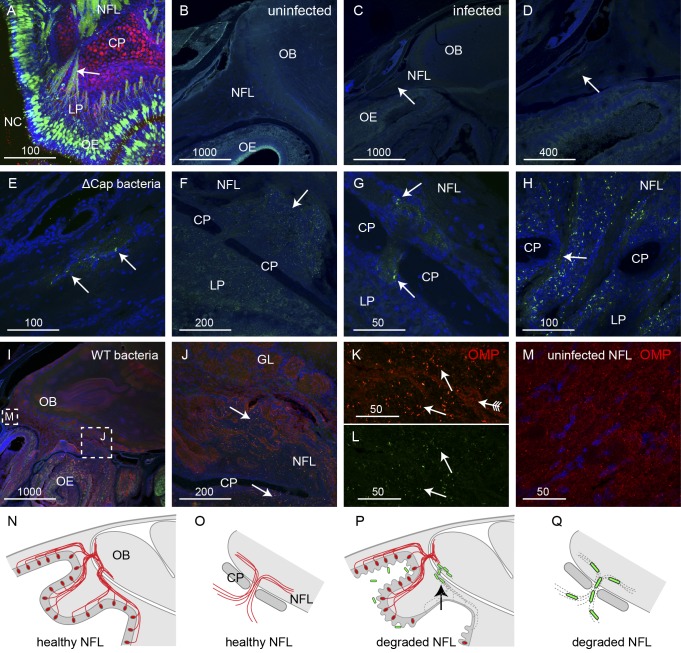
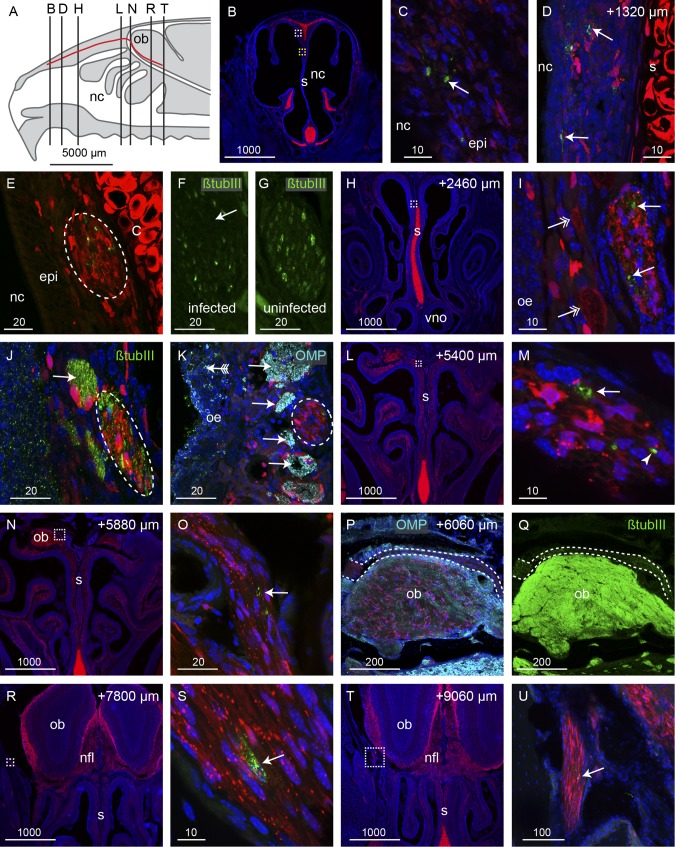
ABSTRACT Melioidosis is a potentially fatal disease that is endemic to tropical northern Australia and Southeast Asia, with a mortality rate of 14 to 50%. The bacterium Burkholderia pseudomallei is the causative agent which infects numerous parts of the human body, including the brain, which results in the neurological manifestation of melioidosis. The olfactory nerve constitutes a direct conduit from the nasal cavity into the brain, and we have previously reported that B. pseudomallei can colonize this nerve in mice. We have now investigated in detail the mechanism by which the bacteria penetrate the olfactory and trigeminal nerves within the nasal cavity and infect the brain. We found that the olfactory epithelium responded to intranasal B. pseudomallei infection by widespread crenellation followed by disintegration of the neuronal layer to expose the underlying basal layer, which the bacteria then colonized. With the loss of the neuronal cell bodies, olfactory axons also degenerated, and the bacteria then migrated through the now-open conduit of the olfactory nerves. Using immunohistochemistry, we demonstrated that B. pseudomallei migrated through the cribriform plate via the olfactory nerves to enter the outer layer of the olfactory bulb in the brain within 24 h. We also found that the bacteria colonized the thin respiratory epithelium in the nasal cavity and then rapidly migrated along the underlying trigeminal nerve to penetrate the cranial cavity. These results demonstrate that B. pseudomallei invasion of the nerves of the nasal cavity leads to direct infection of the brain and bypasses the blood-brain barrier. IMPORTANCE Melioidosis is a potentially fatal tropical disease that is endemic to northern Australia and Southeast Asia. It is caused by the bacterium Burkholderia pseudomallei, which can infect many organs of the body, including the brain, and results in neurological symptoms. The pathway by which the bacteria can penetrate the brain is unknown, and we have investigated the ability of the bacteria to migrate along nerves that innervate the nasal cavity and enter the frontal region of the brain by using a mouse model of infection. By generating a mutant strain of B. pseudomallei which is unable to survive in the blood, we show that the bacteria rapidly penetrate the cranial cavity using the olfactory (smell) nerve and the trigeminal (sensory) nerve that line the nasal cavity.
摘要 类鼻疽是一种潜在致命的疾病,流行于澳大利亚北部热带地区和东南亚地区,死亡率为 14%至 50%。类鼻疽杆菌是导致这种疾病的病原体,它可以感染人体的许多部位,包括大脑,从而导致类鼻疽的神经表现。嗅神经构成了从鼻腔直接进入大脑的通道,我们之前曾报道过,类鼻疽杆菌可以在老鼠的嗅神经中定植。我们现在已经详细研究了细菌穿透鼻腔中的嗅神经和三叉神经并感染大脑的机制。我们发现,嗅上皮细胞对鼻腔内的类鼻疽杆菌感染作出广泛的嵴状变响应,随后神经元层崩解,暴露出下面的基底层,细菌随后在该处定植。随着神经元细胞体的丧失,嗅轴突也退化了,细菌随后通过嗅神经的开放通道迁移。通过免疫组织化学,我们证明类鼻疽杆菌通过嗅神经穿过筛板迁移,在 24 小时内进入大脑嗅球的外层。我们还发现,细菌定植在鼻腔内的薄呼吸上皮细胞中,然后迅速沿着下面的三叉神经迁移,穿透颅腔。这些结果表明,类鼻疽杆菌对鼻腔神经的侵袭导致了对大脑的直接感染,并且绕过了血脑屏障。 重要性 类鼻疽是一种潜在致命的热带疾病,流行于澳大利亚北部和东南亚地区。它是由类鼻疽杆菌引起的,这种细菌可以感染身体的许多器官,包括大脑,并导致神经症状。细菌穿透大脑的途径尚不清楚,我们已经使用感染的小鼠模型研究了细菌沿支配鼻腔的神经迁移并进入大脑额叶的能力。通过生成一种不能在血液中存活的类鼻疽杆菌突变株,我们表明细菌通过排列在鼻腔中的嗅神经和三叉神经迅速穿透颅腔。