University of Queensland and Blue Care Research and Practice Development Centre, School of Nursing and Midwifery, University of Queensland, 56 Sylvan Rd, Brisbane, Queensland, 4066, Australia,
J Cachexia Sarcopenia Muscle. 2014 Sep;5(3):229-36. doi: 10.1007/s13539-014-0144-z. Epub 2014 Apr 16.
Sarcopenia is a significant geriatric syndrome with both health care expenditure and personal burden. Most recently, the European Working Group in Sarcopenia in Older Adults has established a consensus definition and assessment criteria for sarcopenia that includes a below-normal muscle mass and muscle function (either or both of below-normal muscle strength and physical performance). Using these criteria, work is needed to identify the prevalence and risk factors among the old, and those most susceptible to sarcopenia, the very old. This manuscript describes the recruitment and data collection methodology, and direct burden to participants, among a very old cohort residing in a residential aged care (RAC) setting.
Eleven RAC facilities participated in the study. Potential participants were identified by the facility service manager and then randomised into the study. All participants gave self or substitute decision maker consent. Participants undertook a single one on one assessment that included measures of sarcopenia, functional capacity, cognitive and nutritional health, falls, activity, facility and hospital history, physical activity and assessment burden. A sub-study of physical activity and sedentary behaviours measured by activPAL3™ inclinometer was also conducted.
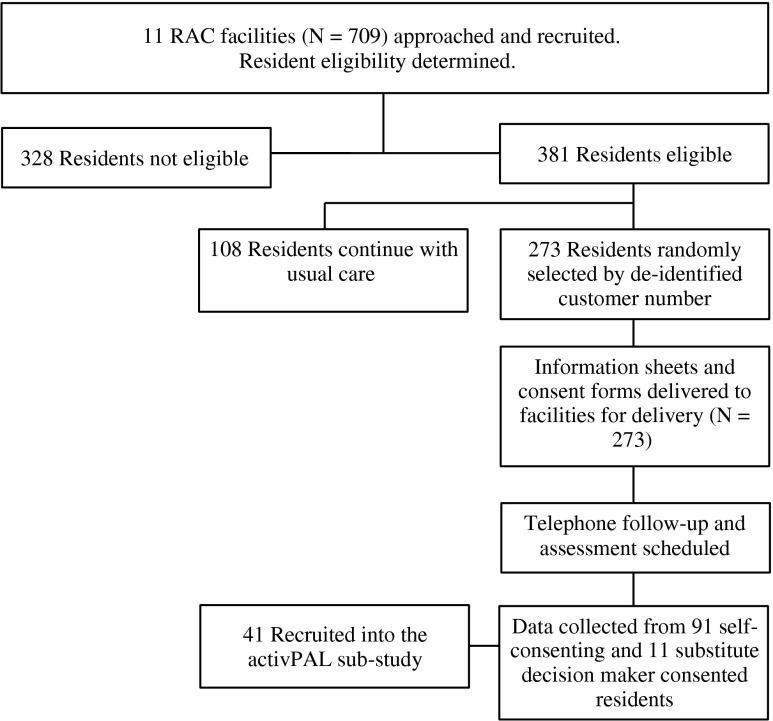
Of 709 residents, 328 were ineligible to participate. Two hundred and seventy-three residents were randomised to the study and 102 gave informed or substitute decision maker consent. Participants were 84.5 ± 8.2 years of age and had been in care for 1,204.2 ± 1,220.1 days. The groups need for care was high (Aged Care Funding Instrument score of 2.6 ± 1.7) and they had a below-normal functional (Short Physical Performance Battery summery score of 3.5 ± 2.4). The larger percentage of participants had no depression and normal cognitive capacity. A total of 33 residents participated in the activPAL study. Each assessment took an average of 27.0 ± 7.0 min, with a low assessment burden reported by participants.
The successful assessment of sarcopenia and physical activity in a RAC setting is labour intensive to establish, but feasible to conduct. Low recruitment numbers and the restrictive exclusion criteria, may have limited the accuracy of this work. However, this work is a primary step in establishing the level of sarcopenia and its risk factors for those in end-of-life care.
肌少症是一种重要的老年综合征,不仅会增加医疗保健支出,还会给个人带来负担。最近,欧洲老年人肌少症工作组提出了肌少症的共识定义和评估标准,包括肌肉质量和肌肉功能低于正常水平(或肌肉力量和身体表现均低于正常水平)。根据这些标准,需要确定老年人以及最易患肌少症的高龄老人的患病率和风险因素。本文描述了居住在养老院(RAC)环境中的非常高龄老人队列的招募和数据收集方法,以及对参与者的直接负担。
有 11 家养老院参与了这项研究。设施服务经理确定潜在参与者,然后对他们进行随机分组。所有参与者都自行或由替代决策者同意参加研究。参与者接受了一次一对一的评估,评估内容包括肌少症、功能能力、认知和营养健康、跌倒、活动、设施和住院史、身体活动和评估负担等。还进行了一项使用 activPAL3™测斜仪测量身体活动和久坐行为的子研究。
在 709 名居民中,有 328 名不符合参与条件。273 名居民被随机分配到研究中,102 名居民给予了知情或替代决策者的同意。参与者的年龄为 84.5±8.2 岁,入住养老院的时间为 1204.2±1220.1 天。他们的护理需求较高(老年护理资金工具评分 2.6±1.7),功能也低于正常水平(简短身体表现电池总和评分 3.5±2.4)。大多数参与者没有抑郁,认知能力正常。共有 33 名居民参加了 activPAL 研究。每次评估平均需要 27.0±7.0 分钟,参与者报告评估负担较低。
在养老院环境中成功评估肌少症和身体活动需要大量的劳动投入,但这是可行的。由于招募人数少,排除标准严格,这可能限制了这项工作的准确性。然而,这项工作是确定临终关怀人群中肌少症及其风险因素的重要步骤。