Crabbé Aurélie, Ledesma Maria A, Nickerson Cheryl A
The Biodesign Institute, Center for Infectious Diseases and Vaccinology, Arizona State University, Tempe, AZ, USA.
Pathog Dis. 2014 Jun;71(1):1-19. doi: 10.1111/2049-632X.12180. Epub 2014 May 23.
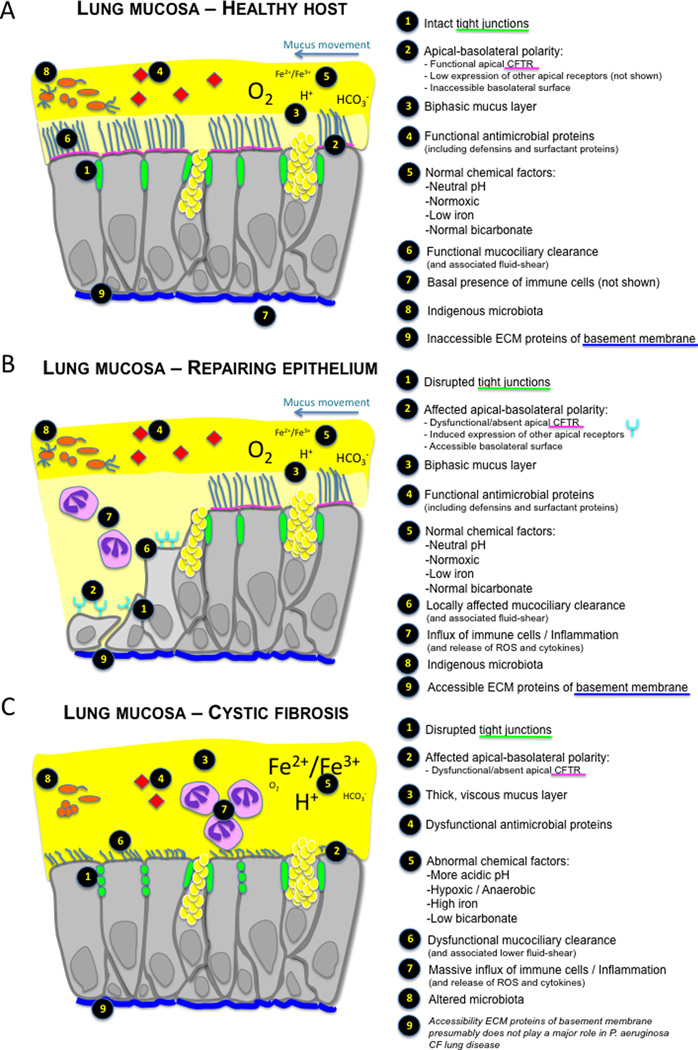
Why is a healthy person protected from Pseudomonas aeruginosa infections, while individuals with cystic fibrosis or damaged epithelium are particularly susceptible to this opportunistic pathogen? To address this question, it is essential to thoroughly understand the dynamic interplay between the host microenvironment and P. aeruginosa. Therefore, using model systems that represent key aspects of human mucosal tissues in health and disease allows recreating in vivo host-pathogen interactions in a physiologically relevant manner. In this review, we discuss how factors of mucosal tissues, such as apical-basolateral polarity, junctional complexes, extracellular matrix proteins, mucus, multicellular complexity (including indigenous microbiota), and other physicochemical factors affect P. aeruginosa pathogenesis and are thus important to mimic in vitro. We highlight in vitro cell and tissue culture model systems of increasing complexity that have been used over the past 35 years to study the infectious disease process of P. aeruginosa, mainly focusing on lung models, and their respective advantages and limitations. Continued improvements of in vitro models based on our expanding knowledge of host microenvironmental factors that participate in P. aeruginosa pathogenesis will help advance fundamental understanding of pathogenic mechanisms and increase the translational potential of research findings from bench to the patient's bedside.
为什么健康人能抵御铜绿假单胞菌感染,而患有囊性纤维化或上皮受损的个体却特别容易受到这种机会致病菌的侵害呢?为了解决这个问题,深入理解宿主微环境与铜绿假单胞菌之间的动态相互作用至关重要。因此,使用能够代表健康和疾病状态下人类黏膜组织关键特征的模型系统,能够以生理相关的方式重现体内宿主-病原体相互作用。在这篇综述中,我们讨论黏膜组织的各种因素,如顶-基底极性、连接复合体、细胞外基质蛋白、黏液、多细胞复杂性(包括原生微生物群)以及其他物理化学因素如何影响铜绿假单胞菌的致病性,因而在体外模拟这些因素很重要。我们着重介绍了在过去35年中用于研究铜绿假单胞菌感染过程的复杂性不断增加的体外细胞和组织培养模型系统,主要聚焦于肺部模型,以及它们各自的优缺点。基于我们对参与铜绿假单胞菌致病性的宿主微环境因素的不断深入了解,持续改进体外模型将有助于推动对致病机制的基础理解,并提高研究结果从实验室到患者床边的转化潜力。