Department of Biological Sciences, Osaka University, 1-1 Machikaneyama, Toyonaka, Osaka 560-0043, Japan.
BMC Genet. 2014 Apr 16;15:46. doi: 10.1186/1471-2156-15-46.
Several lines of evidence associate misregulated genetic expression with risk factors for diabetes, Alzheimer's, and other diseases that sporadically develop in healthy adults with no background of hereditary disorders. Thus, we are interested in genes that may be expressed normally through parts of an individual's life, but can cause physiological defects and disease when misexpressed in adulthood.
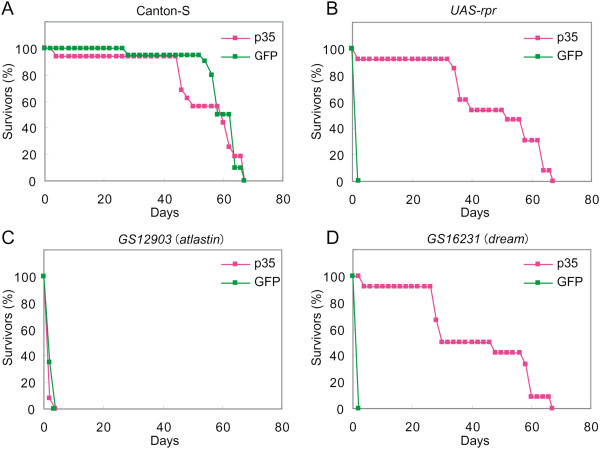
We attempted to identify these genes in a model organism by arbitrarily misexpressing specific genes in adult Drosophila melanogaster, using 14,133 Gene Search lines. We identified 39 "reduced-lifespan genes" that, when misexpressed in adulthood, shortened the flies' lifespan to less than 30% of that of control flies. About half of these genes have human orthologs that are known to be involved in human diseases. For about one-fourth of the reduced-lifespan genes, suppressing apoptosis restored the lifespan shortened by their misexpression. We determined the organs responsible for reduced lifespan when these genes were misexpressed specifically in adulthood, and found that while some genes induced reduced lifespan only when misexpressed in specific adult organs, others could induce reduced lifespan when misexpressed in various organs. This finding suggests that tissue-specific dysfunction may be involved in reduced lifespan related to gene misexpression. Gene ontology analysis showed that reduced-lifespan genes are biased toward genes related to development.
We identified 39 genes that, when misexpressed in adulthood, shortened the lifespan of adult flies. Suppressing apoptosis rescued this shortened lifespan for only a subset of the reduced-lifespan genes. The adult tissues in which gene misexpression caused early death differed among the reduced-lifespan genes. These results suggest that the cause of reduced lifespan upon misexpression differed among the genes.
有几条证据表明,遗传表达失调与糖尿病、阿尔茨海默病和其他疾病的风险因素有关,这些疾病在没有遗传障碍背景的健康成年人中偶发出现。因此,我们对那些在个体生命的某些部分可能正常表达但在成年时异常表达时会导致生理缺陷和疾病的基因感兴趣。
我们试图通过在成年黑腹果蝇中随机异常表达特定基因,使用 14133 个基因搜索系来识别这种模型生物中的这些基因。我们鉴定了 39 个“缩短寿命基因”,当这些基因在成年时异常表达时,会使果蝇的寿命缩短到对照果蝇的 30%以下。这些基因中有大约一半的人类同源基因已知与人类疾病有关。大约四分之一的缩短寿命基因,通过抑制细胞凋亡,恢复了因它们的异常表达而缩短的寿命。当这些基因在成年时特异性异常表达时,我们确定了导致寿命缩短的器官,并发现虽然一些基因仅在异常表达于特定的成年器官时会导致寿命缩短,但其他基因在异常表达于各种器官时也会导致寿命缩短。这一发现表明,组织特异性功能障碍可能与基因异常表达导致的寿命缩短有关。基因本体分析表明,缩短寿命基因偏向于与发育相关的基因。
我们鉴定了 39 个在成年时异常表达会缩短成年果蝇寿命的基因。仅对一部分缩短寿命基因,通过抑制细胞凋亡恢复了因异常表达而缩短的寿命。在异常表达导致早期死亡的成年组织中,不同的缩短寿命基因有所不同。这些结果表明,在异常表达的基因中,导致寿命缩短的原因有所不同。