McLean Imaging Center, McLean Hospital , Belmont, MA , USA ; Department of Psychiatry, Harvard University Medical School , Boston, MA , USA.
Front Hum Neurosci. 2014 Apr 1;8:196. doi: 10.3389/fnhum.2014.00196. eCollection 2014.
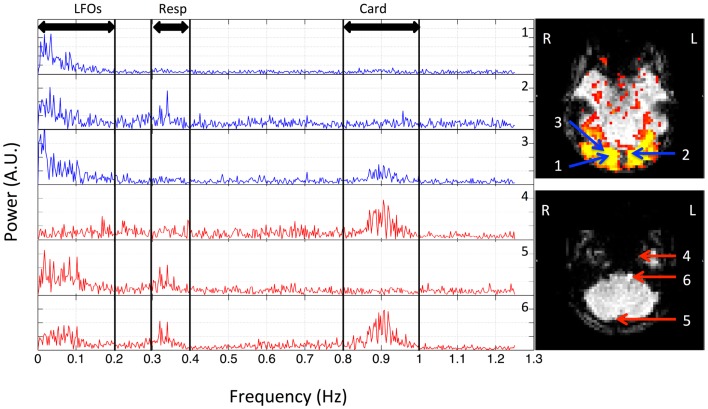
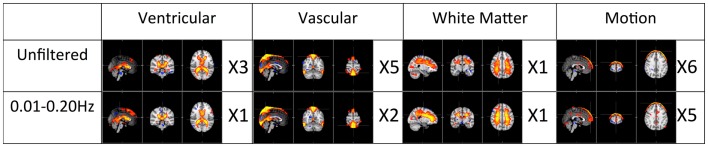
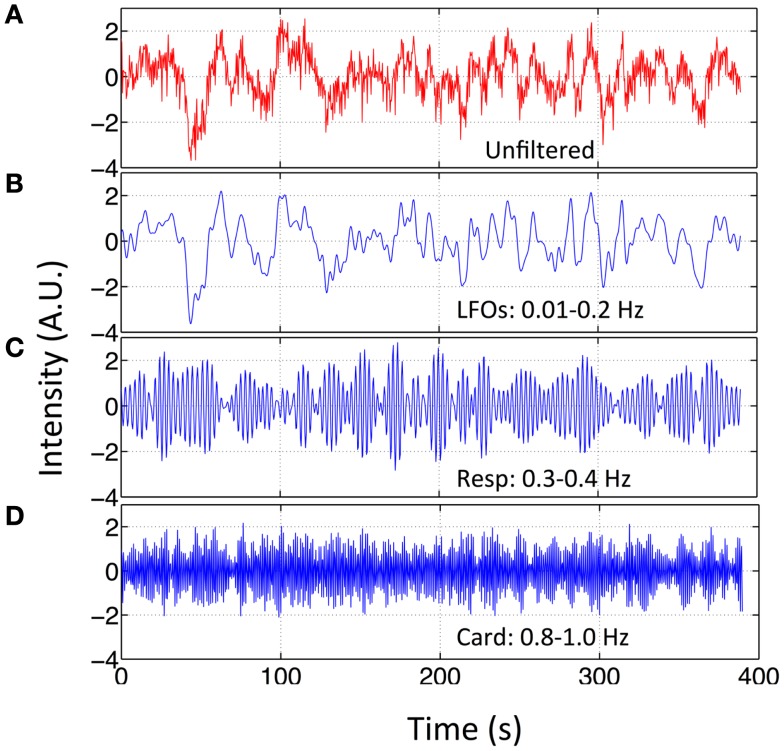
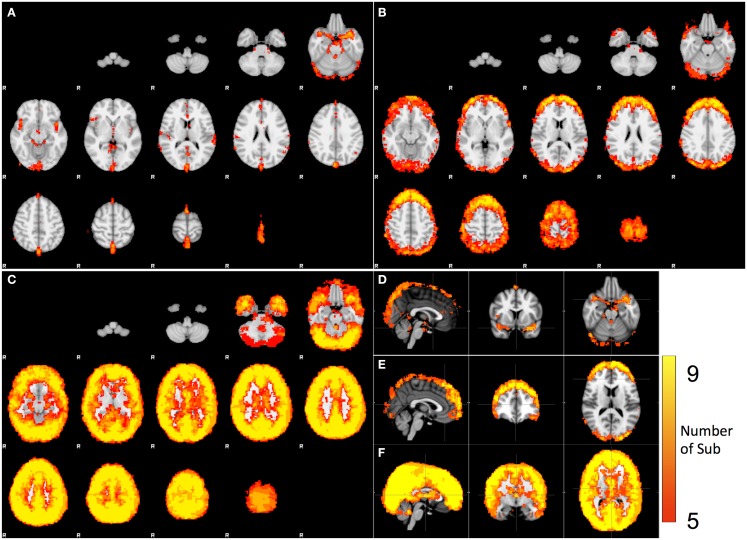
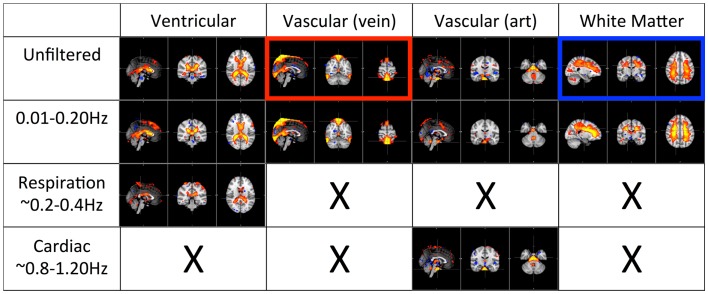
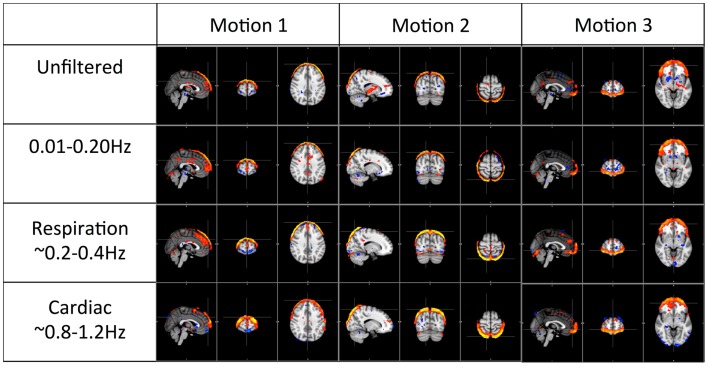
The blood-oxygen-level dependent (BOLD) signal in functional MRI (fMRI) reflects both neuronal activations and global physiological fluctuations. These physiological fluctuations can be attributed to physiological low frequency oscillations (pLFOs), respiration, and cardiac pulsation. With typical TR values, i.e., 2 s or longer, the high frequency physiological signals (i.e., from respiration and cardiac pulsation) are aliased into the low frequency band, making it hard to study the individual effect of these physiological processes on BOLD. Recently developed multiband EPI sequences, which offer full brain coverage with extremely short TR values (400 ms or less) allow these physiological signals to be spectrally separated. In this study, we applied multiband resting state scans on nine healthy participants with TR = 0.4 s. The spatial distribution of each physiological process on BOLD fMRI was explored using their spectral features and independent component analysis (ICA). We found that the spatial distributions of different physiological processes are distinct. First, cardiac pulsation affects mostly the base of the brain, where high density of arteries exists. Second, respiration affects prefrontal and occipital areas, suggesting the motion associated with breathing might contribute to the noise. Finally, and most importantly, we found that the effects of pLFOs dominated many prominent ICA components, which suggests that, contrary to the popular belief that aliased cardiac and respiration signals are the main physiological noise source in BOLD fMRI, pLFOs may be the most influential physiological signals. Understanding and measuring these pLFOs are important for denoising and accurately modeling BOLD signals.
功能磁共振成像(fMRI)中的血氧水平依赖(BOLD)信号既反映了神经元活动,也反映了全局生理波动。这些生理波动可归因于生理低频振荡(pLFO)、呼吸和心脏搏动。在典型的 TR 值(即 2 秒或更长时间)下,高频生理信号(即来自呼吸和心脏搏动)会混叠到低频带,难以研究这些生理过程对 BOLD 的单独影响。最近开发的多频带 EPI 序列,具有极短的 TR 值(400ms 或更短),可实现全脑覆盖,允许这些生理信号进行频谱分离。在这项研究中,我们使用 TR=0.4s 的多频带静息状态扫描对 9 名健康参与者进行了扫描。使用其频谱特征和独立成分分析(ICA)探索了每个生理过程在 BOLD fMRI 上的空间分布。我们发现,不同生理过程的空间分布是不同的。首先,心脏搏动主要影响大脑底部,那里有高密度的动脉。其次,呼吸影响前额叶和枕叶区域,表明与呼吸相关的运动可能是噪声的来源。最后,也是最重要的是,我们发现 pLFO 的影响主导了许多突出的 ICA 成分,这表明,与普遍认为混叠的心脏和呼吸信号是 BOLD fMRI 中主要生理噪声源的观点相反,pLFO 可能是最具影响力的生理信号。理解和测量这些 pLFO 对于降噪和准确建模 BOLD 信号很重要。