Yaniv Yael, Maltsev Victor A
Laboratory of Cardiovascular Science, Intramural Research Program, National Institute on Aging - National Institutes of Health Baltimore, MD, USA ; Department of Biomedical Engineering, Technion - Israel Institute of Technology Haifa, Israel.
Laboratory of Cardiovascular Science, Intramural Research Program, National Institute on Aging - National Institutes of Health Baltimore, MD, USA.
Front Pharmacol. 2014 Apr 1;5:58. doi: 10.3389/fphar.2014.00058. eCollection 2014.
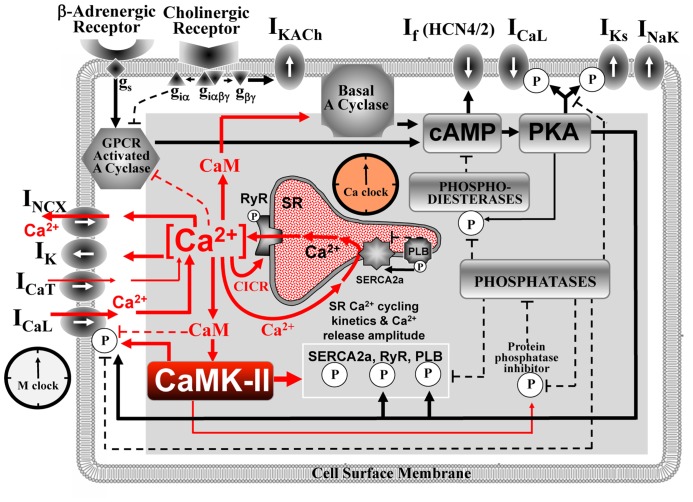
Sinoatrial node (SAN) is the primary heart pacemaker which initiates each heartbeat under normal conditions. Numerous experimental data have demonstrated that Ca(2+-) and CaMKII-dependent processes are crucially important for regulation of SAN cells. However, specific mechanisms of this regulation and their relative contribution to pacemaker function remain mainly unknown. Our review summarizes available data and existing numerical modeling approaches to understand Ca(2+) and CaMKII effects on the SAN. Data interpretation and future directions to address the problem are given within the coupled-clock theory, i.e., a modern view on the cardiac pacemaker cell function generated by a system of sarcolemmal and intracellular proteins.
窦房结(SAN)是主要的心脏起搏器,在正常情况下启动每次心跳。大量实验数据表明,Ca(2+)和CaMKII依赖性过程对窦房结细胞的调节至关重要。然而,这种调节的具体机制及其对起搏器功能的相对贡献仍主要未知。我们的综述总结了现有数据和现有的数值建模方法,以了解Ca(2+)和CaMKII对窦房结的影响。在耦合时钟理论的框架内给出了数据解释和解决该问题的未来方向,耦合时钟理论是对由肌膜和细胞内蛋白质系统产生的心脏起搏器细胞功能的现代观点。